Chinese Revolution · 1911
Was 1911 a real revolution or just the Qing’s collapse?
The seminar question: “Was 1911 a revolution at all — or the collapse of a dynasty that revolutionaries happened to be standing near?”
By 1911 decades of defeat by foreign powers had drained confidence in the Qing dynasty. On 10 October 1911 soldiers mutinied at Wuchang after a plot was exposed at Hankou, fifteen provinces abandoned the throne within six weeks, and the child emperor Puyi abdicated in February 1912.
WW2 is free — every chapter. Try chapters 1–2 of any 2 other atlases (3 with a free account). Opening a new atlas uses one of them. Membership opens all 21 — Join.
Free printable Chinese Revolution study guide, sent by email ↓
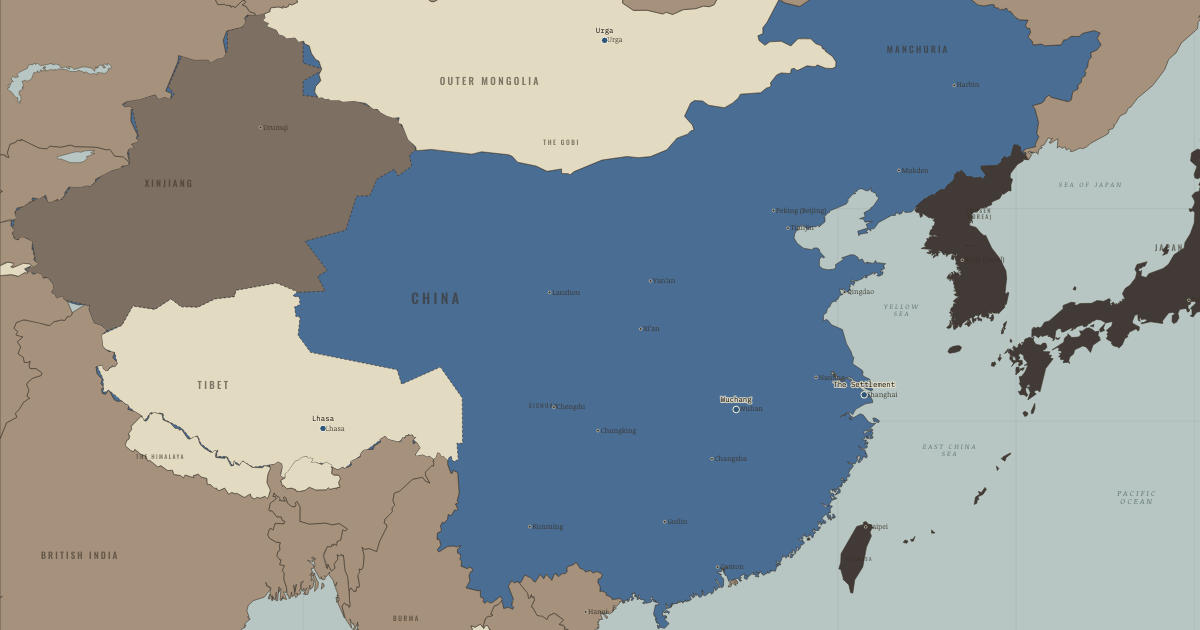
The distinction that governs this whole atlas is the one between sovereignty, the legal right to rule a territory, and control, the practical power to enforce that rule. The single blue expanse of 1911 concealed a state that had almost lost the second. The Qing was the oldest continuous empire in the world, yet it had been defeated by Britain twice and by France and Japan besides. It had been carved into foreign spheres of influence and forced to pay the Boxer indemnity out of customs revenue that foreigners collected on its behalf. The tan rim around China marks that external pressure, from British India and Burma to French Indochina and the Russian empire along the northern arc. The charcoal marks the sharpest threat of all in Japan, which had annexed Taiwan in 1895 and Korea in 1910 and now watched Manchuria for its opening. Foreign power reached inside the country as well, since parts of Shanghai (the ● of the International Settlement) were governed by foreign councils and exempted from Chinese law. Every movement in this atlas grew out of the determination to undo that condition.
The short answer
- Defeat as a system, not an event. From the Opium War (1839–42) to the Boxer Protocol (1901), every generation of Qing statesmen lost a war and paid for it in ports, tariffs and legal immunities for foreigners. The humiliations compounded: customs revenue pledged to indemnities could not build a navy. A navy built in the 1880s was sunk by Japan in 1895. By 1911 the dynasty’s core claim — that it could protect the civilization it governed — had been falsified in public, repeatedly, for seventy years.
- Reform that armed its own gravediggers. After 1901 the Qing tried everything at once: abolished the ancient examination system (1905), built New Armies on the German model, promised a constitution. Each reform manufactured enemies. The examination’s end orphaned a scholar class and sent students to Japan, where they met revolutionaries. The New Armies gave provinces modern soldiers who owed the throne nothing — Wuchang was a New Army mutiny. States are most fragile mid-reform, when the old legitimacy is dismantled and the new one not yet built.
- The railway fuse. In May 1911 the court nationalized the provincial railway companies and pledged the lines to foreign lenders — expropriating the gentry investors of Sichuan and Hunan at a stroke. The Railway Protection movement put respectable provincial elites in the streets months before Wuchang. The troops sent to suppress Sichuan’s protests came from the very Hubei garrisons that then rose. The dynasty’s last act was to teach its natural supporters that Peking was the enemy.
- A revolutionary idea already in place. Sun Yat-sen’s alliance had staged and lost ten risings since 1895, and its real work was elsewhere: in student journals, in overseas Chinese remittances, in the New Army cells that turned a police raid into a mutiny. Republicanism in 1911 was thin — few Chinese had voted for anything. But the alternative had simply expired. As one revolutionary put it, the dynasty was not overthrown. It collapsed.
THE TURNING POINT
Wuchang, 10 October 1911. The hinge is not the bomb but the response: fifteen provinces seceded from the dynasty in six weeks, almost bloodlessly, because provincial elites and New Army officers everywhere made the same private calculation — nothing was worth defending. When a state falls that easily, the revolution has not won power. It has found power lying in the street. Who actually picks it up (an army-builder, not the republicans) is Chapter 2, and the whole era follows from that answer.
What it changed
A republic without republicans. The provisional government at Nanjing has a flag, a calendar and Sun Yat-sen. It has no army. Within six weeks it trades the presidency to Yuan Shikai, the one man whose Beiyang Army can compel the abdication. The revolution’s first act is to hand itself to a general. The pattern will repeat.
The empire’s edges detach. Mongolia (1911) and Tibet (1912–13) leave with the dynasty that had ruled them, and no Chinese government accepts either departure. Every later regime — warlord, Nationalist, Communist — inherits the claim to the whole Qing map. The gap between claim and control on these edges runs to 1951 and beyond.
Japan takes notes. Tokyo watches a great empire dissolve into provinces and concludes that China is not a state but an opportunity — a lesson it applies in Shandong in 1914 and in the Twenty-One Demands of 1915. The strongest single force in the next four decades of this map is the Japanese army’s reading of Chinese weakness.
The full answer, argued
The case for collapse is strong: the risings Sun’s movement actually planned all failed. Wuchang succeeded by accident. Power passed not to republicans but to provincial elites and the Beiyang generals — continuity of local power wearing a new flag. But Joseph Esherick and others point out what changed underneath: the monarchy, the cosmology of the Mandate of Heaven, and the Confucian examination elite all ended within a decade, and no one seriously tried to restore them (Yuan’s attempt, Chapter 2, was laughed and fought off the stage in months). A useful formulation: 1911 was a thin political revolution that opened the door to the thick social ones — May Fourth, the party-states, land revolution. This took four more decades to walk through it. Judge revolutions less by the day power changes hands than by what can no longer be said or restored afterward.
An interesting fact
Sun Yat-sen learned of the Wuchang rising from a newspaper — in Denver, Colorado, mid-way through a fundraising tour of overseas Chinese communities. Rather than sail straight home he went the long way, via London and Paris, trying to secure diplomatic recognition and a halt to foreign loans for the Qing. He reached Shanghai on 25 December 1911, was elected provisional president four days later, and held the office for six weeks before trading it away to Yuan Shikai for the abdication. The republic’s founding father spent its founding abroad — a fair emblem of how far the revolution ran ahead of the revolutionaries.
This is the study layer of Xinhai Revolution of 1911, chapter 1 of China in Revolution, 1911–1949; the full index of the atlas is here.
Related questions
THE FREE PRINTABLE STUDY GUIDE
Join the Dispatch — a short welcome series, then a letter when a new atlas opens — and the printable study guide for China in Revolution is yours now, free.
NO TRACKING · YOUR ADDRESS IS USED FOR THE DISPATCH AND NOTHING ELSE · UNSUBSCRIBE ANYTIME