Chinese Revolution · 1924
Was the warlord era China’s state-building laboratory?
The seminar question: ““The warlord era was not an interruption of China’s state-building but its laboratory.” How far do you agree?”
After Yuan’s death in 1916, military cliques ruled China’s regions and fought for Peking, the prize that carried foreign recognition and customs income. In 1919 anger at the Versailles decision on Shandong sparked the May Fourth movement, and in 1921 a tiny Chinese Communist Party formed in Shanghai.
Chapter 3 is part of membership. WW2 is free — every chapter. Try chapters 1–2 of any 2 other atlases (3 with a free account). Opening a new atlas uses one of them. Membership opens all 21 — Join.
Free printable Chinese Revolution study guide, sent by email ↓
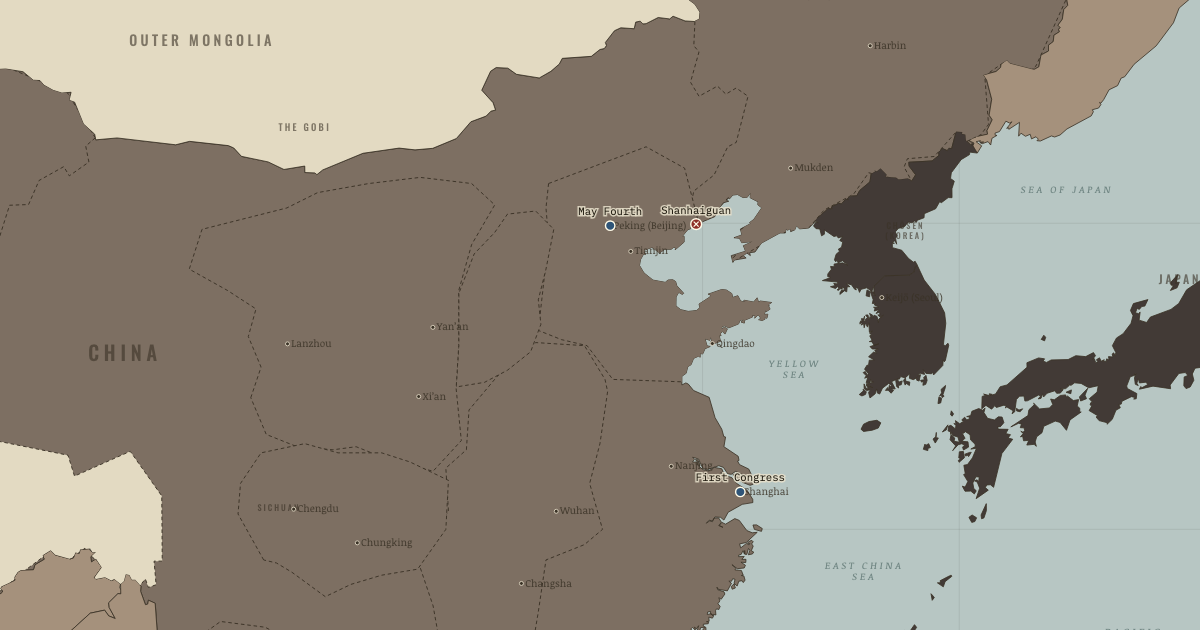
A warlord was a regional military ruler whose army was the direct source of his political authority and his revenue, and once Yuan’s central power dissolved the map shattered into the grey-tan plates it would wear for a decade. Each plate was a separate answer to the same question of what governs when nothing does. Manchuria belonged to Zhang Zuolin, a former bandit with Japanese patrons and the region’s arsenals, while the Peking–Tianjin plain fell to the Zhili clique, whose real prize was the capital itself, because whoever held Peking collected foreign recognition and the customs surplus and so turned the “government of China” into a trophy that changed hands by war; the ✕ at Shanhaiguan marks the largest of those wars, perhaps 450,000 men with artillery, aircraft and armored trains, settled in the end by betrayal. Wu Peifu held the central Yangtze, Yan Xishan ran Shanxi behind its mountains as a private model kingdom, and Sichuan was a war unto itself. In the far south, Canton was a patch of blue where Sun Yat-sen was trying to build what none of the others had, a state organized around a doctrine, while Xinjiang and Tibet in the northwest and southwest carried on outside the fiction altogether.
The short answer
- Armies as capital, war as business. A warlord’s army was a revenue machine: it taxed opium and salt, printed money, mortgaged railways and mines to foreign lenders, and grew by absorbing defeated units — soldiers were assets that changed employers, not causes. This is why the wars look strangely indecisive: destroying an enemy army destroyed value everyone wanted to capture. The system was stable because it was profitable. It beggared every province it touched.
- The Peking government as prize. Foreign powers recognized whoever held Peking, and the Maritime Customs — foreign-run, scrupulously efficient — paid its surplus to that government. So the fiction of a Republic of China survived because it was worth fighting over: the Zhili–Fengtian wars of 1922 and 1924 were, at bottom, contests for a treasury and a letterhead. International recognition, meant to stabilize states, here subsidized their dismemberment.
- Versailles radicalizes a generation. China had joined the Allies and sent 140,000 laborers to the Western Front, believing Wilson’s promises. At Paris it learned that Japan’s claim to Shandong had been secretly conceded by Britain and France in 1917, and that its own Peking government had signed loans acknowledging the arrangement. The betrayal discredited three things at once — the West as model, the treaty system as remedy, and the warlord government as representative. Bolshevism’s offer to renounce Tsarist privileges in China (1919–20) landed on exactly this wound.
- A cultural crisis under the political one. May Fourth’s deepest claim was that the Confucian family, the classical language and the examination-bred elite had failed a Darwinian test of survival. Whether or not that was fair, it meant the era’s politics were fought with total stakes: not which clique should govern, but what a Chinese person should be. Movements that promise to answer that question — a party-state, a purified nation, a class revolution — recruit better than movements that promise good administration.
THE TURNING POINT
May Fourth, 1919. Pick this over any battle of the decade: the warlord wars moved borders that moved back, but May Fourth manufactured the two parties that would contest the rest of the century. Both the reorganized Nationalists and the infant Communists were staffed by May Fourth students, funded and modeled by the Soviet answer to May Fourth’s question, and legitimated by its nationalism. When ideas outlast armies, put the hinge on the ideas.
What it changed
Moscow finds its opening. The Comintern reads May Fourth correctly — Chinese nationalism is the revolutionary force. The tiny CCP should ride it. In 1923 signs its bargain with Sun: arms, money and organizers for the Nationalists, with Communists admitted inside as individuals. Both parties on the next chapter’s map are Leninist by architecture and Soviet by subsidy.
The warlord system peaks and rots. The 1924 Zhili–Fengtian war ends with Feng Yuxiang seizing Peking mid-campaign — warlordism eating its own rules. The public exhaustion with government-by-auction is the tide the Northern Expedition will ride. The cliques’ inability to combine against a common threat is the weakness it will exploit.
A party of fifty waits. The CCP spends the decade as the junior, urban, intellectual partner — organizing railwaymen and mill workers, suffering its first massacre (the 1923 Peking–Hankou railway strike), learning United Front work from inside the KMT. Nothing on the map shows it. The map will need seventeen years to catch up to its importance.
The full answer, argued
The interruption reading is intuitive: a decade of parasitic armies, famine belts and mortgaged railways, ended only when a real state marched north. But look at what the era built. Yan Xishan’s Shanxi and even Zhang Zuolin’s Manchuria ran schools, arsenals and railways. The era’s desperation legitimized the party-army as China’s political form — both the KMT and CCP concluded from it that pluralism equals fracture, an assumption that outlived the century. And the wars themselves trained the officer corps of every later conflict. Diana Lary and others also note the deep social residue: banditry, refugee flows, and the militarization of rural life that later revolutionaries organized. A defensible synthesis: the warlord era destroyed the republic’s first answer (constitutionalism) and incubated its second (the Leninist party-state) — a laboratory, but one whose successful experiment was authoritarian. Be suspicious of any era labeled mere chaos. Institutions are always being formed in it.
An interesting fact
May Fourth’s longest-lasting conquest was the written language itself. For two thousand years the empire wrote in classical Chinese — as distant from speech as Latin from Italian — which made literacy a class monopoly by design. Hu Shi’s 1917 essay in New Youth proposed writing in the vernacular; within three years the Ministry of Education (of the warlord government, no less) ordered primary schools to teach in it, and by the mid-1920s newspapers, fiction and political argument had switched. It is among the fastest peaceful language reforms on record — and everything after it in this atlas, from party manifestos to village literacy classes, is written in the language May Fourth made.
This is the study layer of Warlord Era and May Fourth Movement, chapter 3 of China in Revolution, 1911–1949; the full index of the atlas is here.
Related questions
THE FREE PRINTABLE STUDY GUIDE
Join the Dispatch — a short welcome series, then a letter when a new atlas opens — and the printable study guide for China in Revolution is yours now, free.
NO TRACKING · YOUR ADDRESS IS USED FOR THE DISPATCH AND NOTHING ELSE · UNSUBSCRIBE ANYTIME