Ancient Rome · 146 BC
Did Rome plan its Mediterranean empire or stumble into it?
The seminar question: “Did Rome plan a Mediterranean empire, or stumble into one? What would count as evidence either way?”
Rome entered the Greek east as an ally and referee, then broke Macedon at Cynoscephalae and at Pydna in 168 BC and drove the Seleucid king Antiochus III out of Greece. In 146 BC it destroyed both Carthage and Corinth, and in 133 BC the last king of Pergamon bequeathed his realm to Rome.
Chapter 3 is part of membership. WW2 is free — every chapter. Try chapters 1–2 of any 2 other atlases (3 with a free account). Opening a new atlas uses one of them. Membership opens all 21 — Join.
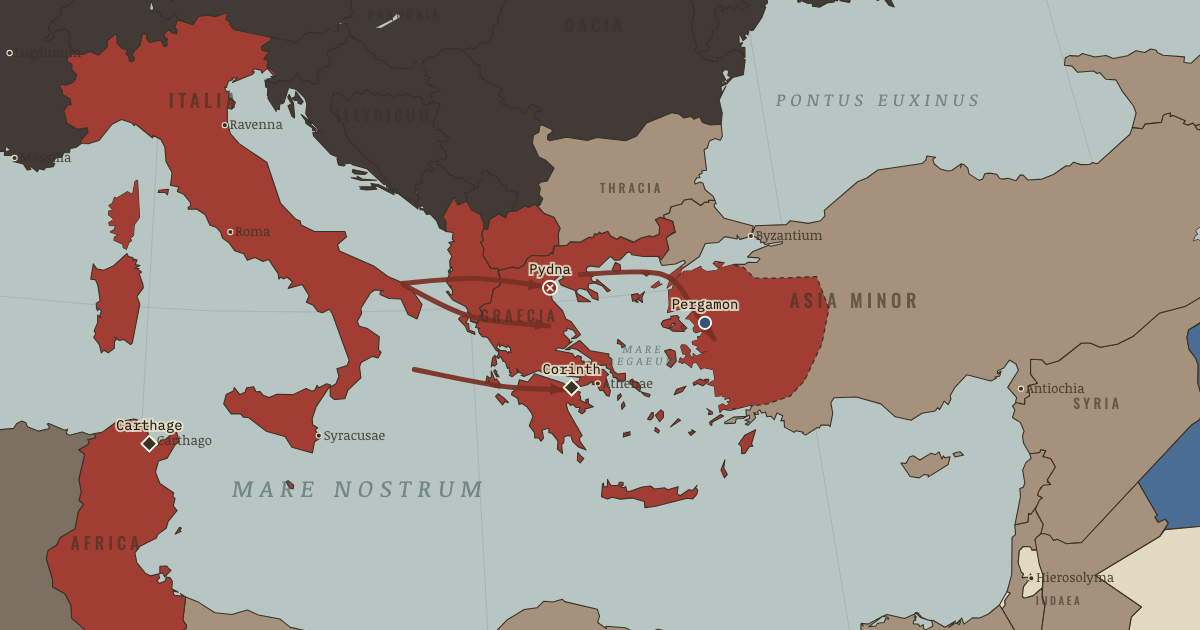
Rome first arrived in the Greek east wearing the mask of a liberator, and the gap between that role and what it became is the real subject of this chapter. It presented itself as the protector of Greek states against the power of Macedon, but each time it settled a dispute it acquired new clients and new obligations that drew it back into the next one. Its military advantage made the outcome hard to resist. The legion fought in small, separately led units that could keep their order on broken ground, where the Macedonian phalanx, a dense hedge of long pikes that was formidable only while its line stayed unbroken, fell apart once the ground or its own casualties opened gaps. That difference decided the battles of Cynoscephalae and Pydna, and after Pydna in 168 BC Macedon was carved up and a thousand leading Greeks, among them the historian Polybius, were carried off to Italy as hostages.
The short answer
- A power vacuum with an invitation. The Hellenistic balance ran on three great monarchies checking each other; by 200 BC Egypt had a child king and Macedon and Syria were carving up its holdings — while Greek states (Pergamon, Rhodes, Athens) begged the new western power to intervene. Rome rarely burst in; it was invited in, repeatedly, by easterners playing Rome against their neighbors. Empires often enter through open doors.
- The phalanx meets the maniple. The Macedonian phalanx was invincible on flat ground and helpless the moment terrain or casualties broke its wall of pikes: at Cynoscephalae and Pydna the legion’s small, independently-officered blocks flowed into the gaps like water into a cracked pot. At Pydna 20,000 phalangites died against about 100 Romans (so Roman sources claim — inflate at will). Tactical systems, like political ones, are tested at their joints.
- Fear, honor, and the Hannibal reflex. Rome’s eastern wars were sold at home as pre-emption: never again would a great power arm a Hannibal (Antiochus sheltering the exiled Carthaginian confirmed every anxiety). Historians debate whether this fear was sincere strategy or convenient cover for glory-hunting aristocrats — the “defensive imperialism” debate below — but note that both readings produce the same arrows.
- Plunder as fiscal policy. The eastern wars paid so spectacularly — Aemilius Paullus brought home enough in 167 to abolish direct taxation of Roman citizens forever — that peace became fiscally irrational. When conquest funds the treasury, the treasury votes for conquest: an incentive structure, not a conspiracy.
THE TURNING POINT
Pydna, 22 June 168 BC. One hour of battle ends the 150-year-old kingdom of Alexander’s homeland — but the deeper turn happens weeks later at Eleusis, near Alexandria, where a Roman envoy meets the Seleucid king invading Egypt, draws a circle around him in the sand, and demands his answer before he steps out of it. Antiochus IV, master of Asia, withdraws his whole army on a single Roman’s word. No battle, no treaty: after Pydna, the entire eastern Mediterranean understands that Roman displeasure is a sufficient instrument of war.
What it changed
A slave society hardens. Conquest’s human plunder — 150,000 Epirotes enslaved in one day in 167, whole cities sold after 146 — industrialized Italian agriculture into slave-run estates (latifundia) and detonated the servile wars: Sicily twice, then Spartacus. The dispossessed free poor drifted to Rome. Every element of the Republic’s coming crisis is now on the board.
Asia: the province that corrupts. The Pergamene bequest was farmed out to private tax syndicates (publicani) whose extraction rates beggared Anatolia and enriched the equestrian class that bid for the contracts. Provincial misgovernment became a currency of Roman politics — and eastern hatred of the tax farmers would soon hand Mithridates 80,000 Italian victims in a single day.
Greek culture conquers its conqueror. Greek became the second language of the Roman elite; Greek philosophy, historiography, medicine, art and urbanism became Rome’s own high culture, transmitted onward with Roman roads and law. When this atlas ends, the Roman east endures precisely because it is Greek-speaking and city-dense — a survival seeded here.
The full answer, argued
The classic seminar fight. The “defensive imperialism” school points out that Rome annexed almost nothing for fifty years — it fought, settled, and went home, leaving client arrangements; empire-as-real-estate came late and reluctantly (Macedon became a province only after four wars). The aggression school (Harris and successors) counters that annual consuls needed wars, the plunder economy needed victims, and Rome’s “defensive” fears were remarkably productive of other people’s territory. Test with 146: destroying Carthage and Corinth defended nothing — both were exemplary terror, empire by deterrence. Perhaps the honest answer: Rome had no blueprint but had built a machine — political careers, army, treasury — that converted every crisis into expansion, and a machine’s output is its purpose. Ask the same question of any modern power’s “reluctant” growth.
An interesting fact
One thing Rome did not do in 146: sow Carthage’s soil with salt. No ancient source mentions it — the detail is a modern embellishment that seeped into textbooks in the nineteenth and twentieth centuries and was only run to ground by a historian in 1986. Rome cursed the site, yes — and then, a century later, planted a colony on it that grew into one of the empire’s greatest cities, the same Carthage whose loss in AD 439 breaks the West in Chapter 11. The destruction was real and total; the salt is a legend about how badly later ages wanted annihilation to come with a ritual.
This is the study layer of Roman conquest of Greece, chapter 3 of The Rise and Fall of Rome, 264 BC – AD 476; the full index of the atlas is here.
Related questions
THE FREE PRINTABLE STUDY GUIDE
Join the Dispatch — a short welcome series, then a letter when a new atlas opens — and the printable study guide for Rome is yours now, free.
NO TRACKING · YOUR ADDRESS IS USED FOR THE DISPATCH AND NOTHING ELSE · UNSUBSCRIBE ANYTIME