Ancient Rome · 216 BC
Why did Rome keep fighting after the Battle of Cannae?
The seminar question: “Rome lost perhaps one adult male citizen in eight at Cannae — in one afternoon — and kept fighting. Why could it, when any contemporary state would have sued for peace?”
In the Second Punic War (218–201 BC) Hannibal crossed the Alps and destroyed Roman armies at the Trebia, Lake Trasimene and Cannae in 216 BC, aiming to break Rome’s network of Italian allies. Several southern peoples defected, but the central Italian core held, and the Senate refused to negotiate and raised fresh legions.
WW2 is free — every chapter. Try chapters 1–2 of any 2 other atlases (3 with a free account). Opening a new atlas uses one of them. Membership opens all 21 — Join.
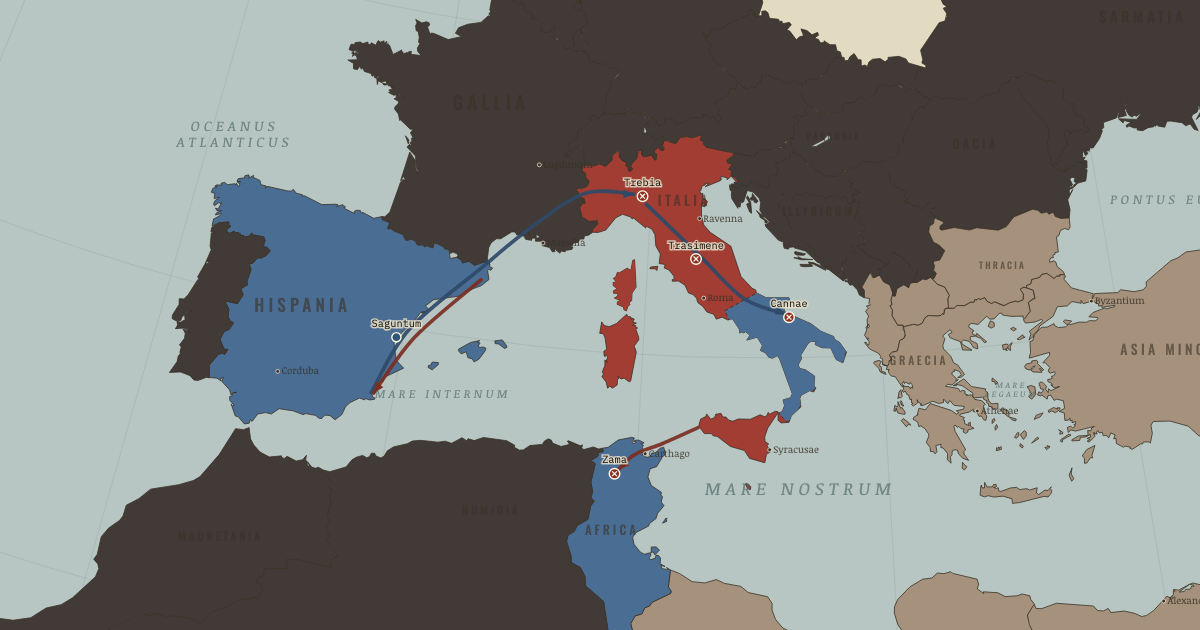
The campaign Hannibal launched in 218 BC was one of the most daring in history, and its purpose explains its shape. Leaving Carthaginian Spain with a large army, he crossed the Rhône and then the Alps in autumn snow, losing most of his men on the way and reaching Italy with perhaps 26,000 survivors. It was enough, because he did not need numbers so much as victories that would persuade Italy to abandon Rome. At the Trebia he lured a Roman army across an icy river and destroyed it; at Lake Trasimene he trapped another in fog and killed it, consul and all; and at Cannae in 216 BC he let his centre give way on purpose, closed his cavalry around the Roman flanks, and annihilated the largest force Rome had ever fielded, with ancient estimates of the dead ranging from about 48,000 to 70,000. Much of southern Italy defected to him, and by the ordinary rules of ancient warfare the war was over.
The short answer
- A treaty written in resentment. The peace of 241 was harsh; the seizure of Sardinia in 238 — legally naked opportunism while Carthage fought its own mutinous mercenaries — made it insulting. Barcid Spain was built explicitly to fund and man a rematch. Polybius, who knew the players, called Roman bad faith over Sardinia the war’s true cause. Punitive peaces breed second wars: file the principle away.
- Saguntum: the tripwire city. Rome took the small Spanish town of Saguntum under its protection — deep inside Carthage’s agreed sphere. When Hannibal stormed it in 219, Rome demanded his surrender; Carthage’s council backed him. Both sides had constructed a casus belli they could not climb down from — Messana all over again, and both knew it.
- Hannibal’s theory of victory. He knew Rome’s strength was the socii, so his strategy was not to sack Rome — he never seriously tried — but to shatter the alliance by demonstration: destroy the legions in the field, parade Italian prisoners freed without ransom, and wait for Italy to defect. It was the right theory about the wrong alliance: the Latin core, bound by citizenship and intermarriage rather than fear, held.
- Command by committee, annually. Rome’s yearly consular elections — its strength in depth — was its tactical weakness: aggressive amateurs like Varro at Cannae repeatedly gave Hannibal the pitched battles he wanted. Only when Rome suspended its own norms (repeated commands for Fabius and Marcellus, a private-citizen proconsul in Scipio) did the asymmetry close. Note the cost: bending the constitution to fight Hannibal set precedents ambition would remember.
THE TURNING POINT
Cannae, 2 August 216 BC. The hinge is not the battle but the response. Any Hellenistic state that lost 60,000 men — an eighth of its adult male citizens and allies within reach — would negotiate; that was what battle was for. Rome instead lowered the property qualification, armed slaves and criminals, forbade public mourning past thirty days, and refused even to ransom its own prisoners. Hannibal’s officer Maharbal allegedly told him: “You know how to win a victory; you do not know how to use one.” The judgment is unfair to Hannibal and exactly right about Rome — Cannae proved the Republic could not be beaten by any means its enemies understood.
What it changed
The Mediterranean’s center of gravity moves west. Carthage’s fall to client status leaves Rome as the only major naval power west of Greece. Watch the tan of the African hinterland turn grey too: Numidia under Masinissa becomes Rome’s ally and Carthage’s tormentor. Spain’s silver mines now flow into Roman hands and provide the war chest for everything that follows.
A generation trained by catastrophe. The men who fought Hannibal for seventeen years came home with professional-grade experience and a conviction of Roman invincibility earned the hard way. Within three years of Zama they were aimed at Macedon. The Hellenistic east, which had watched the western duel as spectators, was about to meet the winner.
Italy’s countryside begins to change. Seventeen years of armies living off Italy ruined smallholders; war captives flooded in as slaves; the wealthy bought up devastated land into estates. The social crisis that kills the Republic in Chapter 4 is usually traced to this decade — argued by historians from Appian to today, and visible on no map until it explodes.
The third war: a memorial, not a chapter. Fifty years later, with Carthage revived commercially but militarily harmless, Cato ended every Senate speech with “Carthage must be destroyed.” In 149 Rome manufactured a pretext; in 146 the city fell after a three-year siege — its people killed or enslaved, its site cursed. Find the ◆ marker on the map and read it: this was not strategy but the extermination of a fear.
The full answer, argued
Assemble the machine from the previous chapter. Demography: the socii network gave Rome a recruiting pool near three-quarters of a million, so even 100,000 dead in three years was survivable arithmetic, however unbearable humanly. Politics: annual magistracies meant no irreplaceable commander, and a senatorial culture where negotiation after defeat was social death. Alliance design: Hannibal’s whole strategy required Italian defection, but Rome’s core allies were bound by citizenship, marriage and shared plunder, not fear — the south defected, the center never did. Compare Carthage, whose mercenary armies were exactly as loyal as its treasury was full. The transferable lesson: wars of attrition are won by whichever side’s political system can metabolize loss — a lesson that will reappear when you reach the Goths, and again whenever you read a modern war.
An interesting fact
Zama did not finish Hannibal — peace did something stranger with him. Elected suffete (chief magistrate) of Carthage in 196 BC, he audited the books and broke the embezzling oligarchs so effectively that within five years Carthage offered to pay off its fifty-year indemnity in one lump sum; Rome refused — the leash mattered more than the money — then hounded him from court to court across the east until he took poison in Bithynia rather than be extradited, around 183 BC. By Livy’s reckoning, Scipio Africanus died the same year, in bitter self-imposed exile from an ungrateful Rome. The ancient historians noticed the symmetry; so should you.
This is the study layer of Second Punic War, chapter 2 of The Rise and Fall of Rome, 264 BC – AD 476; the full index of the atlas is here.
Related questions
THE FREE PRINTABLE STUDY GUIDE
Join the Dispatch — a short welcome series, then a letter when a new atlas opens — and the printable study guide for Rome is yours now, free.
NO TRACKING · YOUR ADDRESS IS USED FOR THE DISPATCH AND NOTHING ELSE · UNSUBSCRIBE ANYTIME