Ancient Rome · 264 BC
Why did a quarrel over Messana start the First Punic War?
The seminar question: “Rome and Carthage had been allies against Pyrrhus just fourteen years earlier. Why did a squabble over one Sicilian city pull them into twenty-three years of war?”
The First Punic War began in 264 BC when mercenaries holding Messana, on the Sicilian strait facing Italy, appealed for protection and Rome’s assembly voted to intervene against Carthage. Rome’s manpower from its Italian allies met Carthage’s wealth and navy in a long war of endurance that ran until 241 BC.
WW2 is free — every chapter. Try chapters 1–2 of any 2 other atlases (3 with a free account). Opening a new atlas uses one of them. Membership opens all 21 — Join.
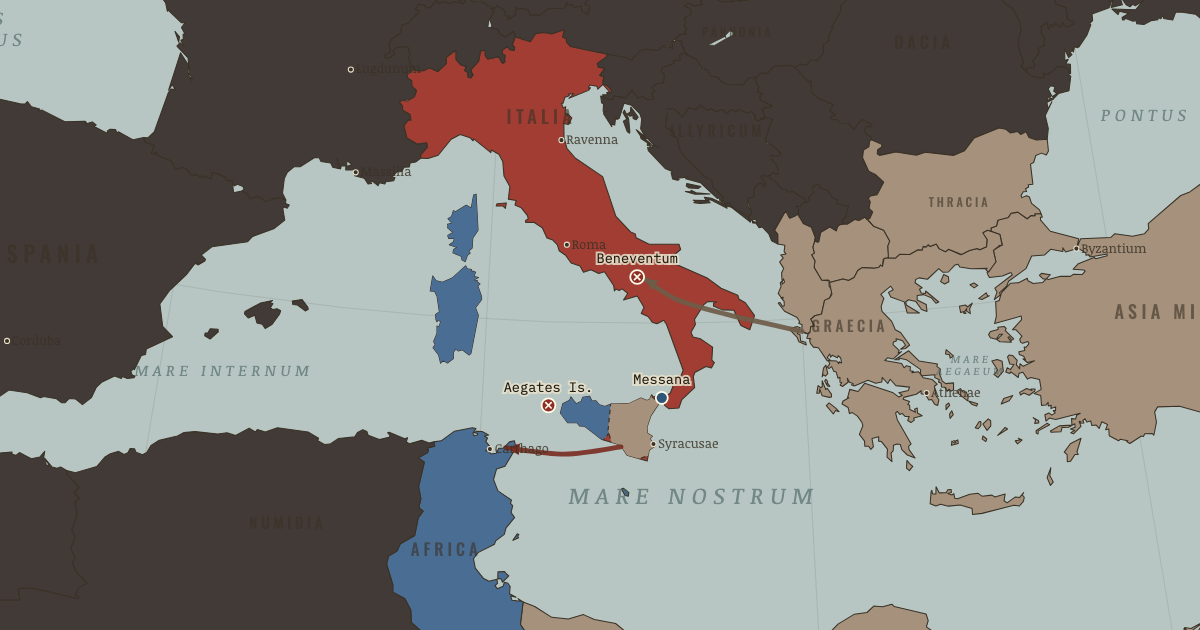
The war became a test of endurance, and the reason becomes clear once we look at how each of the two states was actually built. Rome’s real strength was a system for producing soldiers. Over the previous two centuries it had tied the other peoples of Italy to itself as allies who kept their own governments and, in return, owed troops whenever Rome called, so that a generation later the Greek historian Polybius reckoned this network could field more than 700,000 men of fighting age, a reserve closer to that of a modern nation mobilising its whole population than to a typical ancient city. Carthage produced its power through wealth instead. Its trading empire financed the finest navy in the region and paid for professional soldiers hired from many nations, though armies raised in this way last only as long as the money and the ports that supply them, and they shrink the moment either one fails.
The short answer
- The socii system: manpower as a constitution. Rome’s wars ran on a unique alliance structure. Defeated Italian states kept their laws and lands but supplied troops — and the loyal could earn Roman citizenship. Where Carthage bought soldiers with silver, Rome minted them from defeat itself. This is the single most important fact in the atlas: every red advance for the next four centuries is powered by it.
- Two ambitious magistrates a year. A consul had twelve months to win the glory that defined a Roman aristocrat’s life. The system produced commanders who sought battle, assemblies happy to vote for wars that paid, and — crucially — a state that never depended on any single general’s survival. Lose an army, elect another consul, raise another army.
- Sicily: the strait with no owner. Messana sits three miles from Italy. A Carthaginian garrison there put the rival’s navy in sight of Rome’s allies; a Roman garrison put legions on Carthage’s island. Neither power trusted the other with the strait — a textbook security dilemma, where the defensive move of each read as aggression to the other.
- What Pyrrhus taught everyone. Pyrrhus arrived with the best army money could hire and won at Heraclea and Asculum — losing men he could not replace against an enemy that reappeared each spring at full strength. “Another such victory and we are undone.” The Hellenistic world filed the lesson away; Carthage was about to learn it at sea.
THE TURNING POINT
The Mamertine appeal, 264 BC. The Senate, uneasy about aiding mercenaries who had seized a city by massacre, deadlocked — and referred the choice to the popular assembly, which voted for war and its spoils. A constitutional detail with world-historical consequences: the decision that began Rome’s march to empire was made not by strategists but by voters. Once legions crossed the strait, neither side could back down without conceding the western Mediterranean.
What it changed
Rome becomes a naval power in five years. Using a wrecked Carthaginian quinquereme as a template, Rome built 100+ warships and invented the corvus boarding-bridge to turn sea battles into infantry fights. The deeper point: Rome treated war-making itself as a technology to be copied and improved. Watch this adaptability recur — it is the Republic’s real weapon.
The first provincia. Sicily was not made an ally but a taxed possession under a Roman governor — a new legal category that turned war into revenue. The province model (tribute, a governor with near-absolute power, tax farmers) becomes the empire’s skeleton, and its governors’ rapacity becomes the Republic’s chronic disease.
Carthage’s revenge takes root in Spain. Stripped of Sicily, then cheated of Sardinia in 238 while distracted by a mercenary revolt (watch the islands change on the map), Carthage sent the Barcid family to build a new silver-funded empire in Hispania. Hamilcar Barca reportedly made his nine-year-old son swear eternal enmity to Rome. The boy’s name was Hannibal.
The full answer, argued
Weigh three layers. Structure: two expanding powers now shared a narrow sea, and Messana made the overlap concrete — each could tell itself the other’s garrison was a dagger. Institutions: Rome’s consuls needed wars and its assembly profited from them, while Carthage’s trading oligarchy could not concede the sea lanes that fed it. Contingency: a band of mercenaries chose exactly the wrong city to seize. Historians lean structural — some collision was probable — but nothing required a 23-year death-struggle; escalation was chosen, year by year, by leaders who each believed one more fleet would end it. The transferable lesson: wars between near-equals rarely stay limited, because the side that is losing always has one more fleet to build.
An interesting fact
The seabed off the Aegates Islands has kept the receipts: over the past two decades, archaeologists have raised some two dozen bronze warship rams from the waters where the war ended in 241 BC — the first ancient sea battle whose site has ever been found. Several rams bear Latin inscriptions naming the Roman quaestors who approved them for service; at least one carries a Punic dedication invoking Baal — the paperwork of both navies, legible on the sea floor twenty-three centuries later.
This is the study layer of First Punic War, chapter 1 of The Rise and Fall of Rome, 264 BC – AD 476; the full index of the atlas is here.
Related questions
THE FREE PRINTABLE STUDY GUIDE
Join the Dispatch — a short welcome series, then a letter when a new atlas opens — and the printable study guide for Rome is yours now, free.
NO TRACKING · YOUR ADDRESS IS USED FOR THE DISPATCH AND NOTHING ELSE · UNSUBSCRIBE ANYTIME