Ancient Rome · 62 BC
Did Marius’ army reform kill the Roman Republic?
The seminar question: “Marius’ army reform looks like a technical fix — a recruiting rule. Make the case that it, and not any villain’s ambition, killed the Republic.”
Rome’s conquests enriched a narrow elite while ruining the small farmers who filled the legions. The reforming tribunes Tiberius and Gaius Gracchus were killed in 133 and 121 BC, Marius opened the legions to the landless, and in 88 BC Sulla marched his own legions on Rome, beginning civil war.
Chapter 4 is part of membership. WW2 is free — every chapter. Try chapters 1–2 of any 2 other atlases (3 with a free account). Opening a new atlas uses one of them. Membership opens all 21 — Join.
The first rupture came through an attempt at reform, which is what makes it so revealing. In 133 BC Tiberius Gracchus proposed returning illegally occupied public land to poorer citizens, and the response of the Senate and its supporters was to kill him along with hundreds of his followers; his brother Gaius and thousands more died the same way in 121 BC. This political murder demonstrated that the Republic had no accepted method for settling a dispute over the profits of empire, and that force would decide such questions instead. Marius later opened recruitment to the poorest citizens, which solved an urgent shortage of soldiers but created a new dependency, because veterans now relied on their commander, rather than on the state, to obtain the land they had been promised on discharge.
The short answer
- Victory’s losers: the smallholder crisis. The legionary was a farmer who could afford his own arms; but decades of overseas service ruined farms, and conquest’s slave-flood let the rich replace free labor entirely. The recruiting base literally died of the empire it had won. Every reformer from the Gracchi onward was trying to solve this circle; every solution threatened someone’s property; and property, in the Senate, always had the votes — and eventually the clubs.
- The Marian reform: THE structural cause. Arm the poor and their loyalty follows their livelihood — which the state, refusing to fund veteran pensions systematically, left in the hands of individual generals. From 107 BC onward, every Roman army is a potential political party with weapons, and every successful general must extort land from the Senate or betray his men. Sulla, Pompey, Caesar, Octavian: each is this one incentive structure wearing a different face. When you reach Chapter 6, note that Augustus’ first permanent fix is a state military treasury.
- Empire’s profits, concentrated; empire’s costs, socialized. Provincial extortion, tax-farming syndicates, and slave-worked estates concentrated fantastic wealth in a few hundred families while the urban poor multiplied. Politics became the art of buying the poor with grain and games — or mobilizing their desperation. The Republic’s institutions, designed for a city-state of farmers, had no answer to inequality on an imperial scale. Consider what institutions ever do.
- No monopoly on violence. Rome had no police, no standing army in Italy, no legal force between a magistrate’s bodyguard and a legion. When politics turned murderous in 133, there was nothing between debate and street gangs — and nothing between street gangs and Sulla’s legions. States that cannot referee their internal conflicts eventually hold auditions for a referee. The Republic’s last fifty years are those auditions.
THE TURNING POINT
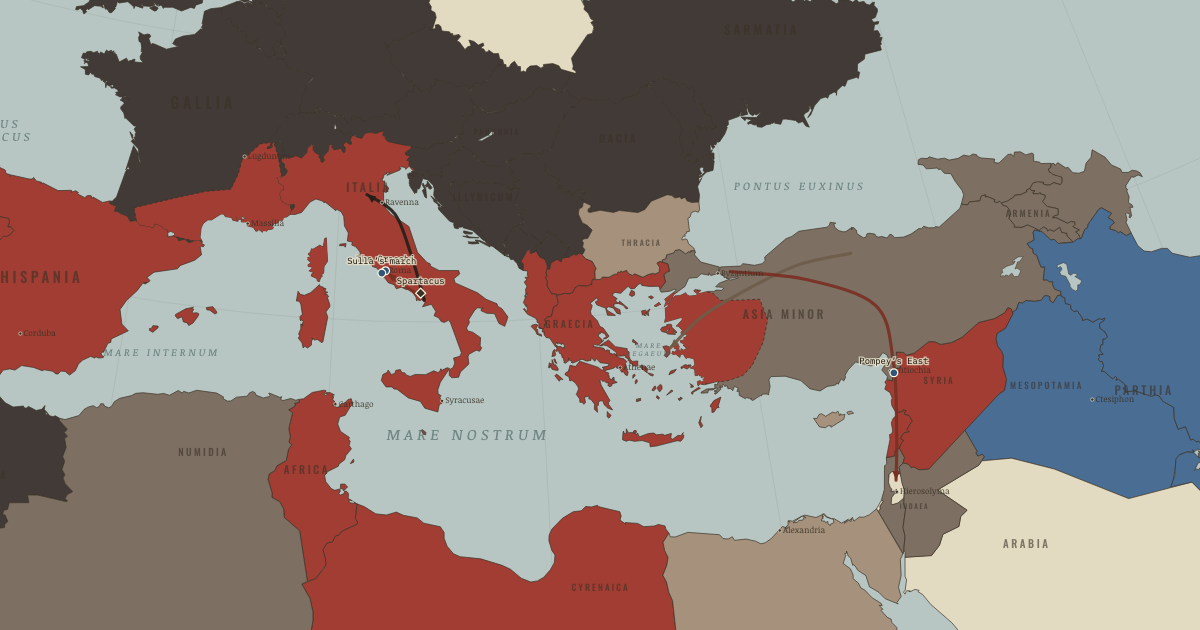
Sulla marches on Rome, 88 BC. When Sulla asked his officers to march on the city, all but one refused — but the soldiers followed him to a man: Marius’ landless legionaries, choosing their general and their promised farms over a constitution that had never fed them. Every safeguard — religious, legal, customary — failed at once, because none had ever contemplated the question. Rome’s walls, it turned out, were defended only by the assumption that no Roman would attack them. Assumptions are load-bearing; watch what happens to every state in this atlas when one snaps.
What it changed
The east acquires an architecture. Pompey’s settlement (66–62) — Syria annexed, Judea and Armenia made clients, cities founded, Mithridates dead — organizes the eastern map you now see: red provinces on the coast, a grey-tan buffer of client kings behind, and Parthia’s blue looming across the Euphrates. It is the Republic’s greatest administrative achievement, done entirely by one man’s decree: the empire is learning to prefer a monarch before it admits it.
The First Triumvirate. In 60 BC Pompey (glory and veterans), Crassus (money) and Caesar (ambition and debts) form a private syndicate to divide the state’s decisions among themselves. Caesar takes a five-year command in Gaul as his share. The Republic’s remaining history is the mathematics of three reducing to one.
Violence ratchets, never resets. Each escalation — Gracchan clubs, Sullan proscriptions, gang-run elections in the 50s — became the floor for the next. Political scientists call it a broken equilibrium; Romans called it the anger of the gods. Either way, note the ratchet’s direction: no actor could unilaterally de-escalate without being destroyed by one who didn’t. The only exits were collapse or a monopolist.
The full answer, argued
Run the counterfactual discipline. Before 107: armies of propertied men who returned to their farms — Sulla’s march is unimaginable, because his soldiers would not have followed. After 107: every army’s pension depended on its general’s political muscle, so soldiers rationally backed their patron against the state — the same incentive produced Sulla, Pompey’s threats, Caesar’s crossing, and Octavian’s entire career; four different personalities, one structure. Against this, the “great villain” reading must explain why the Republic produced an unbroken supply of villains precisely after the reform, and none of comparable success before. The strongest reply is that Marius merely formalized a rot already begun (land crisis, Gracchan violence) — the reform was a symptom that became a cause. Both can be true: structures load the gun; individuals pull triggers. Distinguishing the two is most of what political history is for.
An interesting fact
Mithridates left his name to a medical idea: convinced Rome would poison him, he dosed himself with small amounts of toxins for years — “mithridatism,” acquired immunity, still carries his name. The ancient historians supply the bitter coda: cornered by a rebellion in 63 BC, the old king took his poison at last, found it would not work, and had to ask a bodyguard for the sword. Pliny says Pompey found the antidote recipe, in the king’s own hand, among the spoils — and European pharmacies were still compounding “mithridatium” from its supposed descendants into the eighteenth century.
This is the study layer of Crisis of the Roman Republic, chapter 4 of The Rise and Fall of Rome, 264 BC – AD 476; the full index of the atlas is here.
Related questions
THE FREE PRINTABLE STUDY GUIDE
Join the Dispatch — a short welcome series, then a letter when a new atlas opens — and the printable study guide for Rome is yours now, free.
NO TRACKING · YOUR ADDRESS IS USED FOR THE DISPATCH AND NOTHING ELSE · UNSUBSCRIBE ANYTIME