Ancient Rome · AD 117
How did Rome govern so many people with so few officials?
The seminar question: “Rome governed a quarter of humanity with fewer administrators than a modern mid-sized city. How — and what was the hidden price of governing so cheaply?”
During the Pax Romana the Roman Empire reached its greatest extent under Trajan around AD 117, ruling perhaps 60 to 70 million people with roughly 300,000 soldiers and a very small civil service. Local city elites collected taxes and ran courts, while revolts were crushed, as in Judaea, where the Temple was destroyed in AD 70.
Chapter 7 is part of membership. WW2 is free — every chapter. Try chapters 1–2 of any 2 other atlases (3 with a free account). Opening a new atlas uses one of them. Membership opens all 21 — Join.
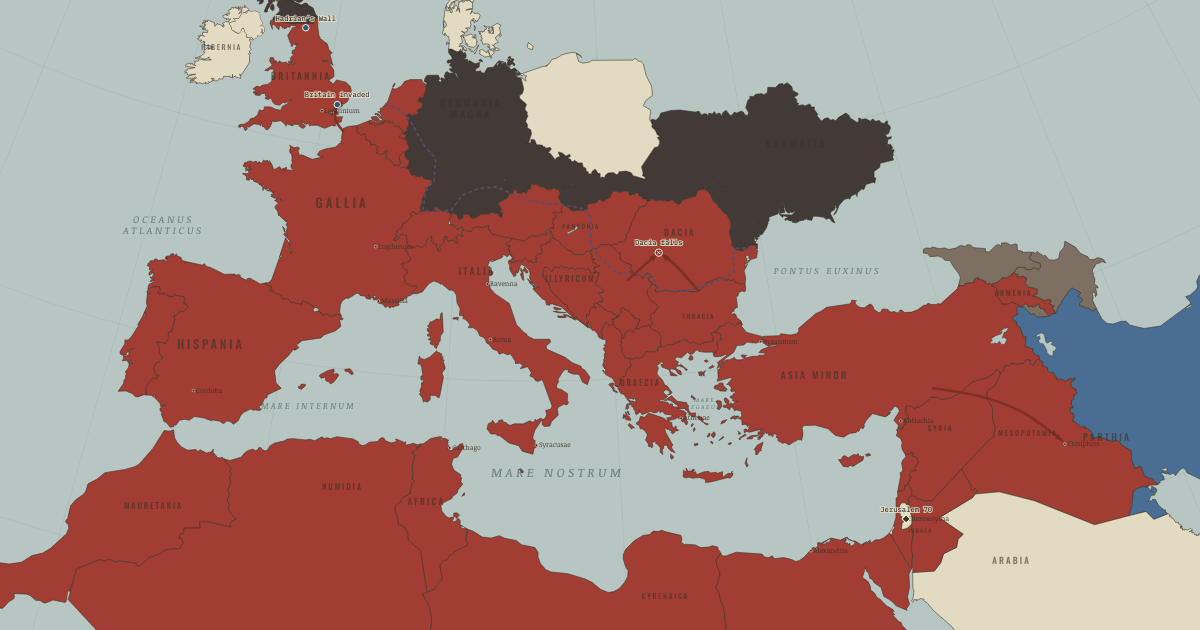
The map reached its greatest extent under Trajan around AD 117, stretching from the Atlantic into Mesopotamia, but the more telling fact is how lightly it was governed. Britannia had been invaded under Claudius in AD 43, and Dacia, north of the Danube, was taken in two hard wars between 101 and 106 for its gold, seeding the Latin that would grow into Romanian. Trajan’s final conquests in the east reached the Persian Gulf but were held for only about two years before Hadrian handed them back. Roughly 300,000 soldiers and a very small senior civil service ruled sixty to seventy million people, and they could do so because the real work of government was local. The leading families of each city collected taxes, funded public buildings and administered justice in return for citizenship, office and prestige, and roads, safe sea lanes and a common coinage bound those cities into one system that Romans could call, without irony, mare nostrum, “our sea.”
The short answer
- Cities as the operating system. Rome didn’t administer people; it franchised elites. A conquered region got a charter town, and its landowners got citizenship, careers and status in exchange for running taxes, courts and roads. The empire was a network of a few thousand such bargains — which is why it needed almost no bureaucracy, and why it endured: the governed classes were shareholders. Note the corollary for Chapter 12: where cities were dense (the Greek east), Rome outlasted Rome; where thin (the west), the network was the first thing to die.
- The legions as engineers and settlers. A legion in peacetime was a construction firm with swords: roads, bridges, aqueducts, surveying. Veterans’ colonies seeded Latin-speaking towns from Spain to Syria. Conquest’s instrument doubled as integration’s — the same institution that broke a province then built it into the network. Militaries that only fight are cheaper and buy much less.
- A frontier held by reputation. Thirty legions could not defend 8,000 km of border as a barrier; they didn’t try. The limes was a tripwire and a customs line; actual security rested on deterrence — the certain knowledge, taught at Sarmizegetusa and Jerusalem, that Rome’s retaliation was unlimited. Deterrence is cheap until it is tested simultaneously in two places; hold that thought for 235.
- Good luck wearing the costume of good government. The “Five Good Emperors” (96–180) chose successors by adoption — praised ever since as merit-based design. But each happened to lack a surviving son; the first with one (Marcus Aurelius) promptly ended the streak by anointing the disastrous Commodus. Historians’ warning: distinguish systems from lucky runs before you copy the lesson. The Principate’s succession bug was hiding, not fixed.
THE TURNING POINT
Hadrian’s Wall, AD 122. Eighty Roman miles of stone across Britain’s neck — militarily modest, symbolically seismic. Hadrian, inheriting Trajan’s overstretched maximum, gave back Mesopotamia, wrote off expansion, and toured the empire drawing lines: here, and no farther. An ideology older than the Republic — empire without limit, imperium sine fine — quietly retired. The choice was probably right (the eastern conquests were unholdable), but mark what it means on a strategy map: a power that stops choosing where to advance has agreed to let its enemies choose where it will defend. From 122 on, every war in this atlas starts on the other side’s initiative.
What it changed
Romanization becomes self-sustaining. By 180, Gaul, Spain and Africa are producing senators, authors and emperors (Trajan and Hadrian are Spanish, Septimius Severus African); Latin has generations of native speakers from the Atlantic to the Danube. This cultural depth is why, when the western state dies in Chapter 11, its languages, law and church do not. Conquest lasted centuries; the assimilation it enabled lasts to this morning.
The 212 citizenship: completion and hollowing at once. Caracalla’s universal grant finished the Republic’s oldest trick — turning the defeated into Romans. But by erasing the citizen/subject gradient, it also retired citizenship as an incentive, just as pressure on the frontiers made the army, not the town council, the ladder that mattered. Status competition migrated from civic benefaction to military rank; the cities, the empire’s load-bearing institution, slowly stopped being worth the price of their upkeep.
Plague enters the ledger. The Antonine plague (165–c.180) is the first empire-wide epidemic in the record — armies infected, Egyptian villages emptied on the tax rolls, recruitment and prices disturbed for a generation. Historians now weigh disease alongside politics in Rome’s trajectory (Harper’s “Fate of Rome” makes the strongest case). Whatever its exact toll, note the systemic exposure it revealed: an integrated Mediterranean moves microbes as efficiently as grain.
The full answer, argued
The how: subcontracting. Cities self-governed; local elites collected taxes for the status Rome rationed; the army built the infrastructure; deterrence substituted for garrisons. Total state overhead may have been 5–7% of GDP — a miracle of cheapness. The price: the system had no reserves and no redundancy. No standing central army behind the frontier (a usurper’s field army and an invader’s path looked identical); no professional revenue service when city elites stopped volunteering; no institutional loyalty deeper than the current emperor’s name. It was a fair-weather constitution — spectacular at running success, unable to absorb two simultaneous shocks. Chapter 8 supplies the shocks. The transferable question for any efficient system, ancient or modern: what did you delete to get this lean, and what storm makes you miss it?
An interesting fact
The best window into daily life on this frontier is a waterlogged rubbish heap: at Vindolanda, a fort near Hadrian’s Wall, anaerobic soil preserved hundreds of wafer-thin wooden writing tablets — the garrison’s actual mail, from strength reports to a note that the soldiers’ beer had run out. The most famous, from around AD 100, is a birthday-party invitation from one officer’s wife, Claudia Severa, to another, Sulpicia Lepidina; its closing greeting, added in Severa’s own hand, is among the earliest known Latin handwriting by a woman. One report calls the locals Brittunculi — “wretched little Britons” — the empire’s casual voice, caught verbatim.
This is the study layer of Pax Romana, chapter 7 of The Rise and Fall of Rome, 264 BC – AD 476; the full index of the atlas is here.
Related questions
THE FREE PRINTABLE STUDY GUIDE
Join the Dispatch — a short welcome series, then a letter when a new atlas opens — and the printable study guide for Rome is yours now, free.
NO TRACKING · YOUR ADDRESS IS USED FOR THE DISPATCH AND NOTHING ELSE · UNSUBSCRIBE ANYTIME