Ancient Rome · AD 312
Did Diocletian’s reforms save or weaken the Roman Empire?
The seminar question: “Diocletian and Constantine saved the Roman Empire by roughly doubling the state. Did the cure weaken the patient?”
From 284 Diocletian rebuilt the Roman state: the Tetrarchy of four rulers, about a hundred provinces, separate civil and military commands, and a larger army and tax system. The Tetrarchy collapsed after he retired in 305, and Constantine won the civil wars that followed, including the Battle of the Milvian Bridge in 312.
Chapter 9 is part of membership. WW2 is free — every chapter. Try chapters 1–2 of any 2 other atlases (3 with a free account). Opening a new atlas uses one of them. Membership opens all 21 — Join.
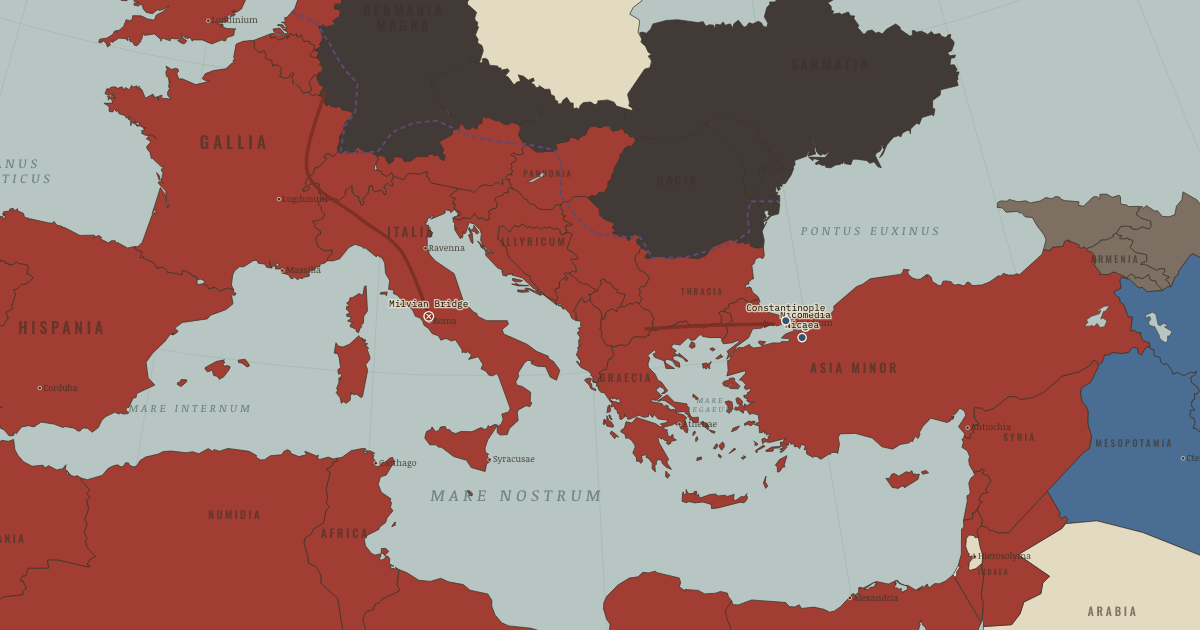
Diocletian’s answer to the crisis was to replace the old disguise of one-man rule with an openly heavier monarchy, governed from the Greek east at Nicomedia rather than from Rome. Where Augustus had played the modest first citizen, Diocletian presented himself as a sacred, half-divine ruler surrounded by ceremony, on the reasoning that men are less willing to murder what they are taught to worship. This new style is often called the Dominate, from the Latin for “lord and master.” Against the constitutional flaw that had produced the century of usurpers, he built the Tetrarchy, sharing rule among four emperors each based near a frontier, so that four armies had four legitimate masters instead of one throne and many bidders. Against the machinery of collapse he added structure. He roughly doubled the provinces to around a hundred, separated civilian governors from military commanders, enlarged the army toward half a million men with mobile forces held behind the line, and rebuilt taxation in kind and tied to an annual budget.
The short answer
- Reform by survivor’s logic. Every Diocletianic structure answers a specific third-century failure: tetrarchy answers usurpation, civil/military separation answers governor-generals, taxation in kind answers debased coinage, court divinity answers the cheapness of emperors’ lives. It is crisis-shaped government — brilliant against the last catastrophe, mute on the next (nothing in it addresses barbarian settlement or the west’s thinner economy). Institutions are fossils of their founding emergencies; read any constitution, including yours, that way.
- The failed persecution proved the church’s weight. Diocletian’s Great Persecution (303–311) — scriptures burned, clergy jailed, sacrifice tests — was the empire’s most systematic attempt to break Christianity, and its failure was public: too many Christians, too networked, too willing to die well, in too many official posts. Constantine’s embrace a decade later was therefore not a leap into the dark but a re-reading of demonstrated facts: the network that could not be broken could be borrowed. Persecutions that fail conduct legitimacy to their victims — a regularity worth carrying out of this atlas.
- The center of gravity was already eastern. Diocletian ruled from Nicomedia and visited Rome once. The tax base, the cities, the recruits and the dangerous frontier all lay east of Italy; Constantinople merely gave the fact an address. Note what this quietly decides: when the halves of the empire are formally separated in 395, the east gets the capital built for endurance and the revenues to garrison it — the west gets Rome’s prestige and Rome’s exposure. Chapter 11’s asymmetry is being constructed here, in peacetime, by sensible men.
- Christianity offered what paganism structurally couldn’t. Classical religion was a portfolio of local cults — superb at civic identity, incapable of empire-wide organization. The church came with a parallel administration (one bishop per city, councils, letters, charity budgets), a universal membership across class and ethnicity, and an ideology of legitimate authority under one God that fit a Dominate perfectly. Constantine did not just adopt a faith; he acquired the only institution in the empire with its own functioning infrastructure — the institution, Chapter 12 will note, that outlives the state it joined.
THE TURNING POINT
The Milvian Bridge, 28 October 312. Strip the vision story to its verifiable core and it is still a hinge: a Roman emperor bet his war on the god of a persecuted minority — perhaps a tenth of his subjects, far less of his army — and won, and paid the debt publicly for 25 years. Christianity moved from tolerated to sponsored to (by century’s end, under Theodosius) mandatory; the classical world’s religious ecosystem, thousands of years deep, was legislated away within three generations. Few battles anywhere have redirected more downstream history — not because of the fighting, which was ordinary, but because of what the winner chose to make it mean. Contingency and agency in one afternoon: the historian’s favorite cocktail.
What it changed
A heavier state as the new normal. Late Roman government — the Dominate’s courts, compulsory guilds, hereditary tenant-farmers (coloni) bound to estates, tax collectors with soldiers — is the price tag of survival, and contemporaries itemized it bitterly (“more tax-eaters than taxpayers,” claims one pamphleteer; the Price Edict of 301, trying to freeze inflation by decree, failed as economics predicts). The debate runs hot today: did the heavier state save the empire for two more centuries, or hollow the loyalty and economy that were its real walls? Hold the question until you watch the west’s taxpayers in 476 conspicuously decline to fight for it.
Church and state fuse — and start wrestling. Once emperors sponsored the church, they inherited its quarrels (Nicaea was called to settle one) and it inherited their politics. Within 80 years a bishop — Ambrose — will force an emperor to public penance (see Thessalonica’s ◆ marker in the next chapter): a scene inconceivable under Augustus. The long European contest of crown and church — and the whole concept of an authority above the state — is born in this alliance. Chapter 12 counts it among Rome’s most consequential bequests.
Two capitals, two futures. Constantinople’s founding creates, for the first time, an eastern center that needs nothing from the west — its own senate, mint, grain supply (Egypt’s, redirected), and court. Administrative convenience in 330; by 395, formal division; by 476, the difference between the half that fell and the half that lasted until 1453. Scrub the timeline across those dates and watch the dashed line on the map become the most consequential border in European history.
The full answer, argued
The case for the cure: after 284 the empire held its frontiers for a century, beat Persia repeatedly, and the east — which kept the full Diocletianic apparatus — endured for a millennium; heavier government demonstrably could work. The case against: the fourth-century sources groan with tax flight, curial elites bribing their way off city councils, peasants preferring barbarian landlords to Roman collectors (Salvian says so explicitly), and a west whose thinner economy carried the same apparatus on half the revenue — until its taxpayers’ indifference in the 470s let it die unmourned. The synthesis worth defending: the reforms saved the whole and redistributed the fragility — eastward resilience purchased at western expense, loyalty converted into compliance. States in crisis almost always face this trade (capacity now, consent later); Rome took it knowingly. Whether any alternative existed is the counterfactual your seminar should fight about.
An interesting fact
Diocletian’s retirement home never emptied. His fortified palace on the Dalmatian coast was so vast that when refugees from nearby Salona fled inside its walls in the seventh century they founded a town in it — the town is Split, Croatia, and roughly 3,000 people still live within the palace today, laundry strung between imperial columns. The sharpest irony stands at its center: the mausoleum of the empire’s greatest persecutor of Christians was converted into Split’s cathedral, dedicated to a bishop martyred in Diocletian’s own persecution — and the emperor’s body vanished from history.
This is the study layer of Diocletian and Constantine, chapter 9 of The Rise and Fall of Rome, 264 BC – AD 476; the full index of the atlas is here.
Related questions
THE FREE PRINTABLE STUDY GUIDE
Join the Dispatch — a short welcome series, then a letter when a new atlas opens — and the printable study guide for Rome is yours now, free.
NO TRACKING · YOUR ADDRESS IS USED FOR THE DISPATCH AND NOTHING ELSE · UNSUBSCRIBE ANYTIME