WWI · NOV 1915
Was Gallipoli a good idea badly executed?
The seminar question: “Gallipoli: a brilliant strategy ruined by execution, or a bad idea rescued by nothing?”
In 1915 both sides looked beyond the stalled Western Front. Italy joined the Entente, the Allied attack at Gallipoli ended in evacuation, and the breakthrough at Gorlice–Tarnów forced Russia’s Great Retreat. Bulgaria joined the Central Powers and Serbia was overrun, and the Ottoman government carried out the Armenian genocide.
Chapter 6 is part of membership. WW2 is free — every chapter. Try chapters 1–2 of any 2 other atlases (3 with a free account). Opening a new atlas uses one of them. Membership opens all 21 — Join.
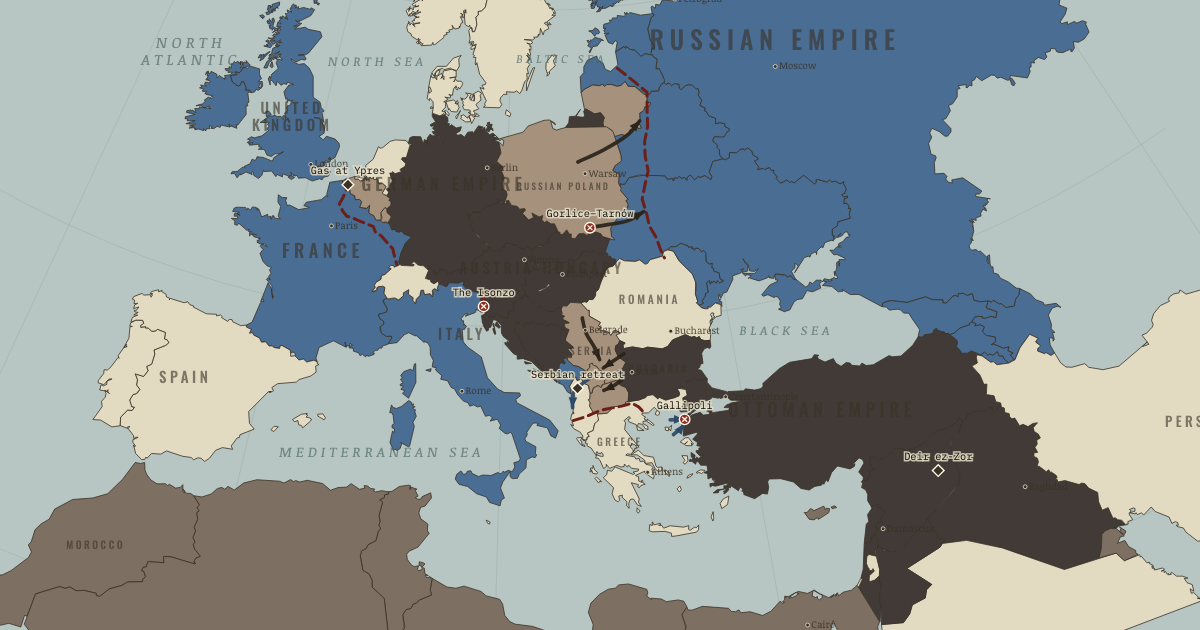
With the Western Front blocked, both coalitions looked elsewhere for a decision. Germany used poison gas at Ypres and opened the age of chemical warfare. Italy joined the Entente in exchange for promised Austro-Hungarian territory and began a long series of attacks along the Isonzo river. At Gallipoli, Allied forces tried to force the Dardanelles, resupply Russia and drive the Ottoman Empire out of the war, but the Ottoman defenders held the ridges and the operation ended in evacuation.
The short answer
- The “easterner” temptation. If the Western Front is a wall, said London’s easterners, go around: the Dardanelles, Salonika, Mesopotamia. The logic was real — knock out weak allies, open Russia’s supply line (grain out, shells in), rally the Balkans. The execution required amphibious and expeditionary competence nobody yet had, at the end of supply lines the “sideshows” never got priority on. The strategic idea kept being right on paper and dying of logistics.
- Italy auctioned. Italy had been the Triple Alliance’s third member — and stayed neutral in 1914, arguing the alliance was defensive. In 1915 both sides bid for it; the Entente could offer what wasn’t theirs: Trentino, Trieste, Dalmatia. The secret Treaty of London (26 April) bought an army of 875,000 — and planted a grievance, because at Versailles Italy would receive less than the promise, and “mutilated victory” would become Fascism’s founding myth.
- Bulgaria’s price. Bulgaria, mauled in 1913’s Second Balkan War, wanted Macedonia back from Serbia. After Gallipoli stalled and Gorlice broke Russia’s prestige, Berlin looked the stronger horse — and could pay in Serbian land. Bulgaria’s entry (October 1915) doomed Serbia and opened the Berlin–Constantinople railway: watch the charcoal corridor connect on the map. Small states read maps too; nothing recruits like victory.
- Why the east bent when the west would not. Twice the frontage, half the force density, weaker Russian rail behind the front and a Russian army short a rifle per man in 1915: breakthrough was possible in the east in a way it simply was not in France. Falkenhayn never believed the east could be decisive — space swallows victories, as Napoleon learned — but 1915 bought the Central Powers a year and nearly broke Russia’s state.
THE TURNING POINT
Gorlice–Tarnów, 2 May 1915. The war’s most consequential forgotten battle: a four-hour hurricane bombardment on a narrow front — the method later perfected everywhere — and the entire Eastern Front moves 500 km. It saved Austria-Hungary (for now), convinced Bulgaria, doomed Serbia, and poisoned Russia from within: after the Great Retreat, Tsar Nicholas took personal command at the front, making every future defeat personally his. The road to February 1917 starts here.
What it changed
Russia wounded where it cannot heal. The army recovers — 1916 will prove it — but the home front does not: refugees choke the cities, inflation eats wages, and the Tsar at headquarters leaves Petrograd to the Tsarina and Rasputin. Military defeat is being converted into political collapse on a three-year fuse.
A corridor of empires. With Serbia crushed, trains run Berlin–Vienna–Sofia–Constantinople: guns and gold south, and the Ottoman war effort — Gallipoli’s ammunition included — is resupplied. The Central Powers are now a contiguous bloc from the North Sea to Mesopotamia; the Entente’s answer is the slow siege you will see at sea.
Gallipoli’s long shadow. Churchill fell from office and went into the trenches. Amphibious warfare was written off until planners studied Gallipoli’s failures and prepared differently for 1944. Australia and New Zealand date their nationhood from Anzac Cove; 25 April remains their day of remembrance. Mustafa Kemal also began the ascent that ended with him founding modern Turkey on the empire’s ruins.
The genocide, named. The Armenian genocide is this war’s deepest civilian crime: a government using war’s cover and machinery — railways, gendarmes, requisition law — against its own citizens. The Entente coined “crimes against humanity” for it in May 1915, then largely dropped the matter at the peace. Impunity was noticed; Hitler would later ask who remembered the Armenians. Memory is not decoration — it is deterrent, which is why this marker is on the map.
The full answer, argued
Make both cases honestly. For the concept: the Ottoman Empire was the bloc’s weakest member; the straits were the only route to resupply Russia at scale, whose shell famine was real; success might have swung the neutral Balkans. Against it: the naval-only attempt forfeited surprise; minesweepers crewed by civilians turned back under fire; the land plan assumed terrain and an enemy that didn’t exist — ridge country, and an Ottoman army that fought superbly under Kemal on interior lines. The execution was unarguably botched (August’s Suvla landing met almost no opposition and dug in on the beach). Most historians now judge: a genuine strategic idea, of a difficulty its authors never grasped — the gap between “worth trying” and “achievable with 1915’s tools” is where 130,000 men died. The meta-lesson: grade strategies on the capabilities you have, not the ones the map assumes.
An interesting fact
The chlorine cloud at Ypres was one chemist’s project: Fritz Haber, whose nitrogen-fixing process feeds — then and now — a large share of humanity, and who organized gas warfare as a patriotic duty. Days after he returned from the front, his wife Clara Immerwahr — the first woman to earn a doctorate in chemistry at Breslau — shot herself with his service pistol; whether it was protest at his work is still debated, because the surviving evidence is fragmentary. In 1918 Haber received the Nobel Prize for the ammonia synthesis that, by replacing blockaded Chilean nitrates, was also keeping German shells filled — one chemistry, feeding and killing at once.
This is the study layer of Gallipoli and the widening of WWI, chapter 6 of The Great War, 1871–1923; the full index of the atlas is here.
Related questions
THE FREE PRINTABLE STUDY GUIDE
Join the Dispatch — a short welcome series, then a letter when a new atlas opens — and the printable study guide for WWI is yours now, free.
NO TRACKING · YOUR ADDRESS IS USED FOR THE DISPATCH AND NOTHING ELSE · UNSUBSCRIBE ANYTIME