WWI · DEC 1914
Do WWI generals deserve the ‘lions led by donkeys’ label?
The seminar question: ““Lions led by donkeys” — is the contempt for First World War generals deserved?”
After 1914 the Western Front settled into a line of trenches about seven hundred kilometres long, from the North Sea to the Swiss border, that barely moved for almost four years. Machine guns, barbed wire and artillery broke exposed attacks, and railways let defenders bring up reserves faster than attackers could advance.
Chapter 5 is part of membership. WW2 is free — every chapter. Try chapters 1–2 of any 2 other atlases (3 with a free account). Opening a new atlas uses one of them. Membership opens all 21 — Join.
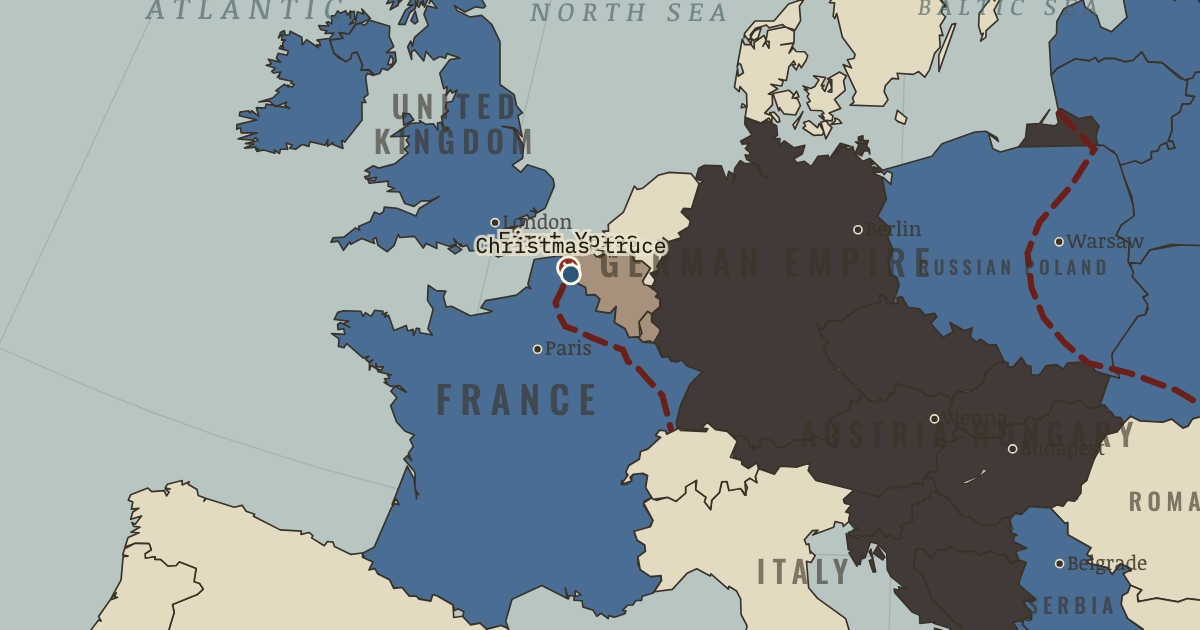
The dashed line on the map runs about seven hundred kilometres from the North Sea to the Swiss border, and it stayed almost fixed because defensive firepower had grown stronger than battlefield movement. Machine guns, barbed wire and artillery could break an exposed attack before it crossed the open ground between the trenches. Railways then allowed a defender to bring reserves to a threatened sector far faster than infantry could advance across shelled and broken earth. The combination locked the front in place for years.
The short answer
- Firepower outran mobility by a generation. Between 1870 and 1914 firepower multiplied — magazine rifles, machine guns, recoil-absorbing artillery — while battlefield mobility stayed at horse and boot, and battlefield command at whistle, runner and cuttable wire. Armies could tear holes but not move through them faster than the enemy could seal them. The internal-combustion answer (tank, truck, ground-attack aircraft) existed by 1918 only; the gap between those dates is the trench war.
- The defender’s railway advantage. The Western Front sat in Europe’s densest rail country, and lateral lines let a defender shift a division overnight. The attacker’s advance destroyed the very infrastructure he needed to continue — roads shelled by his own barrage, rail gauges to convert, ammunition hauled by horse over a moonscape. Success was self-limiting: the deeper you broke in, the weaker you got and the stronger the defense grew.
- Density: no flanks to turn. In the west, millions of men held 700 km — enough to be strong everywhere. Compare the Eastern Front on this map: twice the length, similar numbers, so it bent and swung in ways the west never could. Deadlock was not universal law but force-to-space ratio; where density fell (Palestine, Macedonia in 1918), maneuver returned.
- Attack anyway: the political imperative. Germany stood on French and Belgian soil; no French government could sit still, and coalition politics demanded offensives to relieve allies — Verdun pulled British attacks, Russia’s straits pulled Gallipoli. Many bloody offensives were less military judgment than alliance payments. Judge the generals inside that constraint, then judge the ones who refused to learn inside it too.
THE TURNING POINT
First Ypres, October–November 1914. The last chance of open warfare in the west dies in Flanders: the outnumbered BEF’s regulars — riflemen so fast the Germans reported machine guns — stop the final German drive for the Channel ports and are effectively destroyed doing it. When the fighting gutters out in the November rain, the line is continuous from sea to Alps. The door has shut; the siege of Europe begins.
What it changed
Attrition becomes the strategy. If the line cannot be broken, kill the men holding it faster than they are replaced: 1916 makes this explicit doctrine at Verdun and the Somme. The war’s center of gravity moves from the map to the census and the factory ledger.
The siege workshop. Deadlock breeds innovation on a monstrous scale: poison gas (Chapter 6), mining and counter-mining, aerial photography and sound-ranging, creeping barrages, and at last the tank — each a key tried against the same lock, each answered within months. The 1918 combination that finally works is assembled from these failures.
Total war reaches home. Holding the line consumed nations: conscription spread (Britain, the volunteers’ nation, adopted it in 1916), women entered war industry by the million, food was rationed, dissent policed. The distinction between soldier and civilian — already dying at Louvain — eroded everywhere. Remember this when the blockade chapter asks who a legitimate target is.
The full answer, argued
Hold two truths at once. Real incompetence and callousness existed — commanders who repeated failed methods for years, staffs that never saw the mud. But the caricature explains nothing: every army on every front, brilliant or stupid, produced the same deadlock, because the problem was structural — firepower without mobility, offense politically mandatory. And the armies demonstrably learned: compare the Somme’s first day to the BEF’s 1918 all-arms method (Chapter 12). The fair question for any commander is not “did men die for meters?” but “did he adapt at the speed the evidence allowed?” Some did; some did not; the system guaranteed the tuition would be paid in lives either way.
An interesting fact
The Christmas truce of 1914 was real — and it was a patchwork, not a miracle of the whole front: mostly British and German sectors around Ypres, while elsewhere the shelling never paused. Letters home describe carols answered across no-man’s-land, joint burial parties, swapped buttons and tobacco — and football, though the famous organized match with its 3–2 score rests on thin, secondhand testimony; what the evidence firmly supports is a few improvised kickabouts. The high commands took no chances the next year: Christmas 1915 brought orders threatening courts-martial (a Scots Guards captain actually faced one) and artillery shoots timed for the day itself.
This is the study layer of Trench warfare on the Western Front, chapter 5 of The Great War, 1871–1923; the full index of the atlas is here.
Related questions
THE FREE PRINTABLE STUDY GUIDE
Join the Dispatch — a short welcome series, then a letter when a new atlas opens — and the printable study guide for WWI is yours now, free.
NO TRACKING · YOUR ADDRESS IS USED FOR THE DISPATCH AND NOTHING ELSE · UNSUBSCRIBE ANYTIME