WWI · JUL 1914
Was WWI an accident or a choice, and who was to blame?
The seminar question: “Was the First World War an accident, a choice — or both? Who, if anyone, was to blame?”
After the assassination at Sarajevo on 28 June 1914, Austria-Hungary resolved to crush Serbia and Germany gave it unconditional backing, the so-called blank cheque. Russia mobilized to shield Serbia, Germany declared war on Russia and France, and its troops crossed into Belgium on 4 August, which brought Britain into the war.
Chapter 3 is part of membership. WW2 is free — every chapter. Try chapters 1–2 of any 2 other atlases (3 with a free account). Opening a new atlas uses one of them. Membership opens all 21 — Join.
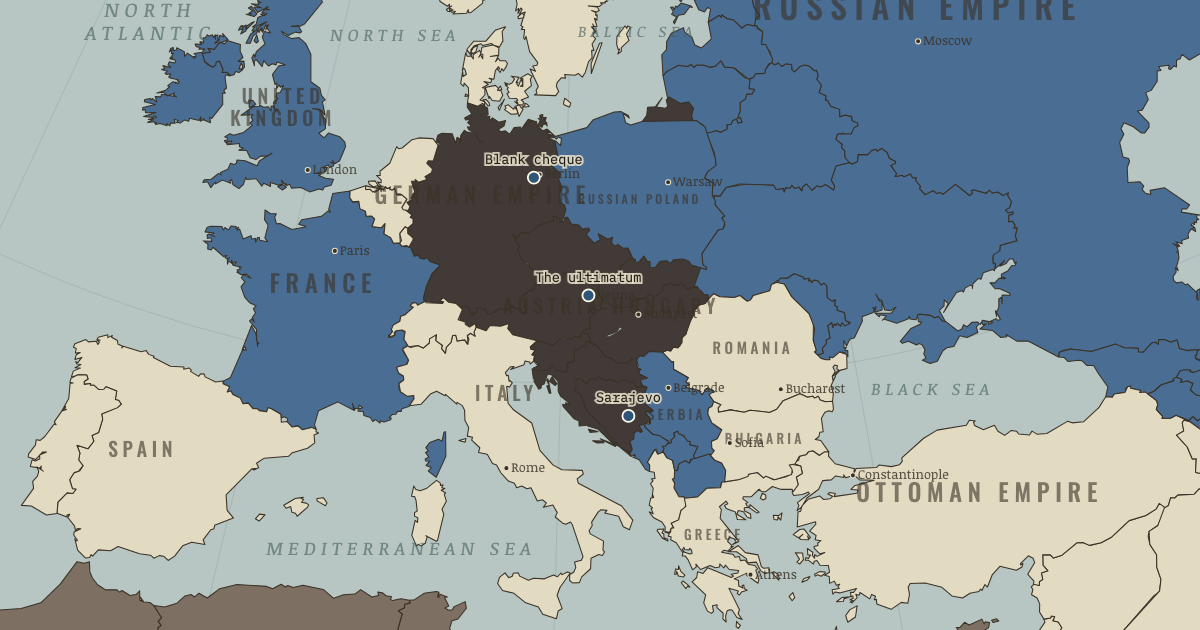
Europe entered the crisis already divided into two armed camps, yet the alliances did not go to war on their own, because at each stage a government had to choose. Austria-Hungary decided to use the assassination of the heir to its throne as the occasion to break Serbian power for good, since it saw Serbian-backed nationalism as a threat to its own survival. Germany gave Vienna unconditional backing, the so-called blank cheque, which encouraged a hard line. Russia then ordered mobilization to deter Austria-Hungary and shield Serbia, a fellow Slavic state whose defeat would leave Russia weaker in the Balkans. Each of these decisions was a deliberate act rather than an automatic reflex of the alliance system.
The short answer
- The alliance machine. Bismarck built alliances to isolate crises; his successors built ones that connected them. By 1914 a Balkan quarrel mechanically summoned five great powers: Austria could not punish Serbia without Russia, Russia could not face Austria without Germany intervening, Germany could not fight Russia without first — by plan — attacking France. The system designed to deter war transmitted it instead.
- Timetables as destiny. Every staff believed the next war would be won by whoever concentrated first; Germany’s Schlieffen Plan needed France beaten in six weeks before Russia’s slow mobilization arrived. That meant Germany literally could not wait out a Russian mobilization — military logic overrode diplomacy in the exact days when diplomacy needed time. “Mobilization means war” was not a metaphor; it was the operating system.
- Austria-Hungary’s existential fear. The Dual Monarchy — eleven nationalities under one aging emperor; note on this map how much of it is not Austria or Hungary — saw South Slav nationalism, sponsored from Belgrade, as a mortal disease. Vienna wanted a local war to destroy Serbia while it still could. The assassination was the pretext; the policy was pre-existing.
- Germany’s closing window. Berlin’s planners watched Russia’s French-financed railways and expected to be unbeatable no longer after 1917. A strong current in the leadership reasoned: if war with Russia is coming, better now. Historians still argue how deliberate this was — the Fischer thesis says very; others see reckless brinkmanship that expected Britain to stand aside. Either way, Berlin chose escalation at every branch.
THE TURNING POINT
Sarajevo, 28 June 1914. The assassination itself nearly failed — a bomb missed in the morning, and Princip got his chance only because the Archduke’s driver took a wrong turn past the café where he stood. Contingency at its purest: the shot did not make the war, but it handed a war party in Vienna the one pretext that could set the machine running.
What it changed
The dominoes fall in one week. Between 28 July and 4 August five empires declare war in a chain none of them controls. Watch the next chapter’s arrows: the first consequence of a Balkan murder is a German army group wheeling through Belgium, 1,500 km from Sarajevo.
Britain comes in — over Belgium. The Cabinet was split until German troops crossed the Belgian border; “the scrap of paper” of 1839 gave the interventionists their cause and the public its story. With Britain came the Royal Navy, the City’s credit, and eventually the empire you can see on the world map — a quarter of humanity.
The short-war illusion. Crowds cheer in every capital (less universally than legend says); soldiers expect to be “home before the leaves fall.” The belief was load-bearing: no government would have marched knowingly into fifty-one months. Chapter 5 shows the machine that made them all wrong.
The full answer, argued
The great historians’ quarrel. The “sleepwalkers” reading stresses the machine: alliances, timetables and misread signals produced a war nobody wanted at that scale. The Fischer school answers with documents: Vienna wanted a Balkan war, and Berlin knowingly risked — some say sought — a continental one while its window was open. A fair verdict distinguishes levels: the system made escalation easy, but specific men in Vienna and Berlin chose escalation at each branch point, and Russia’s early general mobilization shortened everyone’s fuse. The transferable lesson is uncomfortable: deterrence systems that reward moving first convert crises into wars — a lesson the nuclear age relearned with different arithmetic.
An interesting fact
The archduke’s car survives — a Gräf & Stift double phaeton, parked today in Vienna’s Museum of Military History beside Franz Ferdinand’s bloodstained tunic. Its number plate reads A III 118, which later visitors could not resist parsing as Armistice, 11-11-18 — pure coincidence, but the kind history seems to plant on purpose. And in the crisis’s last days the Kaiser and the Tsar — cousins who signed themselves “Willy” and “Nicky” — traded a final flurry of telegrams, in English, each begging the other to stop a machine both had already set running.
This is the study layer of July Crisis and outbreak of WWI, chapter 3 of The Great War, 1871–1923; the full index of the atlas is here.
Related questions
THE FREE PRINTABLE STUDY GUIDE
Join the Dispatch — a short welcome series, then a letter when a new atlas opens — and the printable study guide for WWI is yours now, free.
NO TRACKING · YOUR ADDRESS IS USED FOR THE DISPATCH AND NOTHING ELSE · UNSUBSCRIBE ANYTIME