WWI · MAY 1917
Was WWI a European civil war with global casualties?
The seminar question: ““A European civil war with global casualties” — is that a fair description of 1914–18?”
The war became global because Europe’s powers ruled empires that supplied soldiers, labourers and porters from Africa, Asia, the Pacific and the Americas. Japan seized German possessions in China and the Pacific, and Britain backed the Arab Revolt while secretly agreeing the Sykes–Picot division of the same lands with France.
Chapter 9 is part of membership. WW2 is free — every chapter. Try chapters 1–2 of any 2 other atlases (3 with a free account). Opening a new atlas uses one of them. Membership opens all 21 — Join.
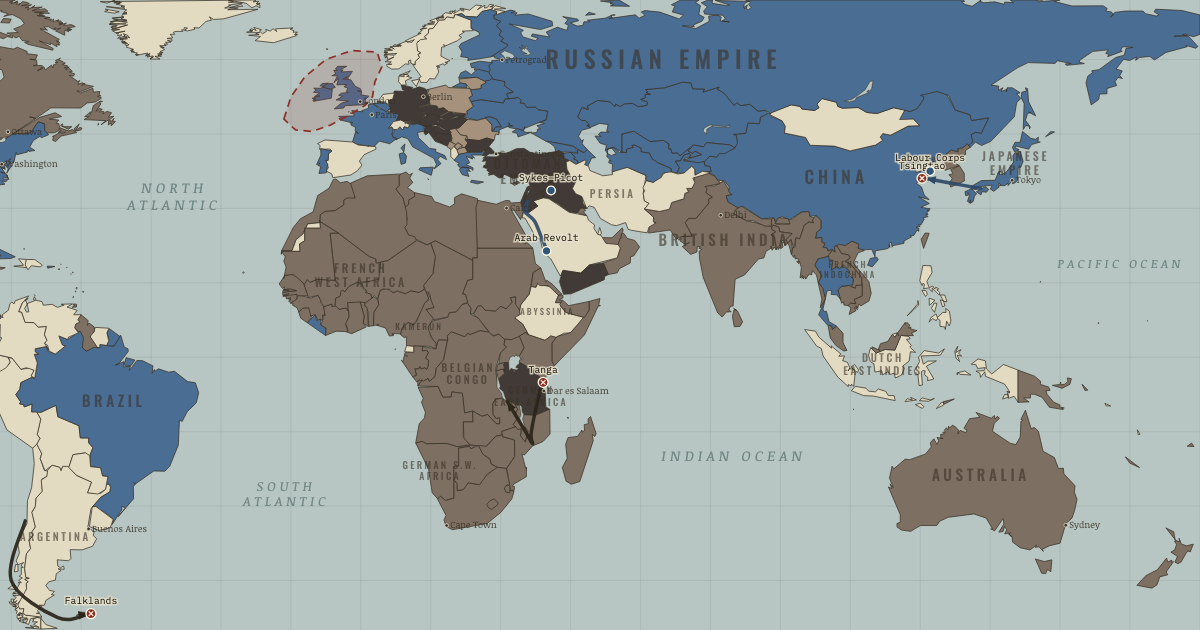
The war became global because the European powers ruled empires, and those empires supplied the men and materials that kept the fighting going. Millions of soldiers, labourers and porters from Africa, Asia, the Pacific and the Americas sustained campaigns they had never chosen to join. India furnished the largest volunteer army yet raised, while the deaths of African porters were enormous but poorly recorded. Japan seized German possessions in China and the Pacific at little cost to itself, and imperial forces fought long campaigns across Africa.
The short answer
- Empires wage war with empires. Why was a European war global on day one? Because its belligerents were not countries but systems: shipping lanes, coaling stations, colonial armies, cable networks. Britain’s first offensive acts of the war included cutting Germany’s undersea cables and hunting its commerce raiders in the Pacific. The colonies were not asked; legally most were simply at war the moment London or Paris was. On this map, sovereignty is the exception.
- Japan’s calculated loyalty. Tokyo honored the 1902 alliance with unusual speed because the price was self-set: Germany’s Chinese port, the Marianas, Carolines and Marshalls — a Pacific empire for six weeks’ siege work. Then, with Europe distracted, the Twenty-One Demands (1915) tried to make China a protectorate. The Great War is chapter one of the Pacific war of 1941: the islands Japan took in 1914 are the ones America stormed in 1944.
- The double promise. The McMahon–Hussein letters (1915–16) promised Arab independence in language whose exclusions are still argued; Sykes–Picot (May 1916) drew French and British zones straight through it; the Balfour Declaration (Nov 1917) promised a Jewish national home in Palestine as well. Each pledge made wartime sense — raise a revolt, bind an ally, court opinion. Together they were unkeepable, and everyone signing knew enough to know it. The modern Middle East’s founding documents are a war expedient in triplicate.
- Lettow’s method — and its price. Lettow-Vorbeck understood he could not win, only cost: every month his few thousand kept a hundred thousand imperial troops, ships and porters occupied was a month they were not in France. Brilliant economy of force — paid almost entirely by Africans: requisitioned crops, burned villages, and porter deaths in six figures. The campaign colonial romance remembers as a gentleman’s safari was, for East Africa, a famine with front lines.
THE TURNING POINT
The double promise, 1916. Between January and May 1916, Britain committed itself to Arab independence and to partition with France over the same territory. It is this atlas’s cleanest example of a turning point that moves no army: when the Ottoman Empire falls (Ch. 12), these incompatible papers — plus Balfour’s — become the operating system of the modern Middle East. Mandates, revolts, borders drawn in straight lines: the war after the war starts here.
What it changed
The empires lose their aura. A generation of colonial soldiers saw Europeans die badly, take orders, and depend on colonial labor and loyalty. Wilson’s “self-determination” and Lenin’s anti-imperialism gave the experience a vocabulary. 1919 answers: Egypt rises, India’s Amritsar massacre kills the liberal empire’s credibility, the May Fourth movement remakes Chinese politics when Versailles hands Shandong to Japan. Decolonization’s timetable was set in this war, even if the departures took another forty years.
Mandates: empire, renamed. The victors did not free the German and Ottoman territories; they distributed them as League of Nations “mandates” — trusteeships with report cards. Watch the world map at the end: the grey-tan actually grows. The gap between the war’s liberation rhetoric and its property settlement radicalized a century of nationalists, from Cairo to Hanoi (a young kitchen worker named Ho Chi Minh petitioned at Versailles, and was not received).
Soldiers of empire, remembered late. The Indian Army’s 74,000 dead, the tirailleurs at Verdun, the Chinese laborers clearing battlefields into 1920, the African porters without graves — imperial memory kept them footnotes for most of a century. Their service and its non-reward is not a sidebar to this war; for most of the world’s population, it was the war.
The full answer, argued
It captures something real: the war’s causes were European, its decisive fronts were European, and the rest of the world was largely conscripted into it through imperial ownership. But push back with this map. For Japan and its neighbors this was a Pacific power transition, not Europe’s quarrel. For the Ottoman lands it was an imperial collapse with local wars — Arab revolt, Armenian genocide, Anatolia’s partition — whose stakes were entirely their own. For India, Africa and Indochina it was the event that turned abstract subjecthood into blood tax, and so began the end of the empires themselves. Perhaps the fairest formula: a European war that could only happen at world scale because Europe owned the world — and that, in fighting it, broke the ownership. Which is why the “world” in its name grew truer every year after 1918.
An interesting fact
Lettow-Vorbeck’s askari were finally paid — in 1964. The West German Bundestag voted funds to honor the Kaiser’s unpaid wages, and a pay table was set up at Mwanza on Lake Victoria; most of the elderly veterans had no papers, so each claimant without one was handed a broom and put through the German manual of arms — none, the account runs, failed the test. It was one small settled debt in an imperial ledger otherwise left open: the African porters, dead in the hundreds of thousands, had no line in it at all.
This is the study layer of WWI outside Europe, chapter 9 of The Great War, 1871–1923; the full index of the atlas is here.
Related questions
THE FREE PRINTABLE STUDY GUIDE
Join the Dispatch — a short welcome series, then a letter when a new atlas opens — and the printable study guide for WWI is yours now, free.
NO TRACKING · YOUR ADDRESS IS USED FOR THE DISPATCH AND NOTHING ELSE · UNSUBSCRIBE ANYTIME