WWI · JAN 1917
Was the British blockade more moral than the U-boat war?
The seminar question: “Both blockades starved civilians to force a government’s hand. Is there a defensible moral line between the British blockade and the U-boat campaign?”
Britain used its command of the sea to cut Germany off from imported food and raw materials, a slow blockade that contributed to severe civilian hunger. The fleets met in full only at Jutland in 1916. Germany’s unrestricted submarine warfare of 1917 was blunted by convoys and helped bring the United States into the war.
Chapter 8 is part of membership. WW2 is free — every chapter. Try chapters 1–2 of any 2 other atlases (3 with a free account). Opening a new atlas uses one of them. Membership opens all 21 — Join.
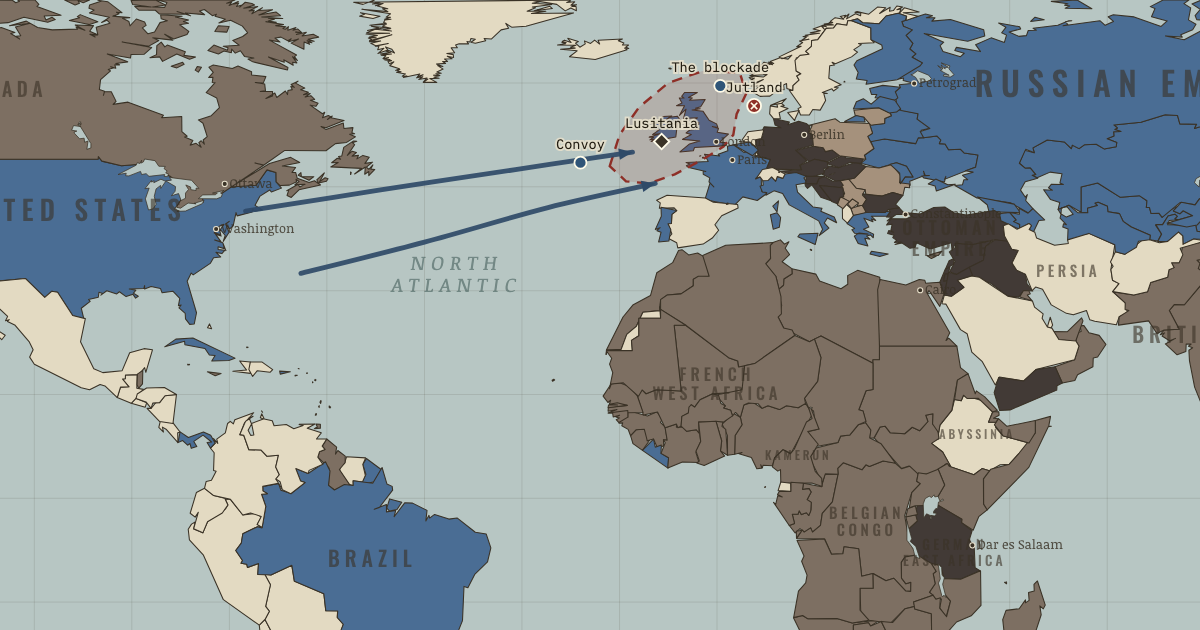
On the world map, Britain controls the exits from the North Sea and uses that control to restrict Germany’s overseas trade. The blockade steadily reduced German access to food, fertilizer and raw materials, working slowly and contributing to severe civilian hunger. Estimates of how many Germans died of blockade-related causes remain disputed, but the reality of the deprivation is not in doubt.
The short answer
- Why Germany built a fleet it couldn’t use. Tirpitz’s “risk fleet” was meant to be dangerous enough that Britain would concede colonies and neutrality rather than fight. It achieved the opposite: it identified Germany as Britain’s existential rival, drove Britain into ententes with France and Russia, and then — too small to win, too precious to lose — spent the war at anchor while its idle crews incubated the mutiny of 1918 (Ch. 13). A procurement decision as a first cause of the war’s alignments: navies are diplomacy in steel.
- The blockade’s legal fiction. Britain stretched “contraband” to cover food and stopped neutral ships wholesale, paying in American irritation but cash-settling claims; distance made it bloodless to watch. The U-boat could not stop and search — its only weapon was sinking. The two blockades killed by the same logic (cut the enemy’s inputs), but one drowned neutrals visibly. The Lusitania’s 1,198 dead (marked here) did more to define “Hun barbarism” in American eyes than three years of the hunger blockade did in any direction — a study in how morality tracks visibility.
- Holtzendorff’s spreadsheet. The 1917 decision was made against the Chancellor’s judgment, on a staff study: X tons sunk, Y neutral tonnage frightened off, Britain’s grain reserve Z weeks — therefore victory in five months, “before a single American soldier sets foot on the continent.” Every input was individually defensible; the model just omitted the enemy’s countermoves (convoy, rationing, American shipyards). It is the war’s purest case of quantified wishful thinking — precision mistaken for truth.
- Why convoy waited three years. The Admiralty resisted convoy with reasons that sounded technical — merchant skippers can’t keep station, ports will congest, escorts are “defensive” — and were really doctrinal: the navy of Nelson hunted enemies, it did not shepherd freighters. The fix required outsiders’ statistics (junior officers and a civilian ministry showed the “weekly 5,000 sailings” figure was inflated 20-fold) and prime-ministerial pressure. Institutions defend their self-image longer than their interests; the sea war’s decisive innovation was a management decision.
THE TURNING POINT
Convoy adopted, May 1917. Within six months of the first escorted convoys, shipping losses fall by two-thirds while U-boat sinkings double: the same ocean, the same boats, a different system. Germany’s five-month clock had been exactly wrong — Britain did not starve, and the declaration’s one irreversible effect, American belligerency, now compounds monthly. If the war has a single cleanest lesson in strategy, it is this pairing: the gamble that ignored countermoves, and the countermove that ended the gamble.
What it changed
America in. Unrestricted sinking plus the Zimmermann telegram (Berlin inviting Mexico to attack the United States — intercepted by British codebreakers and gleefully published) ends American neutrality on 6 April 1917. What it changes first is not soldiers but solvency: the Entente was nearly out of dollars and credit; now the loans, steel, wheat and shipping are unlimited. The soldiers — two million by late 1918 — are the second installment.
The hunger that outlasted the guns. The blockade continued after the armistice, through the winter of 1918–19, as leverage on the Versailles signature. German memory fused “hunger blockade” and “dictated peace” into one grievance; the next German regime planned autarky and conquest of grain lands explicitly against a repeat. Weapons aimed at civilians teach civilian lessons.
A rulebook written in wrecks. Prize law, submarine ethics, the targeting of food — the sea war of 1914–18 posed every question the next century’s total wars would answer worse. Note for the exam of history: in 1939–45 every navy, including the democracies’, adopted unrestricted submarine warfare from day one. What 1917 made scandalous, 1941 made standard.
The full answer, argued
Try the distinctions in turn. Method: stop-and-divert versus sink-on-sight — real, but it tracks capability, not virtue; Britain could afford the gentler method because it had the surface fleet. Visibility: drowned passengers versus rickets statistics — morally arbitrary, yet it governed world opinion. Legality: both sides stretched or broke prize law; Britain’s food-as-contraband was an innovation too. Proportion and intent: both aimed at the enemy’s war-sustaining economy knowing civilians would pay first. An honest answer probably lands here: the difference is one of degree and optics more than kind — which is exactly why the century that followed regulated neither out of existence, and why “economic weapons kill quietly” remains a live question from sanctions debates to siege warfare today. Moral clarity about slow weapons is this chapter’s hardest exercise.
An interesting fact
By 1917 Britain was painting its merchant ships like cubist canvases. “Dazzle” camouflage — the marine painter Norman Wilkinson’s idea — never tried to hide a ship, which is impossible against the horizon; it tried to break up her outline so a U-boat captain, judging course and speed by eye in the seconds a periscope dares stay up, would set his torpedo’s angle wrong. More than two thousand British ships wore it by the armistice; the Admiralty’s own statistics on whether it worked came back ambiguous, but crews and insurers believed — and Picasso, seeing camouflage in wartime Paris, is said to have claimed the credit for cubism: “It is we who created that.”
This is the study layer of Blockade and U-boat war in WWI, chapter 8 of The Great War, 1871–1923; the full index of the atlas is here.
Related questions
THE FREE PRINTABLE STUDY GUIDE
Join the Dispatch — a short welcome series, then a letter when a new atlas opens — and the printable study guide for WWI is yours now, free.
NO TRACKING · YOUR ADDRESS IS USED FOR THE DISPATCH AND NOTHING ELSE · UNSUBSCRIBE ANYTIME