WWI · AUG 1918
Could any German strategy have won WWI in 1918?
The seminar question: “Germany’s spring offensives are often called tactically brilliant and strategically bankrupt. Could any German strategy have won in 1918 — or was the only winning move not to play?”
Germany launched Operation Michael on 21 March 1918, and its stormtroopers broke the British Fifth Army, but its offensives outran their supplies and never split the Allies. From Amiens on 8 August, Allied artillery, tanks, aircraft and infantry advanced together, and by late September Ludendorff was demanding an armistice.
Chapter 12 is part of membership. WW2 is free — every chapter. Try chapters 1–2 of any 2 other atlases (3 with a free account). Opening a new atlas uses one of them. Membership opens all 21 — Join.
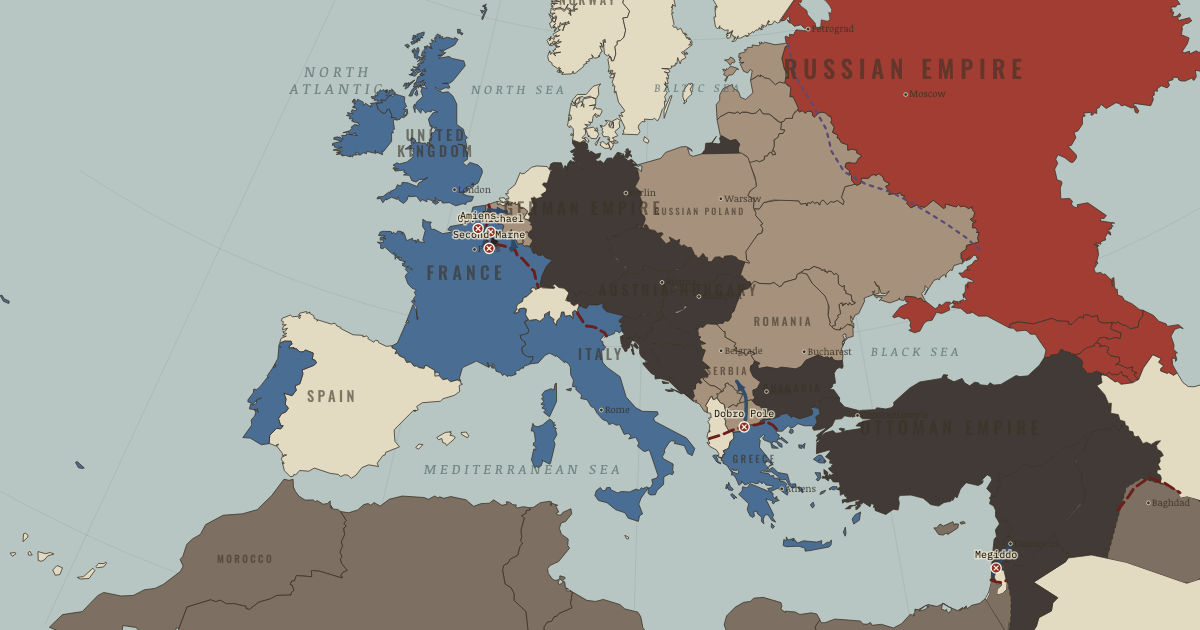
Operation Michael opened on 21 March with a short, intense bombardment. The stormtroopers moved around the strongpoints and broke the front of the British Fifth Army, and Germany advanced farther than it had since 1914. The advance then outran its artillery, food and ammunition, and the later offensives repeated the same pattern. They won large salients on the map but never split the Allies apart or captured an objective that would decide the war.
The short answer
- Why the trench finally broke. By 1918 both sides had solved break-in: predicted artillery fire (no registration, no warning), infiltration or armor to cross the zone, air observation, platoon-level command. What Germany lacked was the second half — exploitation: no tanks worth the name, cavalry dead, trucks few, horses starving. What the Allies had by August was exactly that half: mechanical mobility, unlimited shells, and the operational patience to stop and re-strike. The deadlock (Ch. 5) was a technology gap; 1918 is what its closing looks like from both directions.
- Ludendorff’s strategic vacuum. Asked for Michael’s objective, Ludendorff answered: “We chop a hole. The rest follows.” Each offensive aimed where the line was softest, not where the enemy would break — the bulges won kilometers of shelled mud and lengthened Germany’s own front by 120 km, garrisoned by its bled-out best. Compare Foch’s Hundred Days: no hole chopped anywhere mattered less than the system of holes. It is the war’s final exam in the difference between tactics and strategy, and Germany failed it with its finest tactical instrument.
- The American weight, actual and virtual. Doughboys fought well and greenly (Belleau Wood, Saint-Mihiel, the Meuse–Argonne — America’s deadliest battle ever, 26,000 dead); but the decisive American contribution in 1918 was arithmetic and morale: 10,000 arriving daily meant every German loss was final and every Allied loss replaceable. Ludendorff’s gamble had been to win before this mattered; from July, every German soldier could see it mattering. Armies calculate; then they conclude — and surrender rates after Amiens show the conclusion.
- The soft fronts were structural. Bulgaria’s army had been on half-rations for a year opposite a reinforced Salonika force; Ottoman manpower was spent (and partly redirected to the Caucasus after Russia collapsed); Austria-Hungary was starving at home and deserting by nationality. The “sideshows” didn’t fold because the periphery was attacked harder in 1918 — they folded because blockade, attrition and imperial overstretch had finished their work everywhere at once. The Western Front broke the German army; the whole war broke the coalition.
THE TURNING POINT
Amiens, 8 August 1918. Not the deepest advance of 1918 — but the day the German army stopped believing. Units yelled “strikebreaker!” at reinforcements; 15,000 men surrendered in hours to an attack they never heard being prepared. Ludendorff’s verdict — the war must be ended — dates from this morning. Battles are decided in minds: the Allies’ new method had made German defeat feel, for the first time on the Western Front, mechanical and certain.
What it changed
Five weeks, three armistices. Bulgaria (29 September), the Ottomans (30 October), Austria-Hungary (3 November — its emperor’s peoples already declaring independence behind it): the coalition collapses outside-in, each exit exposing the next neighbor. Germany’s generals had always said the alliance was a corpse chained to them; in autumn 1918 the chain pulled. Chapter 13 is Germany alone.
The birth of modern battle. Amiens’ grammar — combined arms, surprise by calculation, sequenced blows along a broad front — is the twentieth century’s military template: study it and you can read 1939, 1944, 1991. The men who wrote it (Monash, Currie, Fuller; and the Germans who studied their own stormtroop half) taught the next war on both sides. The Western Front’s last lesson was how to make war move again — humanity would use it.
A defeat that fled the battlefield. Because the collapse came in a hundred days after four static years — and because the army retreated in order, and the armistice came before Allied troops stood on German soil — German civilians never saw the defeat. Ludendorff, who demanded the armistice, later helped launder the memory into the “stab-in-the-back”: the army betrayed by socialists, republicans, Jews. The gap between military reality and civic perception in November 1918 becomes the Weimar Republic’s birth defect.
The full answer, argued
Run the alternatives. Stand on defense, shortened line, and negotiate: militarily soundest — the Hindenburg Line held attacks well into 1918 — but “negotiate” founders on what Berlin would offer; the regime that had just written Brest-Litovsk would not trade Belgium, and the Allies, dollars flowing and Americans landing, had decreasing reason to deal. Attack narrower but smarter — at the French, at supply hubs like Amiens or Hazebrouck from the start: perhaps prolongs the war, still meets the same arithmetic. Attack as done: a million casualties for salients. The honest answer is that 1918 was decided in 1917 — by the U-boat gamble that added America, and at Brest-Litovsk, which made compromise unbelievable. After those, Germany’s military choices could only select the shape of defeat: quick by offensive exhaustion, or slow by siege. The transferable lesson is severe: operational brilliance cannot repair a bankrupt grand strategy — it can only spend the remaining assets faster.
An interesting fact
Through the spring offensives Paris was shelled from 120 kilometers away. The Paris Gun — a Krupp freak with a barrel over thirty meters long — lobbed its shells forty kilometers high, the first man-made objects to reach the stratosphere, so high that the gunners corrected their aim for the rotation of the Earth beneath each three-minute flight. Militarily it was almost pointless; then on Good Friday, 29 March 1918, one shell collapsed the roof of the Saint-Gervais church onto the congregation, killing 88 — a third of the weapon’s entire toll in a single strike. The Germans spirited the guns home before the armistice and destroyed them; the Allies never found so much as a barrel.
This is the study layer of Spring Offensive and Hundred Days, chapter 12 of The Great War, 1871–1923; the full index of the atlas is here.
Related questions
THE FREE PRINTABLE STUDY GUIDE
Join the Dispatch — a short welcome series, then a letter when a new atlas opens — and the printable study guide for WWI is yours now, free.
NO TRACKING · YOUR ADDRESS IS USED FOR THE DISPATCH AND NOTHING ELSE · UNSUBSCRIBE ANYTIME