Ancient Rome · AD 396
Why did the Goths admitted in 376 sack Rome in 410?
The seminar question: “In 376 the Goths asked to join the empire; in 410 they sacked its capital. Locate the decisions in between that made the second event grow out of the first — and say which was the last real exit.”
In 376 Rome admitted Gothic refugees fleeing the Huns across the Danube, but corrupt officials starved and exploited them until they rebelled. At Adrianople on 9 August 378 the Goths destroyed an eastern army and killed Emperor Valens; Rome then settled them inside the empire as foederati, and in 410 the Goths sacked Rome.
Chapter 10 is part of membership. WW2 is free — every chapter. Try chapters 1–2 of any 2 other atlases (3 with a free account). Opening a new atlas uses one of them. Membership opens all 21 — Join.
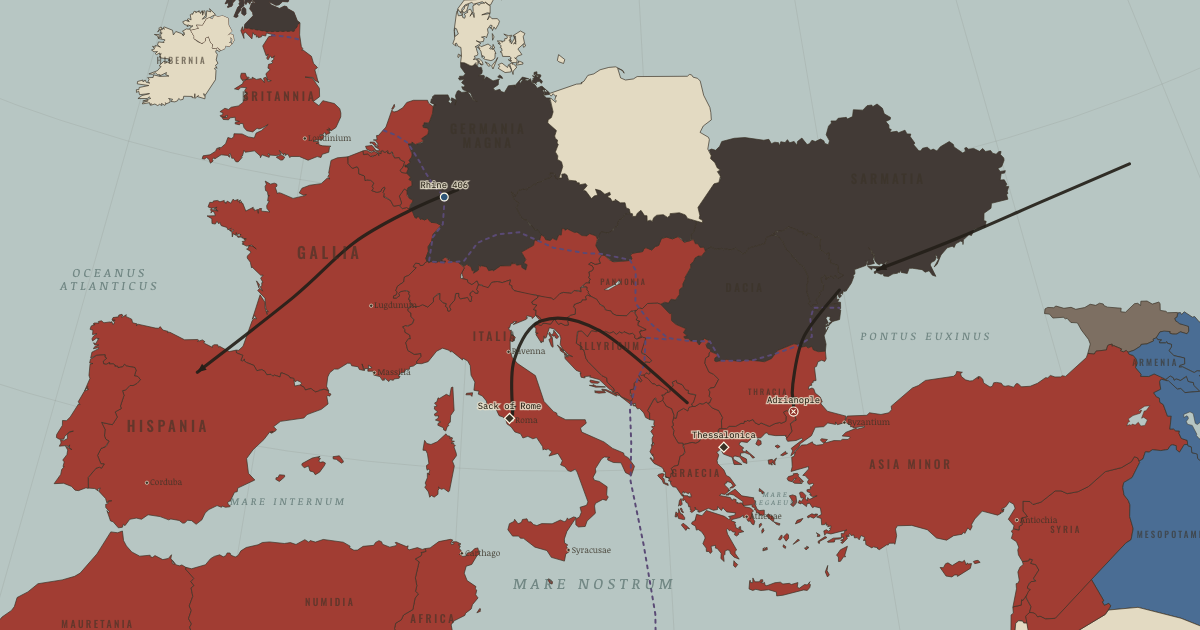
The people who appeared on the Danube in 376 came as refugees rather than as an invading army, and that distinction is the key to everything that followed. The Huns had broken the Gothic world to the north, and a whole Gothic people, perhaps a hundred thousand strong, asked the eastern emperor Valens for admission to the empire. Valens saw future taxpayers and soldiers, and let them cross. But Roman officials embezzled the food meant to feed them and exploited the starving newcomers so ruthlessly that revolt followed. What should have been a policing problem became a catastrophe at Adrianople on 9 August 378. Valens attacked without waiting for the western army, and the Goths destroyed roughly two-thirds of his field force and killed him. A contemporary called it the worst defeat since Cannae, and this time there was no reservoir of Italian allies to refill the ranks.
The short answer
- An exogenous shock: the Huns. Nothing in Roman policy caused the Huns, and the strongest modern account (Heather’s) rests on that: the fourth-century empire was strained but stable until an outside force compressed the entire barbarian world against its borders within one generation. The 376 crossing, the 406 crossing, and Chapter 11’s Attila are one causal chain from the steppe. Against this, internalists note that earlier Rome absorbed Cimbri, Marcomanni, Goths — shocks reveal states’ conditions rather than create them. Hold both: an avalanche needs a slope and a trigger.
- Adrianople’s real damage: the manpower ledger. The eastern field army lost at Adrianople was the empire’s strategic reserve, and — unlike the Republic of Cannae — the late empire had no citizen-militia base to regrow it: recruits were now bought, from taxes or from barbarians. The 382 federate treaty was thus not folly but arithmetic — Gothic spears were the only ones on sale. Every subsequent disaster follows the same equation: fewer taxpayers → cheaper army → barbarian soldiers → land concessions → fewer taxpayers. The fiscal death-spiral thesis of Chapter 11 begins its visible turns here.
- Civil war remained the first priority. Count what the arrows on this map were doing before they turned on the frontier: Theodosius marched the eastern army west twice (388, 394) against Roman usurpers, gutting the Rhine and Danube garrisons; the 406 crossing succeeded because the border was a paper line; Stilicho’s Italy stripped Britain and Gaul to defend Italy — manufacturing the usurper Constantine III. The old lesson of 235 in its terminal form: Rome consistently preferred losing provinces to losing power struggles, until the provinces were gone. That is not a barbarian achievement; it is a Roman choice, made annually.
- Integration refused. At every branching point — 376, 382, Alaric’s decade of offers — the cheapest stable outcome was full integration: make the Goths Romans, as Gauls and Spaniards and Illyrians had been made Romans for five centuries. It never happened: anti-barbarian court factions, religious difference (the Goths were Arian Christians), and the massacre of federate families in 408 kept them a people-in-arms inside the state. The Republic’s genius — turning the defeated into recruiters of loyalty — was the one Roman art the late empire forgot. When you judge Alaric at Rome’s gates, remember he spent fifteen years asking for a job.
THE TURNING POINT
Adrianople, 9 August 378. The military facts are grim but recoverable — Rome had lost whole armies before. What proved irreversible was the settlement: for the first time, a defeated-then-victorious foreign people was planted inside the frontier as a permanent armed polity under its own leaders, because Rome could no longer afford the alternative. The precedent priced every later crisis: why should Vandals, Sueves or Burgundians accept less than the Goths extracted? Ancient historians called Adrianople the beginning of the end and modern ones mostly demur — but as the moment the empire began paying rent on its own territory, the old verdict stands up disturbingly well.
What it changed
The West inherits the exposed half. The 395 division gave the East the short, fortress-anchored frontier (Constantinople, the straits) and two-thirds of the revenue; the West got the Rhine, the upper Danube, Britain, and Africa’s grain as its single fiscal anchor. Study the dashed line on your map as a balance sheet, not a border: every subsequent western catastrophe — 406, 410, 439 — happens on the poor half’s books. Chapter 11 is that balance sheet running out.
410 as an idea. The sack changed little materially — the court sat safe in Ravenna; Alaric died within months, his Goths marching on to Gaul — but ideas are also infrastructure. Pagans blamed the abandoned gods; Augustine’s answer, that no earthly city is God’s city, became the frame through which Latin Christendom understood politics for a thousand years. And every European power that ever sacked or feared for a capital has reached for 410 since. Some events’ chief consequences are the sentences written about them.
Britain: the control experiment. The one province abandoned intact (410) rather than conquered shows what the Roman package — towns, villas, coinage, literacy — did when the state beneath it vanished: within two generations, all of it collapsed, more completely than anywhere the barbarians actually ruled. Archaeology (Ward-Perkins’ pottery and coin horizons) uses Britain as the measure of what Rome had actually been holding up. Keep it in mind when Chapter 12 asks whether “transformation” or “fall” is the honest word.
The full answer, argued
Chart the branching points. 376: admission without integration — Valens wanted soldiers cheap, so the Goths crossed as a people, not as recruits (contrast the old practice of dispersing settlers among provinces). The crossing itself was defensible; the corruption that starved them was not policy but was tolerated, and revolt followed. 378: Valens’ refusal to wait for the western army — pure contingency, a hinge that pride chose. 382: the federate treaty — rational given the losses, fatal as precedent. 395–408: the decade of refused deals with Alaric, when a generalship and land would have converted the Goths into what Gauls had become; the court chose neither war nor peace, then murdered Stilicho and the federates’ families, welding Gothic grievance into Gothic unity. Most historians place the last real exit at 397–408: integration was still purchasable, at a price wounded Roman pride — an empire now weaker than its self-image — would not pay. The transferable lesson is uncomfortable and precise: the price of absorbing outsiders only rises, and states that discover this too late pay in capitals.
An interesting fact
Among the hostages the Goths carried out of Italy was the emperor’s own half-sister, Galla Placidia — and her afterlife rewrites the invasion story. In 414 she married the Gothic king Athaulf at Narbonne, in Roman dress, with a deposed Roman puppet-emperor singing the wedding hymn; Athaulf, a contemporary reports, had decided that Gothic arms should restore the Roman name rather than replace it. Widowed, ransomed back for 600,000 measures of grain, remarried to a Roman general, she ended as Augusta — regent of the Western empire for a dozen years and mother of its emperor: the captive of 410 governing what remained of the world that had failed to protect her.
This is the study layer of Adrianople and the sack of Rome, chapter 10 of The Rise and Fall of Rome, 264 BC – AD 476; the full index of the atlas is here.
Related questions
THE FREE PRINTABLE STUDY GUIDE
Join the Dispatch — a short welcome series, then a letter when a new atlas opens — and the printable study guide for Rome is yours now, free.
NO TRACKING · YOUR ADDRESS IS USED FOR THE DISPATCH AND NOTHING ELSE · UNSUBSCRIBE ANYTIME