American Civil War · APR 1861
Was Lincoln wrong to provoke the Fort Sumter crisis?
The seminar question: “Lincoln could have evacuated Sumter and bought time — many advisers urged exactly that. Was provoking the crisis a mistake?”
Between Lincoln’s election and his inauguration in March 1861, seven Deep South states seceded and founded a Confederacy whose constitution protected slavery. Lincoln chose to send only food to Fort Sumter in Charleston harbor; Confederate guns opened fire on 12 April 1861, and the Upper South then joined the Confederacy.
Chapter 3 is part of membership. WW2 is free — every chapter. Try chapters 1–2 of any 2 other atlases (3 with a free account). Opening a new atlas uses one of them. Membership opens all 21 — Join.
Free printable American Civil War study guide, sent by email ↓
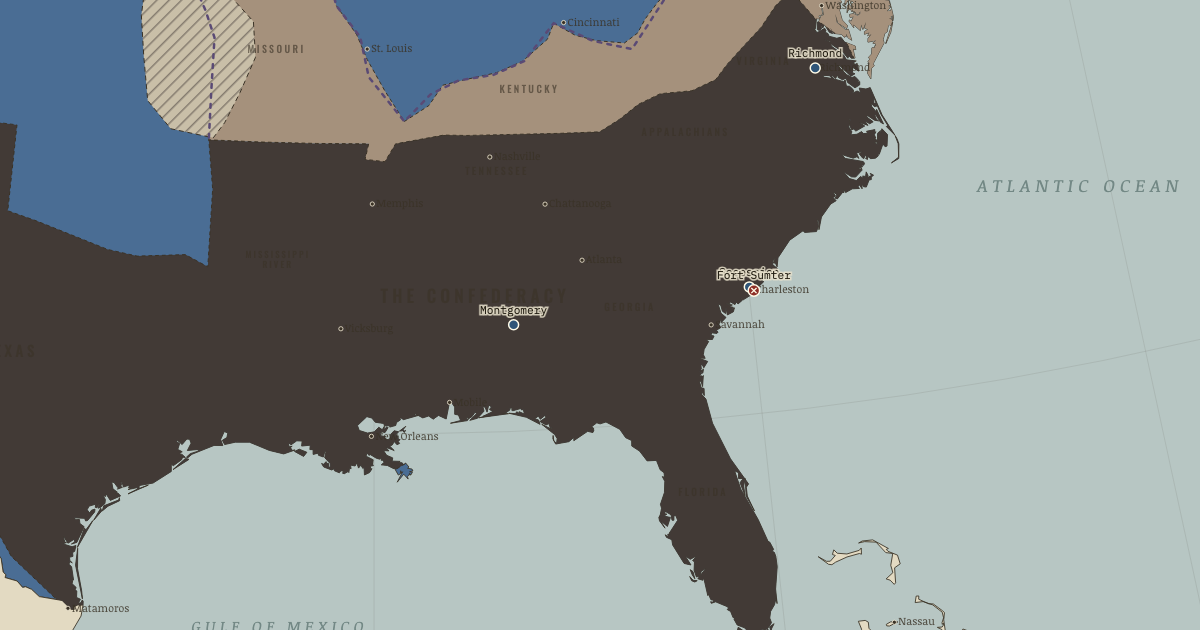
The long interval before Lincoln could take office is the first thing that shaped secession, because the Constitution then left a president-elect waiting until March. Buchanan held that secession was illegal and that the federal government was also powerless to prevent it, a doctrine that produced complete paralysis. Into that gap the Deep South acted: South Carolina and six other states seized federal arsenals and forts, met at Montgomery to write a constitution that guaranteed slavery, and made secession an accomplished fact. Lincoln refused the last great compromise, the Crittenden proposal, because it would have allowed slavery to expand, which was the single issue his election had settled.
The short answer
- A four-month vacuum of power. The Constitution then left presidents-elect waiting until March. Buchanan held that secession was illegal but that coercion was also illegal. A doctrine of perfect paralysis. Into that vacuum the Deep South organized a government, seized arsenals and forts, and made secession a fact before anyone in Washington could contest it. Institutional dead time is when revolutions happen.
- The secessionists’ own words. The ordinances and declarations are primary sources without ambiguity: Mississippi. “our position is thoroughly identified with the institution of slavery, the greatest material interest of the world.” Alexander Stephens, the Confederacy’s vice-president, called slavery the “cornerstone” of the new state. Later generations rewrote the cause. The founders of the Confederacy did not.
- Sumter as a designed dilemma. Lincoln’s resupply announcement transferred the decision to Charleston: fire on food, or watch the fort stand. Davis chose war partly because the Confederacy needed the upper South and believed a fight would bring it in. Which it did, at the price of making the Confederacy the aggressor in Northern eyes and uniting a divided North overnight. Both presidents got the war they expected. Only one got the opening he wanted.
- Why the border stayed. Lincoln suspended habeas corpus in Maryland, tolerated a rump legislature in Missouri, and famously kept hands off Kentucky’s declared “neutrality” until the Confederacy blundered first by occupying Columbus. “I hope to have God on my side,” he is said to have remarked, “but I must have Kentucky”. With it came the Ohio River line, Missouri’s rivers, and 400,000 white men of military age plus, later, tens of thousands of Black recruits.
THE TURNING POINT
Fort Sumter, 12–14 April 1861. The bombardment killed no one in combat and changed everything: it turned a constitutional dispute into a rebellion under fire, brought four more states into the Confederacy, and answered the only question that mattered. Would anyone actually shoot? After 34 hours in April, four years follow. Note the mechanism: wars often start where backing down has become more expensive than fighting, for both sides at once.
What it changed
The upper South flips — and doubles the war. Virginia brings the Tredegar Iron Works (the South’s only great foundry), Robert E. Lee, and a border on Washington itself. The capital moves to Richmond: two capitals a hundred miles apart will fix the war’s bloodiest axis. Watch chapters 6–9 happen almost entirely between those two dots.
West Virginia is born. Virginia’s mountain counties. Few enslavers, decades of grievance against a tidewater legislature that taxed their land and spent the money east. Refuse to follow Richmond. Delegates at Wheeling declare the secession ordinance void within weeks, set up a “Restored Government of Virginia,” and use its consent to carve out a new state: West Virginia enters the Union on 20 June 1863, its admission tied to a gradual-emancipation clause. The constitutional irony was named at the time. A government opposing secession midwived a secession from a state. And Lincoln accepted it as war necessity. The tan belt on your map through the Alleghenies is secession’s own secession.
The border war begins. Missouri gets a war within the war: Wilson’s Creek, then four years of ambush and reprisal in the hatched country on your map. Quantrill, “Bloody Bill” Anderson, and the Union’s Order No. 11 depopulating whole counties. It is the war’s dirtiest theater, and its veterans (the James brothers among them) will haunt the postwar West.
The full answer, argued
Weigh what “time” would have bought. Every week of drift legitimized the Confederacy: European consuls were already in Montgomery, and the border states were being courted hard. Evacuation would have surrendered the constitutional argument. That secession is void. Without firing a shot. Lincoln’s resupply scheme is best read not as provocation but as a forcing move that put the choice of war visibly on Davis, which is why it united the North and kept Britain cautious. The counter-argument: it also brought Virginia and three more states into the Confederacy, perhaps the costliest single consequence of the war. The lesson is uncomfortable: sometimes statesmanship is choosing which catastrophe you can win.
An interesting fact
The bombardment’s only death came after the fighting stopped. The surrender terms allowed Major Anderson a hundred-gun salute to his flag before the garrison marched out; on 14 April 1861, halfway through, a gun discharged prematurely and killed Private Daniel Hough, an Irish-born regular — the first soldier to die in a war that would kill more Americans than both World Wars combined. The salute was halted at fifty rounds; Anderson folded the flag and took it north, and would himself run it back up over the ruined fort four years to the day later.
This is the study layer of Secession crisis and Fort Sumter, chapter 3 of The American Civil War, 1840–1877; the full index of the atlas is here.
Related questions
THE FREE PRINTABLE STUDY GUIDE
Join the Dispatch — a short welcome series, then a letter when a new atlas opens — and the printable study guide for The American Civil War is yours now, free.
NO TRACKING · YOUR ADDRESS IS USED FOR THE DISPATCH AND NOTHING ELSE · UNSUBSCRIBE ANYTIME