American Civil War · JUL 1861
Why did Europe expect the Confederacy to win in 1861?
The seminar question: “The Union’s advantages were overwhelming on paper. Why did nearly every European observer in 1861 still expect the Confederacy to win?”
At Bull Run on 21 July 1861 untrained Union volunteers advancing on Richmond were routed, ending Northern hopes of a short war. The Union held large advantages in population, industry, railroads, finance and naval power, but the Confederacy needed only to survive until Northern voters tired of the cost.
Chapter 4 is part of membership. WW2 is free — every chapter. Try chapters 1–2 of any 2 other atlases (3 with a free account). Opening a new atlas uses one of them. Membership opens all 21 — Join.
Free printable American Civil War study guide, sent by email ↓
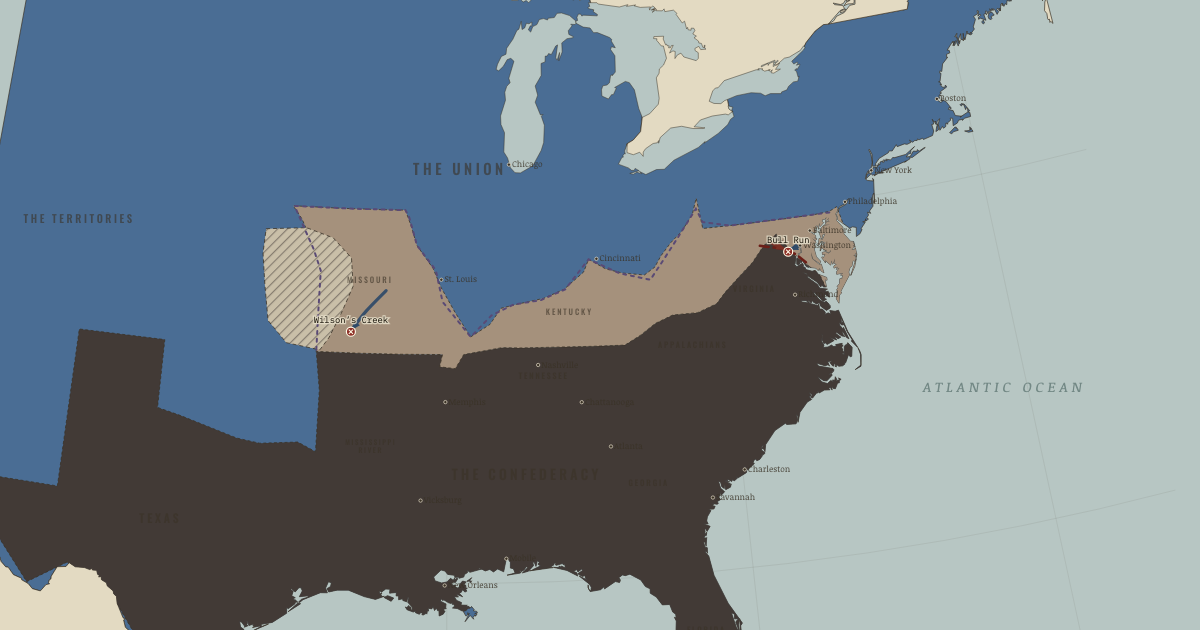
The illusions of a short war met their first test at Bull Run in July 1861, and the lesson lay less in the ground fought over than in what followed. Inexperienced Union troops advanced toward Richmond and collided with equally raw Confederate forces, and when Confederate reinforcements arrived by railroad, the Union line broke and the retreat turned disorderly. The battle changed planning far more than territory. Lincoln abandoned the ninety-day enlistments he had begun with and called for long-service armies, while the Confederacy drew confidence from a victory that solved none of its deeper shortages of men and material.
The short answer
- Ninety-day thinking. Each side reasoned from flattering myths: Northerners believed secession was a planter conspiracy that would collapse at the first defeat. Southerners believed one battlefield humiliation would make the shopkeeper North negotiate. Bull Run disproved the first within hours and seemed to confirm the second. The most dangerous kind of victory, teaching the winner the wrong lesson.
- Asymmetry of objectives. The Confederacy needed a draw. The Union needed conquest. Strategy follows: the South could stand on the defensive, trade space for time, and aim at Northern will. Its elections, its newspapers, its cotton-hungry European creditors. The Union had to project armies hundreds of miles down hostile railroads and rivers. Every later chapter. The blockade, the rivers, the marches. Is this asymmetry being worked out.
- Armies before soldiers. The United States began with a regular army of 16,000, mostly out West. Both sides improvised mass armies from scratch: elected officers, political generals, ninety-day regiments. Bull Run was not a battle of armies but of armed crowds. The four-year learning curve of officers like Grant, Sherman and Lee begins here, mostly in obscurity.
THE TURNING POINT
Bull Run, 21 July 1861. The defeat did the Union a service and the Confederacy a disservice: it destroyed Northern complacency while feeding Southern overconfidence in one afternoon. Lincoln’s response. Half a million long-service men, McClellan to build them, the blockade tightened. Is the true beginning of the war effort. Measure a state not by whether it is beaten but by what it does the following week.
What it changed
McClellan builds the weapon. The Army of the Potomac becomes a real army through the autumn. Drilled, equipped, devoted to the young general building it. The building is superb. The reluctance to risk his creation will become the Union’s central problem of 1862.
The West organizes. While the East digs in, the Union quietly wins the war’s preconditions along the border: Missouri held at Wilson’s Creek (follow the arrow), Kentucky’s neutrality ended by Confederate blunder, and an unglamorous brigadier named Grant occupying the river junctions at Cairo and Paducah. The doors to the Confederate heartland now stand ajar.
Cotton diplomacy fails its first test. The South embargoes its own cotton, certain that starving mills will force British recognition. But warehouses are full from bumper crops, Egypt and India can grow more, and Britain needs Northern wheat almost as much as Southern fiber. The “King Cotton” theory. The Confederacy’s entire foreign policy. Never recovers.
The full answer, argued
Because history sided with the defender: the American Revolution, Spain against Napoleon, and every recent war of national resistance suggested that a determined people on its own soil, needing only a stalemate, beats an invader who must conquer everything. Distance, disease and occupation costs usually devour material advantages. What the observers missed was threefold: rivers and railroads let the Union actually reach the Southern interior. The enslaved third of the Southern population was a hostile resource, not a loyal one. And Northern politics. Tested at the ballot box in 1862 and 1864. Proved more durable than aristocratic Europe believed democracies could be. The general lesson: material superiority predicts nothing until you ask whether it can be delivered, and whether the will to deliver it will survive its costs.
An interesting fact
Wilmer McLean could fairly claim the war pursued him. During the first fighting along Bull Run his farm served as a Confederate headquarters and a shell crashed into his kitchen; to put his family beyond the armies’ reach he moved to a quiet crossroads village in southside Virginia — Appomattox Court House — where in April 1865 Grant and Lee ended the war in his front parlor. His later boast, “the war began in my front yard and ended in my front parlor,” is only a mild exaggeration; within an hour of the signing, Union officers had carried off his parlor furniture as relics — some paying, some not.
This is the study layer of First Battle of Bull Run, chapter 4 of The American Civil War, 1840–1877; the full index of the atlas is here.
Related questions
THE FREE PRINTABLE STUDY GUIDE
Join the Dispatch — a short welcome series, then a letter when a new atlas opens — and the printable study guide for The American Civil War is yours now, free.
NO TRACKING · YOUR ADDRESS IS USED FOR THE DISPATCH AND NOTHING ELSE · UNSUBSCRIBE ANYTIME