American Civil War · JUL 1862
Does the better general actually decide wars?
The seminar question: “Jackson in the Valley and Lee in the Seven Days beat larger armies repeatedly. Does “the better general” actually decide wars?”
In 1862 McClellan shipped the Army of the Potomac to the Virginia Peninsula and advanced slowly on Richmond, while Jackson’s Shenandoah Valley campaign tied down Union troops. Lee took command and attacked in the Seven Days battles of 25 June–1 July, drove McClellan back, then won at Second Bull Run.
Chapter 6 is part of membership. WW2 is free — every chapter. Try chapters 1–2 of any 2 other atlases (3 with a free account). Opening a new atlas uses one of them. Membership opens all 21 — Join.
Free printable American Civil War study guide, sent by email ↓
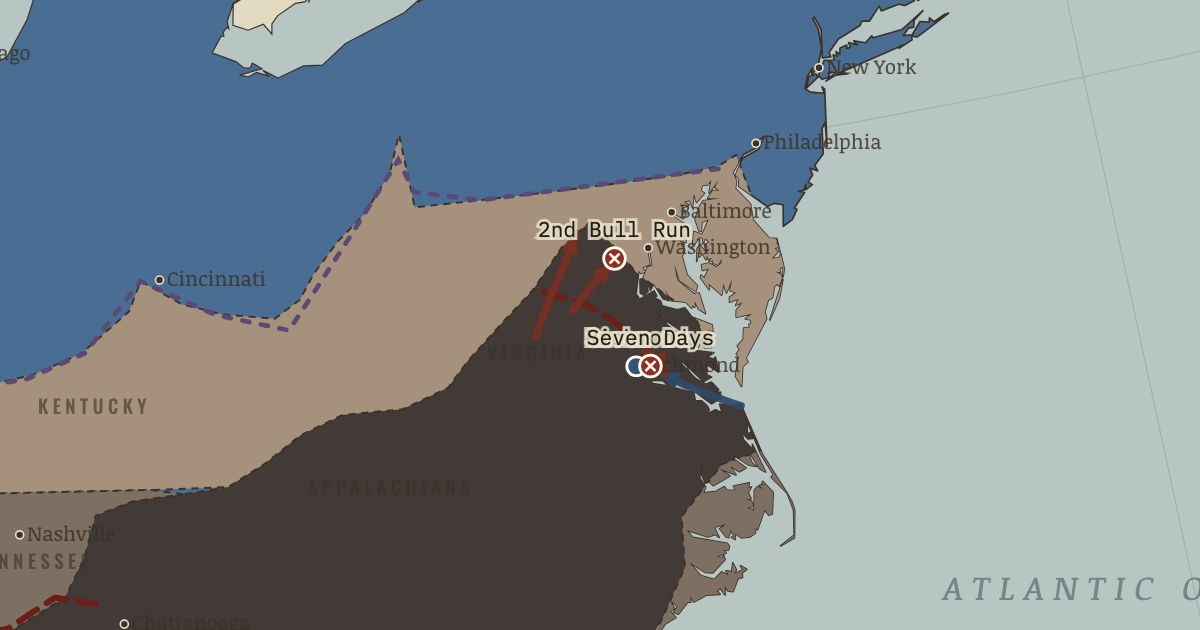
McClellan’s Peninsula campaign was designed to avoid a costly overland march by using the Union’s command of the sea. He built and supplied a great army with real skill, but his intelligence service consistently doubled the enemy’s true numbers, and his preference for a limited war of reconciliation reinforced his caution. By late May 1862 his men were close enough to hear Richmond’s church bells, yet he waited for reinforcements that Washington, suddenly fearful for its own safety, refused to send.
The short answer
- McClellan’s mathematics of caution. He commanded the largest army ever assembled in the hemisphere and believed himself always outnumbered. Pinkerton’s intelligence fed him figures double reality because that is what he asked for, another lesson in leaders hearing what they want. But his caution had a political root too: a Democrat who opposed emancipation, he wanted a tidy, limited war ending in reconciliation, and fought like it.
- Interior lines and the Valley. The Confederacy’s strategic problem. Smaller everywhere. Was answerable in Virginia because it held the interior: railroads and valleys let Richmond swing forces between threats faster than the Union could coordinate converging ones. Jackson’s Valley campaign is the textbook: threaten one point (Washington) to paralyze many. Study it as leverage, not mystique.
- Lee’s gamble on the offensive. Lee reasoned that the South could not win a siege war against superior numbers. Richmond besieged was Richmond lost, only slowly. His answer, all war long, was the offensive: seize initiative, disrupt Union plans, feed Southern morale and Northern war-weariness. It worked repeatedly and cost proportionally more men than the South could replace. Both facts are true, and Chapter 9 is their collision.
THE TURNING POINT
Gaines’ Mill and the Seven Days, 25 June–1 July 1862. The hinge is psychological. McClellan was not destroyed. His army fought superbly in retreat and mauled Lee at Malvern Hill. But he wired Washington that the government had “sacrificed” his army and stopped fighting to save Richmond. Lee learned the opposite lesson: audacity against this enemy pays. One battle-week set both armies’ characters for two years, and ended the possibility that 1862 would be the war’s last year.
What it changed
The war radicalizes. The failure before Richmond killed the limited-war school. In July Congress passed the Confiscation Act freeing the slaves of rebels. Lincoln, the same month, read his cabinet a draft emancipation proclamation and was told to wait for a victory to announce it from. The chain from Seven Days to Antietam to the Proclamation is direct.
Lee’s ascendancy — and its cost. From June 1862 the Army of Northern Virginia becomes the Confederacy’s center of gravity and its legend. But note the ledger even in victory: Lee lost a quarter of his army in the Seven Days. The South is winning battles while losing the arithmetic. Hold that thought until Grant arrives.
Second Bull Run opens the door north. With Union forces beaten and scattered, Lee can carry the war across the Potomac. To feed his army in Maryland’s unburned fields, to menace Washington before the fall elections, and perhaps to win the victory on Northern soil that brings British recognition. Every strand of the war now runs through the next chapter.
The full answer, argued
Distinguish battles from wars. Generalship at the operational level. Jackson’s marches, Lee’s audacity. Repeatedly reversed local odds and bought the Confederacy time, which for a side needing a draw was strategy itself. But zoom out: nothing won in the Valley or the Seven Days reopened the Tennessee River, lifted the blockade, or replaced the 20,000 veterans Lee spent. Wars are decided where operational brilliance intersects (or fails to intersect) the logistics and politics underneath. The South produced more celebrated generals. The North produced generals. Grant, Sherman, Thomas. Whose gifts matched the war actually being fought. Prefer the question: better at what, toward what end?
An interesting fact
When Johnston’s army slipped out of its Centreville lines in March 1862, the Federals who walked in found part of what had held McClellan motionless all winter: logs stripped, painted black, and mounted in the embrasures where heavy artillery was supposed to be — “Quaker guns,” in the soldiers’ joke, ordnance too peaceable to fire. Photographers recorded them and Northern papers howled; the episode fed the doubts about McClellan that Washington never afterward put down. The trick was as old as the Revolution — but rarely has felled timber immobilized a hundred thousand men so completely.
This is the study layer of Peninsula Campaign and Seven Days, chapter 6 of The American Civil War, 1840–1877; the full index of the atlas is here.
Related questions
THE FREE PRINTABLE STUDY GUIDE
Join the Dispatch — a short welcome series, then a letter when a new atlas opens — and the printable study guide for The American Civil War is yours now, free.
NO TRACKING · YOUR ADDRESS IS USED FOR THE DISPATCH AND NOTHING ELSE · UNSUBSCRIBE ANYTIME