American Civil War · JAN 1861
Civil War cause: slavery, states’ rights or economics?
The seminar question: “Was the Civil War “about” slavery, states’ rights, or economics — and is that even a well-formed question?”
By 1860 about four million enslaved people produced the cotton that made up a majority of American exports, and slavery underpinned Southern wealth and political power. Kansas–Nebraska, Dred Scott and John Brown’s raid broke the compromises of the 1850s, and Lincoln’s purely sectional election in November 1860 set off secession.
WW2 is free — every chapter. Try chapters 1–2 of any 2 other atlases (3 with a free account). Opening a new atlas uses one of them. Membership opens all 21 — Join.
Free printable American Civil War study guide, sent by email ↓
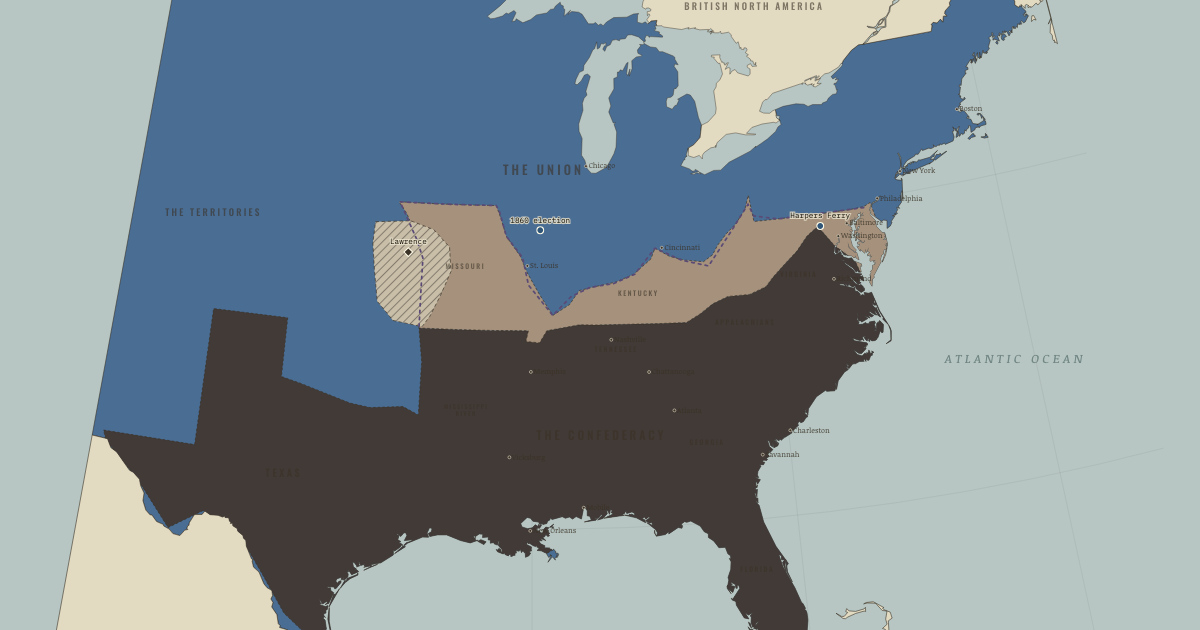
The politics of the 1850s become intelligible once we follow the money beneath them. Enslaved labor made the cotton South one of the wealthiest agricultural regions on earth, and because enslaved people were bought and sold as property, that wealth was also a form of capital that planters, lenders, and states all counted on. This tied plantation profit, credit, and the market value of human beings to a single question, which was whether slavery would keep expanding. Slaveholders reasoned that an institution confined to its existing borders would lose political weight and market value over time, so they treated any limit on expansion as the beginning of a long decline. That is the reason a territory like Kansas, where cotton was not yet grown, could feel like a matter of survival.
The short answer
- Slavery as capital, not merely labor. Emancipation somewhere threatened property values everywhere: an enslaved person in Virginia was worth more because Mississippi and the territories were open markets. That is why the South fought over distant Kansas. Closing the frontier didn’t just limit slavery, it started the clock on its financial collapse. Follow the money and the politics of 1850–60 stop looking irrational.
- Two economies, two civilizations. The free states built factories, railroads, public schools and cities of immigrants. The South built the world’s most profitable plantation economy on bound labor. Each section believed the other was betraying the Founders. The tariff, homesteads, railroads. Every national question became a proxy for the one question underneath.
- The machinery of compromise breaks. Compromise had worked when both sections could win something. Kansas–Nebraska destroyed the one fixed rule (the 36°30′ line). Dred Scott destroyed the possibility of any new rule. And the caning of Senator Sumner on the Senate floor (1856) showed that even the forum itself was failing. Institutions do not usually die at once. They die rule by rule.
- The sectional math of 1860. Free-state population had grown until it could elect a president alone. Lincoln carried every northern state and lost every slave state. The first purely sectional victory in American history. The South’s choice was now to live as a permanent political minority inside the Union, or to leave it. Secession was, among other things, a refusal to lose an election.
THE TURNING POINT
6 November 1860 — the election. Nothing in Lincoln’s platform freed a single enslaved person. It barred slavery only from the territories. But the South read the result correctly: an anti-slavery majority now existed that needed no Southern votes, ever again. Within six weeks South Carolina left. The hinge is not what Lincoln intended to do. It is what his election proved could be done.
What it changed
Secession begins in the Deep South. South Carolina, then the six cotton states, leave between December and February. Before Lincoln even takes office. Watch which states move first: the deeper the investment in slavery, the faster the exit.
The upper South waits. Virginia, Tennessee, North Carolina and Arkansas vote secession down in early 1861. They hold the men, the food and the factories the Confederacy will need. What tips them is not the election but the choice of April. See the next chapter’s sequence carefully.
Both sides inherit a myth. The North goes to war believing a small planter clique has hijacked the Southern masses. The South believes Yankee shopkeepers won’t fight. Both armies at Bull Run will be composed largely of men certain the other side will run.
The full answer, argued
Read the seceding states’ own declarations: South Carolina, Mississippi, Georgia and Texas each name the threat to slavery as the cause, in the first paragraphs. “States’ rights” was the constitutional argument for protecting it (the same states demanded federal power when it served slavery. The Fugitive Slave Act). And the economics were the economics OF slavery: four billion dollars of human property. So the honest formulation is: slavery was the cause. States’ rights was the legal theory. Economics was the mechanism. Distinguishing a cause from its instruments is the transferable skill. Most historical “debates” dissolve when you make that separation.
An interesting fact
Harriet Beecher Stowe’s Uncle Tom’s Cabin (1852) sold some 300,000 American copies in its first year — no novel had done anything like it — and stage versions put Eliza’s flight across the ice in front of audiences who would never read a page of abolitionist argument. The beloved scene of Lincoln greeting Stowe as “the little woman who wrote the book that started this great war” is almost certainly embroidery: it surfaces only decades later in family tradition, with no contemporary record. The book needs no legend — its measurable work was making millions of Northerners feel slavery as a story about mothers and children rather than a constitutional abstraction, which is exactly the ground the compromises of the 1850s could not survive on.
This is the study layer of Causes of the American Civil War, chapter 2 of The American Civil War, 1840–1877; the full index of the atlas is here.
Related questions
THE FREE PRINTABLE STUDY GUIDE
Join the Dispatch — a short welcome series, then a letter when a new atlas opens — and the printable study guide for The American Civil War is yours now, free.
NO TRACKING · YOUR ADDRESS IS USED FOR THE DISPATCH AND NOTHING ELSE · UNSUBSCRIBE ANYTIME