American Civil War · JUL 1863
Was Pickett’s Charge a blunder or a calculated risk?
The seminar question: “Pickett’s Charge has become the war’s emblem of doomed valor. Was it a blunder, or a calculated risk that failed?”
Two Union victories a day apart in July 1863 turned the war. At Gettysburg Union forces held for three days and Pickett’s Charge failed on 3 July; on 4 July Vicksburg surrendered to Grant after a 47-day siege, and with the fall of Port Hudson the Union controlled the Mississippi and split the Confederacy.
Chapter 8 is part of membership. WW2 is free — every chapter. Try chapters 1–2 of any 2 other atlases (3 with a free account). Opening a new atlas uses one of them. Membership opens all 21 — Join.
Free printable American Civil War study guide, sent by email ↓
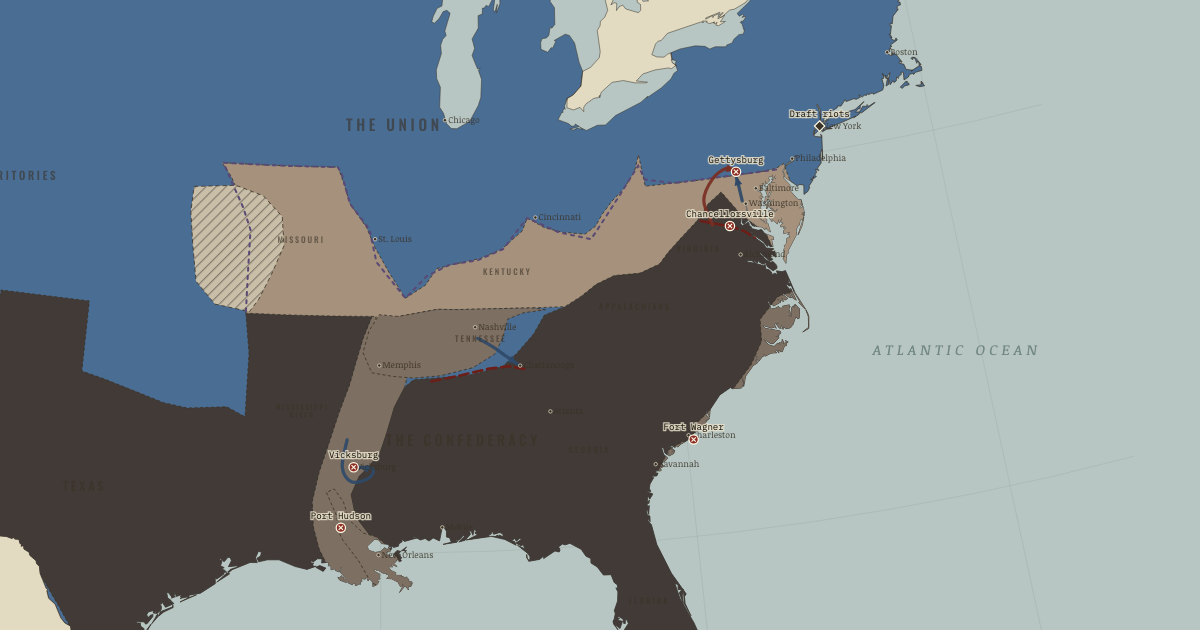
Lee invaded Pennsylvania to feed an exhausted army, shake Northern confidence, and force a decision away from ravaged Virginia. The two armies met at Gettysburg largely by accident, and the Union troops formed a strong defensive line and held both flanks. On 3 July the Confederate assault remembered as Pickett’s Charge crossed nearly a mile of open ground under artillery and rifle fire, and about half the attackers fell. Lee withdrew with his army damaged but still intact, its offensive power spent for good.
The short answer
- Why Lee rolled the dice again. He told Davis the choice was stark: stand still and starve slowly behind the Rappahannock, or invade and force a decision while the army still had its edge. He also believed. After Fredericksburg and Chancellorsville. That his men could break any Union line, and discounted what two years of rifled muskets and earthworks had done to frontal attacks. Confidence is a weapon that dulls with use. Gettysburg’s third day is its edge failing.
- Vicksburg as a problem of approach. The fortress was unassaultable from the river and swamp-guarded from the north. Grant spent a winter failing at canals and bayous. The solution inverted the problem: get south of it on the wrong bank, cross into open country, and make the fortress come out or starve. Compare the pattern at Donelson and later at Chattanooga: Grant’s signature is refusing the strong front and attacking the system that feeds it.
- Two societies under strain. Conscription arrived in both nations (the Confederacy first, 1862), and both laws let the rich buy out. $300 in the North, a “twenty-negro” overseer exemption in the South. “Rich man’s war, poor man’s fight” was a grievance with teeth: draft riots in New York, bread riots in Richmond that spring. Total war taxes social contracts as heavily as treasuries.
THE TURNING POINT
Vicksburg, 4 July 1863. Gettysburg is the war’s most famous battle. Vicksburg is its more decisive one. Gettysburg repelled. The Army of Northern Virginia escaped to fight for two more years. Vicksburg subtracted: a river, a region, 30,000 soldiers, and the Confederacy’s territorial integrity, permanently. It also settled the Union’s command question. The general who took Vicksburg would soon command everything. When ranking turning points, prefer the irreversible to the dramatic.
What it changed
The Confederacy is halved. Scrub the map forward and watch the trans-Mississippi (Texas, Arkansas, west Louisiana) fade from the war: still charcoal, but strategically an island. Richmond’s writ now runs on one side of the river. The anaconda has finished its central coil.
Black soldiers change the war’s meaning. Fort Wagner’s casualty list. And Port Hudson’s and Milliken’s Bend’s the same summer. Ended serious Northern debate about whether Black men would fight. Frederick Douglass drew the syllogism: “He who fights the battles of America may claim America as his country. And have that claim respected.” The road from these parapets to the 14th and 15th Amendments is direct. So is Confederate fury at the sight, which Chapter 9 must name at Fort Pillow.
The last hope becomes political. After July 1863 the Confederacy’s military theory of victory is gone. What remains is Lee’s original insight inverted. Make the war cost so much that the North votes it down in November 1864. Every 1864 campaign, and the entire next chapter, is fought against that clock.
The full answer, argued
Reconstruct Lee’s ledger fairly: two days of flank attacks had nearly broken both Union wings. He judged the center thinned, massed 150 guns to suppress it, and sent his freshest division a mile behind that bombardment. Now audit it: the artillery mostly overshot (worn fuses, smoke), the stone wall and the copse were pre-registered by Union guns, and even success would have punched a salient his exhausted army could not have exploited. Longstreet told him no 15,000 men ever arrayed could take that ground. And was right within the hour. The honest verdict: a calculated risk whose calculations were checkable and wrong, taken because the alternative (retreat without decision) refuted the campaign’s whole premise. Note the pattern for your own decisions: when a plan’s premise fails, escalation of commitment masquerades as boldness.
An interesting fact
Of Gettysburg’s roughly 2,400 civilians, exactly one was killed in the battle: Mary Virginia “Jennie” Wade, twenty years old, struck by a stray bullet that passed through two wooden doors while she kneaded dough in her sister’s kitchen on the morning of 3 July. When the armies marched away they left the town transformed into a hospital — some 21,000 wounded of both sides in and around a community of that size, with thousands of dead men and horses to bury in the July heat. That burial emergency is why a soldiers’ cemetery was chartered on the field — the same cemetery Lincoln would be invited, almost as an afterthought, to offer “a few appropriate remarks” at in November.
This is the study layer of Gettysburg and Vicksburg, chapter 8 of The American Civil War, 1840–1877; the full index of the atlas is here.
Related questions
THE FREE PRINTABLE STUDY GUIDE
Join the Dispatch — a short welcome series, then a letter when a new atlas opens — and the printable study guide for The American Civil War is yours now, free.
NO TRACKING · YOUR ADDRESS IS USED FOR THE DISPATCH AND NOTHING ELSE · UNSUBSCRIBE ANYTIME