Ancient Rome · AD 481
Did Rome fall, or was it transformed?
The seminar question: ““Rome did not fall; it was transformed.” “Rome fell, and civilization measurably collapsed with it.” Stage the debate honestly — then say what is actually at stake in choosing a side.”
No single cause explains the fall of the Western Roman Empire: weak succession rules, civil war, frontier pressure, disease and a thin tax base interacted. The Huns pushed armed peoples inside the frontier and the loss of Africa in 439 broke the West’s finances, while the richer East, behind Constantinople’s defences, survived.
Chapter 12 is part of membership. WW2 is free — every chapter. Try chapters 1–2 of any 2 other atlases (3 with a free account). Opening a new atlas uses one of them. Membership opens all 21 — Join.
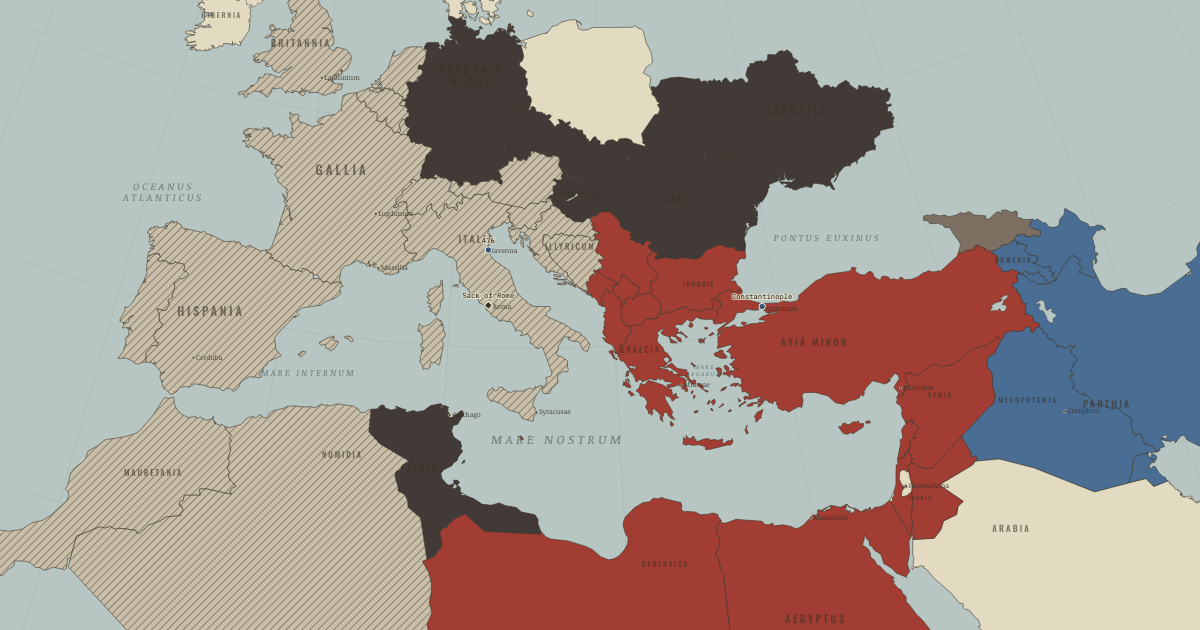
The question of why Rome fell has been argued for more than two centuries, and the sheer number of answers is itself instructive. One scholar counted over two hundred, from moral decay to lead poisoning to climate change. It helps to sort the serious modern explanations into a few families. The fiscal-military account, associated with historians such as Heather and Wickham, treats the empire as a loop of taxes and armies. On this view the Huns disrupted it by driving armed peoples inside the frontier, until the loss of Africa in 439 broke the loop and the spiral did the rest. The transformation school, associated with Peter Brown, argues that there was no corpse to find, because the Mediterranean world evolved as Roman elites became bishops and emperors became kings. Against that, the archaeologist Bryan Ward-Perkins points to the sharp collapse of trade, coinage, towns and literacy across the western provinces, which he insists is too severe to be softened by the word “transformation.”
The short answer
- Reading the debate is reading the historians. Gibbon’s Rome fell to superstition and despotism — an Enlightenment man’s fears. The 1930s found economic collapse; the Cold War found overextension; today’s scholarship finds pandemics, climate shifts and migration crises. The evidence base genuinely grows (ice cores, genomes, shipwreck counts), but the selection of protagonist tracks the present with embarrassing reliability. This does not make the question hopeless; it makes source-criticism of historians part of the method. Every chapter’s field question in this atlas has been training exactly that reflex.
- The comparative check: the half that didn’t fall. Any theory of Rome’s fall must survive one test: the East ran the same institutions, religion and legal system for another thousand years. Moral decay, Christianity, despotism — all present in Constantinople, which endured. What differed was geography (a defensible core), fiscal density, and exposure to the fifth-century steppe cascade. The comparison brutally narrows the field of admissible causes — which is why the fiscal-military and geographic accounts dominate current scholarship. In any collapse you ever study, first find the twin that survived, and difference the two.
- Rome fell upward into permanence. The successor kingdoms called themselves Roman, minted in emperors’ names, and legislated in Latin; Frankish kings wore consular titles; the Church preserved the administrative map. The prestige of Rome grew as its power vanished — becoming the standard against which Europe measured legitimacy for 1,300 years. The lesson runs beyond Rome: the cultural authority of an order and the material power of its state are different assets with different lifespans, and the first frequently peaks after the second is gone.
THE TURNING POINT
The city that did not fall. If one decision separates “the fall of Rome” from “the fall of half of Rome,” it is Constantine’s choice of the Bosporus in 330 — a capital that land armies could not reach and sea walls made safe, set beside the empire’s richest provinces. Every western catastrophe in Chapters 10–11 washed against it and stopped: Alaric turned west, Attila took the gold and turned west, the Goths were redirected west by treaty. The East survived partly because the West existed to absorb the storm — a triage the map performed even when no one commanded it. When Constantinople finally falls, in 1453, to cannon and a new empire, men in Italy will call it the end of the Roman Empire — and they will be right, 977 years after this atlas’ last snapshot.
What it changed
What to take from five centuries of map. Three structural morals, argued across twelve chapters: alliances that convert the defeated into stakeholders beat alliances of fear (Chapters 1–2 against Chapter 10); institutions with no legal succession pay for it in civil war, indefinitely (Chapters 6, 8); and states die fiscally before they die militarily (Chapters 9, 11 — the spreadsheet, then the sack). None of these is about Rome. That is the point of studying Rome.
The unfinished argument is the inheritance. “Why Rome fell” trained European thinkers to interpret their own crises. Machiavelli mined Livy for lessons about republics. The American founders built anti-Caesar safeguards into their constitution: term limits, civilian command and a senate sharing both Rome’s name and its fear. Gibbon wrote while Britain’s empire was rising. Critics have compared almost every declining power since to Rome, usually badly. This atlas has tried to teach a better method: compare mechanism with mechanism, not atmosphere with atmosphere.
Your map, your questions. Switch to Free Explore. Trace one territory through the whole arc — Africa from Carthaginian to Roman to Vandal; Asia Minor from Hellenistic to Roman to (still) Roman at the end; Gaul from Vercingetorix to the Gallic Empire to the Visigoths. Click the dossiers. Every color change on this map is a hundred books, and the Field Exam will tell you which hundred you are ready for.
The full answer, argued
The transformation case: continuity everywhere you look — the same aristocrats in the same villas writing the same Latin, kings ruling through Roman law and Roman bishops, the Church carrying the institutional genome forward; “decline” is a value judgment smuggled in by Renaissance classicists who preferred marble to monasteries. The fall case: the archaeology of complexity — long-distance trade, coin economies, urban populations, literacy, even the size of cattle — crashes across the fifth-to-seventh-century west; peasants in 700 lived materially worse than their ancestors in 300 by nearly every recoverable measure; refusing the word “fall” because elites landed softly mistakes the 5% for the 95%. Both are true at different altitudes: institutions and identities transformed; economies and living standards fell. What is at stake in the choice is the present, not the past — “transformation” comforts an age anxious about its own transitions, while “fall” warns that complex, interdependent systems can actually break, and that the people who write the sources are the last to feel it. A historian’s final discipline is to notice what an answer flatters — and this atlas leaves you with the question armed, not settled.
An interesting fact
The Roman name outlived the Roman state by nearly a millennium and a half. Under Ottoman rule the Greek Orthodox were administered as the Rum milleti — the “Roman nation” — and Greek villagers went on calling themselves Romioi, Romans, into the twentieth century, most of them without a word of Latin. And in Rome itself the Republic’s old signature never retired: the city’s manhole covers, buses and fountains are stamped SPQR — Senatus Populusque Romanus, the Senate and People of Rome — a formula coined before Caesar, still on the municipal letterhead.
This is the study layer of Why Rome fell, chapter 12 of The Rise and Fall of Rome, 264 BC – AD 476; the full index of the atlas is here.
Related questions
THE FREE PRINTABLE STUDY GUIDE
Join the Dispatch — a short welcome series, then a letter when a new atlas opens — and the printable study guide for Rome is yours now, free.
NO TRACKING · YOUR ADDRESS IS USED FOR THE DISPATCH AND NOTHING ELSE · UNSUBSCRIBE ANYTIME