Chinese Revolution · 1946
Could 1945–46 mediation have produced a coalition China?
The seminar question: “The “lost chance” debate: could the 1945–46 mediation have produced a coalition China — or was the civil war already decided?”
Japan’s surrender in 1945 set off a race for Manchuria: Soviet forces overran Manchukuo and let captured weapons reach the Communists, while the United States moved Nationalist armies north. American mediation produced agreements but no trust, and Nationalist gains, including Yan’an in 1947, hid overextension.
Chapter 10 is part of membership. WW2 is free — every chapter. Try chapters 1–2 of any 2 other atlases (3 with a free account). Opening a new atlas uses one of them. Membership opens all 21 — Join.
Free printable Chinese Revolution study guide, sent by email ↓
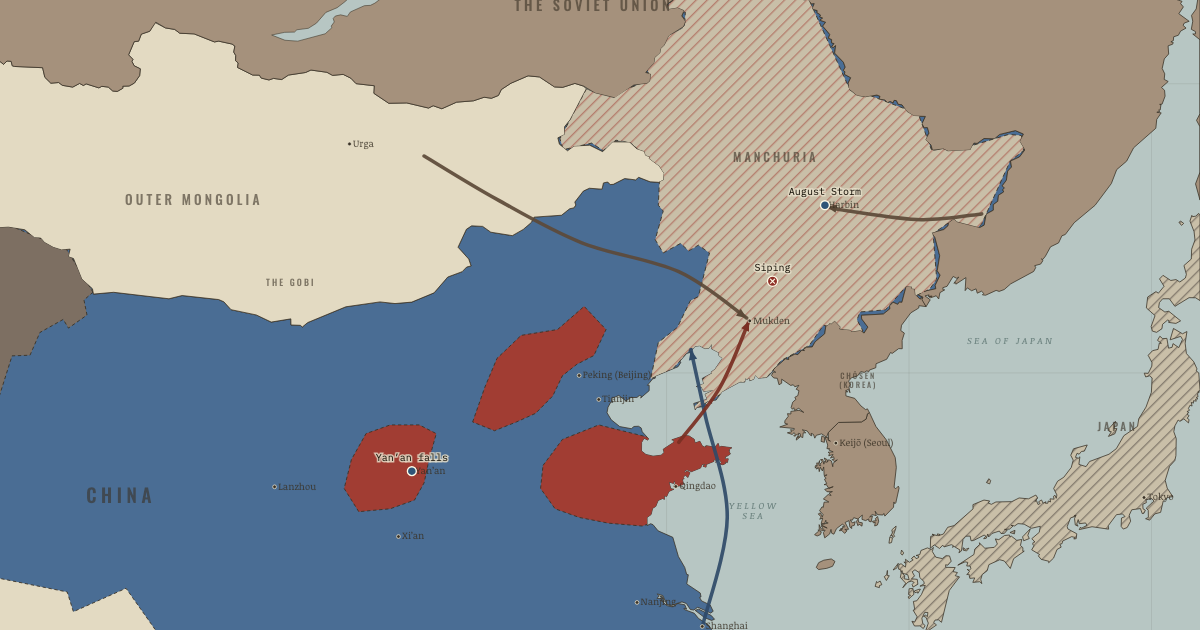
The postwar race was fundamentally about position, because accepting the Japanese surrender also meant occupying the territory a rival might otherwise take. Japan’s surrender opened the largest land-grab in Chinese history, and the map draws it as exactly that race. The two tan arrows from the north are August Storm (the ● at Harbin), for the Soviet Union entered the war on 9 August 1945 and overran Manchukuo in eleven days. It then stripped the region’s factories, a reparations commission later pricing the removals near nine hundred million dollars, and with studied ambiguity let captured Japanese arsenals leak to the Communist columns arriving on foot and by junk from Shandong (the red arrow across the gulf). The blue arrow up the coast is the other racer, as America sealifted and airlifted half a million Nationalist troops north to take the surrenders of a million Japanese, the greatest troop movement Washington ever performed for an ally and the clearest statement of whose China it preferred. In between, the hatching records what both parties already knew, that Manchuria, Japan’s industrial estate and the one region where a Chinese war could be won with factories, was contested from the hour it was created. Its countryside was turning red before its cities had finished changing flags.
The short answer
- Manchuria as the decisive prize. Whoever held the northeast held the only industrial complex in China, ports and railways facing a friendly USSR, and grain surpluses to feed an army. Mao stripped his best cadres and 100,000 troops from other theaters and sent them there in autumn 1945 (“develop the north, defend the south”). Chiang, warned by Wedemeyer and Marshall that his logistics could not carry a Manchurian war, went anyway — legitimacy demanded the recovery of the region whose loss in 1931 had defined him. Both were arguably right about the stakes. Only one could afford the bet.
- Soviet policy: two hands, one direction. Stalin signed a friendship treaty with Chiang’s government (August 1945), extracting Yalta’s concessions — Port Arthur, the railways, Mongolia’s independence confirmed. He simultaneously timed his Manchurian withdrawal (spring 1946) so that Lin Biao’s armies, quietly fed Japanese stocks, stood nearest the vacated cities. Moscow wanted a weak, divided China on its border and hedged toward whichever outcome produced one. It did not expect its client to win outright any more than Washington expected its own to lose.
- Mediation against both parties’ convictions. Marshall’s mission failed not from want of skill but of material: both parties had spent twenty years learning that armies are the only guarantee (Chapter 5’s purge was the syllabus), both used truces to reposition, and neither would fold its forces into a state the other might capture. The ceasefires of 1946 arguably served Lin Biao’s recovery after Siping — a fact Nationalist historiography has never forgiven — and Chiang’s captures served his conviction that force would settle what talks could not. Coalition government was a third China nobody armed believed in.
- Victory’s poisoned inheritance. The government returned to the coastal cities as a conqueror returns, not a liberator: carpetbagging takeover officials, currency conversion that expropriated everyone who had held puppet-issue money, collaborationist industry seized into crony hands, hyperinflation accelerating. In the year of its greatest prestige the state squandered the urban legitimacy it would need for the war it was choosing — while in the villages it recovered, the landlords came back with the flag.
THE TURNING POINT
August Storm, 9–20 August 1945. Eleven Soviet days created the civil war’s decisive arena and dealt its opening hands: Japanese arsenals within Communist reach, a stripped industrial base, a border sanctuary, and a region whose recovery Chiang could not decline and could not sustain. Everything at Liaoshen in 1948 — the sealed rail gate, the besieged garrisons at the end of 1,800-kilometer supply lines — descends from the geometry of these two weeks. Great-power interventions often decide civil wars before the civil wars properly begin. This is the era’s cleanest case.
What it changed
The countryside is reorganized while the cities are besieged. From May 1946 the party converts wartime rent reduction into outright land redistribution across the northern base areas — violent, sweeping, and militarily brilliant: millions of families now hold title deeds that a Nationalist victory would cancel. The armies of 1948 march on that arithmetic. The porters of Huaihai push barrows for their own deeds.
Lin Biao builds an army out of a retreat. North of the Sungari, the defeated force of Siping is rebuilt into the Northeast Field Army: Japanese equipment, absorbed puppet troops, conscription from redistributed villages, winter offensives that bleed the garrisons. By 1948 it outnumbers and outguns the government’s best — the first Communist force in the era’s history to hold every material advantage.
America hedges into irrelevance. Marshall departs in January 1947 blaming both sides. Aid to Nanjing continues at levels large enough to implicate and small enough not to rescue. The “who lost China” recrimination is already being drafted. Its premise, that China was Washington’s to lose, is the first thing a careful student should question.
The full answer, argued
The lost-chance case notes real material: both parties signed the October 1945 communiqué and the January 1946 ceasefire. War-weariness was universal. And a genuinely enforced standstill would have frozen the Communists out of Manchuria’s cities, arguably capping their ambitions. The skeptics. The archives opened since the 1990s, read by Odd Arne Westad, Chen Jian and others — are more persuasive: Mao’s internal directives treated negotiation as a phase of struggle (“talk, talk, fight, fight”). Chiang’s own diaries show identical convictions with opposite casting. And the structural fact stood that two Leninist party-armies had each concluded from 1927 that disarmament equals death. Marshall could suspend the shooting. He could not insure either party against the other’s victory, and coalition without insurance was surrender on an installment plan. The verdict most evidence supports: not a lost chance but a mirage both sides found briefly useful. The transferable test for any peace process: ask not whether the parties will sign, but what enforces the clause each one intends to break.
An interesting fact
The Soviet removals from Manchuria were inventoried almost immediately: the Pauley reparations mission toured the northeast in 1946 and priced the stripped generators, machine tools, locomotives and whole factory lines at roughly 858 million US dollars (about 2 billion including deterioration) — Moscow called the equipment “war booty” taken from Japan, not from China. The commission’s photographs of concrete floors bolted for vanished machines circulated worldwide. Manchuria thus entered the civil war as the prize both armies bled for and an industrial shell — which made the human factors, conscription and grain and porters, weigh all the more in who finally held it.
This is the study layer of Chinese Civil War (1945–47), chapter 10 of China in Revolution, 1911–1949; the full index of the atlas is here.
Related questions
THE FREE PRINTABLE STUDY GUIDE
Join the Dispatch — a short welcome series, then a letter when a new atlas opens — and the printable study guide for China in Revolution is yours now, free.
NO TRACKING · YOUR ADDRESS IS USED FOR THE DISPATCH AND NOTHING ELSE · UNSUBSCRIBE ANYTIME