WWI · FEB 1919
Did the Treaty of Versailles cause the Second World War?
The seminar question: ““The Treaty of Versailles caused the Second World War.” Prosecute and defend that sentence.”
The 1919 peace settlements replaced four fallen empires with a belt of new states, but some 25 to 30 million Europeans became minorities. The Treaty of Versailles limited Germany’s army, demilitarized the Rhineland and imposed reparations, yet left Germany intact. Former German and Ottoman lands became League mandates.
Chapter 14 is part of membership. WW2 is free — every chapter. Try chapters 1–2 of any 2 other atlases (3 with a free account). Opening a new atlas uses one of them. Membership opens all 21 — Join.
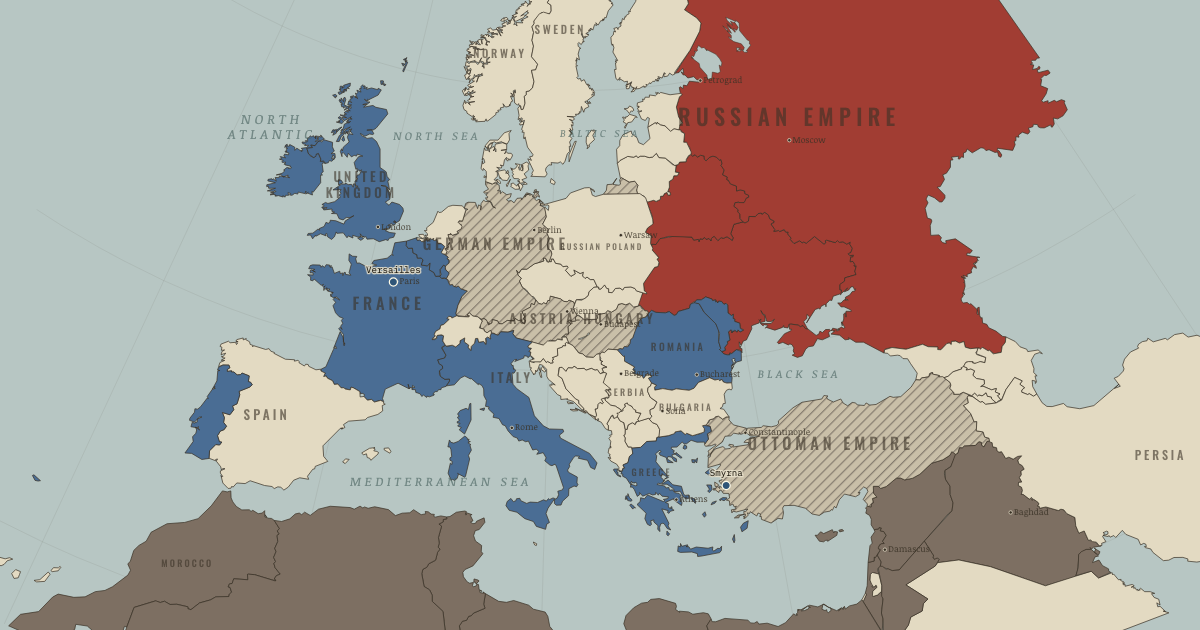
The peace settlements created or restored a line of states from Finland to Yugoslavia and Poland, yet they could not draw national borders around populations that lived intermingled. Roughly twenty-five to thirty million Europeans ended up as minorities inside someone else’s nation-state. Outside Europe, the former German and Ottoman territories became League of Nations mandates rather than independent countries, so that the promise of self-determination stopped at the edge of the colonial world.
The short answer
- Three peacemakers, three incompatible peaces. Clemenceau wanted French security against a neighbor with twenty million more people; Wilson wanted a rule-based order redeeming the slaughter; Lloyd George wanted Germany punished, trading, and balancing France — and each needed home electorates fed (“Hang the Kaiser,” “make Germany pay”). Versailles is their weighted average, which is why it satisfied no theory: too Wilsonian to crush Germany, too Carthaginian to convert it, too compromised to inspire. Committee design is visible in every clause; so is the absence of the two powers who would actually decide Europe’s next war — Russia, uninvited, and America, soon gone.
- The reparations tangle. Follow the money to understand the venom: France owed Britain, Britain owed America, and America — alone — insisted on repayment; German reparations were the only source that could service the chain. Hence sums set high for creditors’ books, collected fitfully, resented totally: the Ruhr occupation of 1923, hyperinflation’s propaganda gift, then American loans lent to Germany to pay France to pay Britain to pay America — a circuit that ran until 1929 cut the current. Keynes’ deepest point stands regardless of the arithmetic: a European economy treated as a courtroom instead of a system would impoverish victors too.
- Self-determination’s impossible geometry. The victors applied the principle where it dismembered enemies, including Austria-Hungary and the Ottoman lands. They suspended it where it inconvenienced them. Austria was forbidden to join Germany, colonies remained under outside rule, and petitioners from Ireland to Ho Chi Minh went unheard. This selectivity was noticed instantly and everywhere. Wilson’s own Secretary of State privately called the phrase “loaded with dynamite.” The map made ethnicity the title-deed of statehood in the world’s most mixed region. Every dictator of the next twenty years would quote Paris’s principle while dismantling Paris’s map.
- Enforcement: the peace nobody guarded. A settlement is worth its enforcement mechanism. Versailles’ was: an American guarantee that died in the Senate (with the League itself, for America), a British commitment that faded with the war’s memory, and a French army expected to police Europe alone — which, when it tried (Ruhr, 1923), was condemned by its own allies. By 1925 enforcement had become “appeasement” avant la lettre. The treaty’s clauses mattered less than this vacuum: a harsh peace unenforced combines the costs of severity with the benefits of none.
THE TURNING POINT
The Hall of Mirrors, 28 June 1919. Two German delegates sign under the eyes of the victors in the room where Bismarck’s empire was born — a humiliation staged as symmetry, 1871 answered. The date answers Sarajevo, five years exactly. It is the most consciously symbolic moment of the century, and symbolism is what it delivered: the settlement’s content began eroding within four years, but its imagery — dictated peace, guilt clause, mirrors — powered German politics until a corporal of this war made its destruction his program.
What it changed
What 1919 genuinely built. Do not let the failure erase the invention: the League of Nations — flawed, but the first permanent machinery for collective security, whose charter, court and agencies the UN inherited wholesale; the International Labour Organization; mandate accountability, however thin; Wilsonian language that anticolonialists worldwide seized and never returned. The 1919 order failed in twenty years; its institutional DNA governs the one you live in. Both facts are the lesson.
The successor wars. The Great War’s formal end settled little on the ground: Polish-Soviet war, Greco-Turkish catastrophe (and the compulsory “population exchange” of 1923 — ethnic cleansing as treaty instrument), Irish independence, Arab revolts against the mandates, Freikorps fighting in the Baltics. Historians increasingly write of a “greater war” of 1912–1923; scrub this atlas’s last snapshots knowing the guns on this map had not actually finished.
The twenty-year armistice. Trace the fuse: war guilt and revision as German consensus (not just Nazi property), Italy’s “mutilated victory,” Hungary’s Trianon irredentism, minorities engineered into pretexts, the Depression detonating a system without shock absorbers — and in 1936 the Rhineland remilitarized while the enforcers watched. Our WW2 atlas opens on exactly that moment: its first chapter is this chapter’s last effect. History does not repeat, but it invoices.
The full answer, argued
Prosecution: the treaty humiliated without weakening — guilt clause, reparations, unilateral disarmament — handing every German government a unifying grievance and Hitler his platform; it scattered German minorities as ready-made pretexts; it excluded Russia and lost America, so the order had no guardians. Defense: the treaty was milder than Brest-Litovsk (Germany’s own 1918 blueprint) and than 1945’s partition; Weimar was strangled as much by the Depression, elite contempt for the republic and deliberate myth-making (the army’s own “stab-in-the-back”) as by any clause; and the treaty’s terms were being peacefully revised — reparations effectively ended by 1932, before Hitler mattered. The tenable verdict: Versailles did not make 1939 — choices in the 1930s did — but it made those choices cheap, by delegitimizing the peace it created and dissolving the coalition that could have defended it. Distinguish, always, between a wound and the decision to infect it: the twenties show reconciliation was possible; the thirties show what it cost to abandon enforcement. That double lesson — punish or reconcile, but resource whichever you choose — is the Great War’s parting gift to statecraft, unwrapped too late.
An interesting fact
Versailles has an end date most histories miss: 3 October 2010. That day Germany made the final payment — about €70 million — on bonds it had floated in the 1920s to meet reparations: a debt that Hitler repudiated, that the 1953 London Debt Agreement partially revived, and whose last tranche of interest was deferred against the day the country should ever reunify. It did, on 3 October 1990 — so the final invoice of the First World War was settled, quietly, on the twentieth anniversary of German reunification, ninety-two years after the guns stopped.
This is the study layer of Treaty of Versailles, chapter 14 of The Great War, 1871–1923; the full index of the atlas is here.
Related questions
THE FREE PRINTABLE STUDY GUIDE
Join the Dispatch — a short welcome series, then a letter when a new atlas opens — and the printable study guide for WWI is yours now, free.
NO TRACKING · YOUR ADDRESS IS USED FOR THE DISPATCH AND NOTHING ELSE · UNSUBSCRIBE ANYTIME