American Civil War · JUL 1864
Was General Grant a butcher?
The seminar question: “Was Grant a “butcher” — and what would answering that question rigorously require?”
Made overall Union commander in 1864, Grant applied pressure on every front at once. In Virginia he kept moving south after the Wilderness, Spotsylvania and Cold Harbor until Lee was fixed in the trenches at Petersburg, at a cost of roughly 55,000 Union casualties in six weeks, while Sherman pressed toward Atlanta.
Chapter 9 is part of membership. WW2 is free — every chapter. Try chapters 1–2 of any 2 other atlases (3 with a free account). Opening a new atlas uses one of them. Membership opens all 21 — Join.
Free printable American Civil War study guide, sent by email ↓
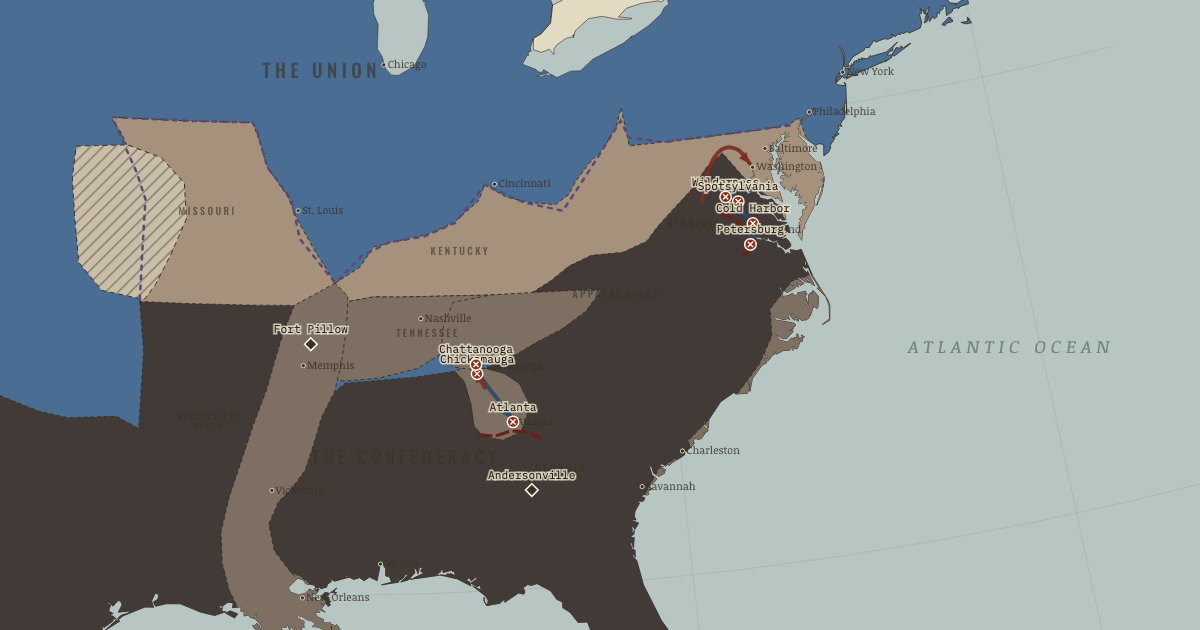
Grant’s plan coordinated several advances in the same weeks, and although the secondary drives often failed, they still limited Confederate movement. In Virginia the veterans on both sides built earthworks within hours of halting, and rifled weapons made frontal assault especially deadly. Lee inflicted heavy losses in the tangled fighting, but Grant broke with every predecessor by refusing to retreat north after each battle, shifting his army south instead until it crossed the James River and threatened Petersburg, the rail junction that supplied Richmond.
The short answer
- Grant’s theory of simultaneity. Since 1861 the Confederacy had survived by railroad. Losing one theater’s battle and lending its divisions to another’s (Chickamauga itself was won with Longstreet’s corps shipped from Virginia). Grant’s May 1864 design attacked the mechanism: Meade at Lee, Sherman at Johnston, plus three secondary drives, all on the same week. The lesser drives mostly failed. The design still worked, because failure that pins an enemy is not failure in a system of pressure.
- The trench ascendancy. By 1864 veterans entrenched within hours of halting. Rifled muskets plus earthworks made assault three-to-one expensive at best (Cold Harbor at worst). The Overland casualties were less a choice than the price of contact itself under the new tactical regime. The American preview of 1914–18, half a century early. Armies learn technology’s lessons only at full price.
- The clock behind everything. Every 1864 decision on both sides aims at 8 November: Grant accepts casualties to deny Lee the initiative before the vote. Lee sends Early raiding to Washington’s suburbs (the red arrow, July 1864) to embarrass Lincoln. Johnston trades space for time hoping Atlanta holds until the election. Reading the campaigns without the election is reading them wrong.
- Race war inside the war. The Confederacy refused to treat Black soldiers as soldiers. Threatening re-enslavement or death, refusing prisoner exchanges that included them (a refusal that, note honestly, is also why the exchange cartel collapsed and camps like Andersonville filled). Fort Pillow was the policy’s logic in action. The Union answer. Grant’s halt of all exchanges until Black prisoners counted equally. Cost Union prisoners dearly and was right. Moral clarity sometimes carries a butcher’s bill of its own.
THE TURNING POINT
The Brock Road crossroads, 7 May 1864. After two days of horror in the burning scrub. A battle Lee arguably won on points. The Army of the Potomac expected the familiar ritual: retreat, reorganize, new general. Instead the columns turned SOUTH, and the exhausted ranks began to cheer. Nothing on the map moved more than a few miles. Everything in the war moved. The hinge of 1864 is not a battle but a direction. The moment the Union’s material superiority acquired a will equal to it.
What it changed
Petersburg: the siege that is not called one. Pinned to Richmond’s rail junction, Lee’s army digs thirty miles of works it cannot afford to man. Grant extends left, railroad by railroad, for nine months. The Crater fiasco included. Until the arithmetic completes itself in April. The Eastern deadlock has become a countdown.
Atlanta within reach — and with it, everything. When Davis replaces the cautious Johnston with Hood, who obligingly attacks and wrecks his own army in three battles, Sherman closes on the city. Its fall in September will decide the election, and the election will decide the war. The next chapter’s subject.
The war’s memory acquires its hardest chapters. Fort Pillow and Andersonville enter American memory as atrocity and tragedy respectively. And as arguments: about what the Confederacy was defending, and about what captivity without exchange cost. This atlas marks both as memorial sites. Nothing about them belongs to the game of strategy.
The full answer, argued
Require comparison, not recoil. Compute both ledgers: Overland losses were enormous absolutely, but Lee’s were worse as a share of force, and Lee’s were irreplaceable. By June 1864 the Army of Northern Virginia could no longer maneuver in the open, which was the campaign’s purpose. Compare careers: Grant’s Vicksburg and Chattanooga were masterpieces of economy. McClellan’s “careful” war produced Antietam’s single day and two more years of fighting. And the gentlemanly seesaw of 1861–63 killed steadily without ending anything. The harder truth: against an entrenched enemy who must be conquered rather than persuaded, the choice was never bloody-versus-bloodless but shorter-versus-longer bleeding. Say that, and then keep the number 55,000 in view anyway. Strategic judgment that stops feeling its costs becomes the butchery it denies.
An interesting fact
The 54th Massachusetts stormed Fort Wagner unpaid — by choice. Offered $10 a month minus $3 for clothing, against a white private’s $13 plus clothing, the regiment refused all pay for eighteen months, and turned down Massachusetts’s offer to make up the difference from state funds: the point was not the money but the rank of citizen it denoted. Corporal James Henry Gooding put it to Lincoln directly in September 1863 — “Are we Soldiers, or are we Labourers?” Congress equalized the pay in June 1864, too late for Gooding, who had been captured at Olustee and died that July in Andersonville.
This is the study layer of Overland and Atlanta campaigns, chapter 9 of The American Civil War, 1840–1877; the full index of the atlas is here.
Related questions
THE FREE PRINTABLE STUDY GUIDE
Join the Dispatch — a short welcome series, then a letter when a new atlas opens — and the printable study guide for The American Civil War is yours now, free.
NO TRACKING · YOUR ADDRESS IS USED FOR THE DISPATCH AND NOTHING ELSE · UNSUBSCRIBE ANYTIME