Age of Revolutions · JUN 1815
Was the Congress of Vienna a masterpiece or a conspiracy?
The seminar question: “Was the Congress of Vienna a masterpiece of statecraft or a conspiracy against the future?”
After 1812 Napoleon’s enemies finally coordinated: at Leipzig in October 1813 they broke French control of Germany, and allied troops entered Paris in 1814. Napoleon returned from Elba but lost at Waterloo on 18 June 1815, while the Congress of Vienna built a balance that helped prevent a continent-wide war until 1914.
Chapter 9 is part of membership. WW2 is free — every chapter. Try chapters 1–2 of any 2 other atlases (3 with a free account). Opening a new atlas uses one of them. Membership opens all 21 — Join.
Free printable Age of Revolutions study guide, sent by email ↓
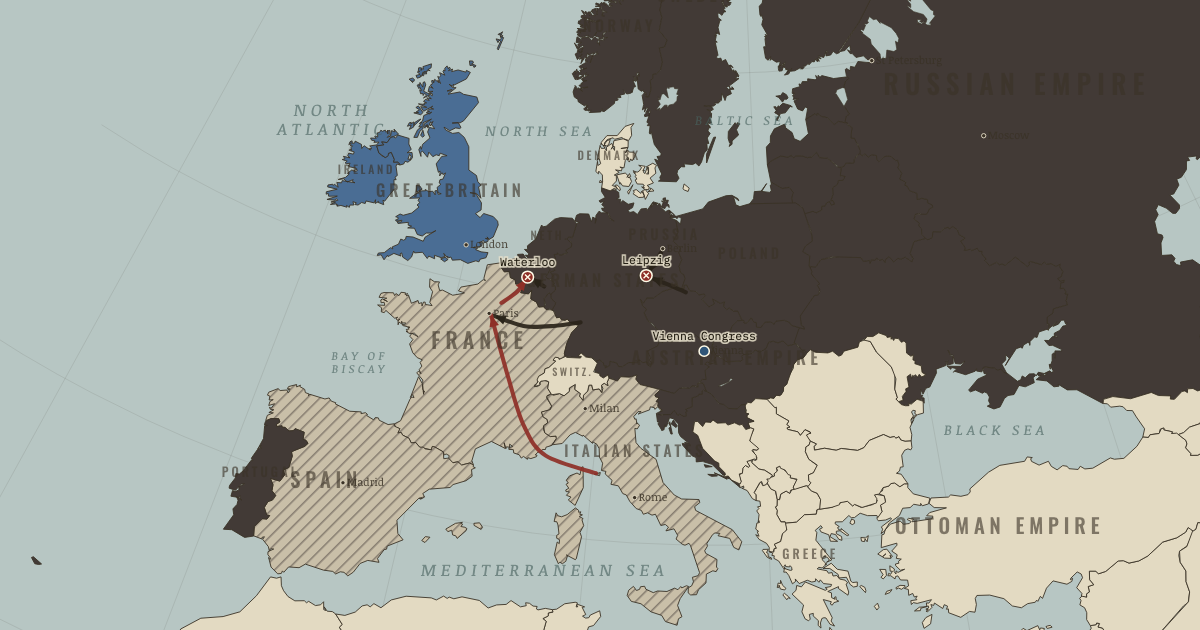
The Sixth Coalition finally combined Russia, Prussia, Austria, Sweden and British finance into a single effort, and its armies had by now learned from France itself. At Leipzig in October 1813 their converging forces outnumbered Napoleon and, crucially, refused to dissolve after local setbacks, while several German allies defected in the middle of the battle. The French retreat that followed ended the satellite system east of the Rhine. In 1814 coalition troops entered Paris, and Napoleon abdicated once his own marshals refused to fight on.
The short answer
- The coalition finally fought as one. Twenty years of separate defeats taught the powers to subordinate rivalry to survival: unified command (Schwarzenberg), British subsidies underwriting everyone (£11 million in 1813 alone), and agreed war aims renewed at each setback (Chaumont, 1814: no separate peace). Napoleon’s system was built to beat coalitions in detail; the Trachenberg Plan simply refused to be beaten in detail. His enemies’ learning curve, not his decline, is the master variable of 1813.
- The nations he awakened. The Leipzig armies were full of volunteers — German students, Prussian Landwehr, Russian serf-militia — fighting for fatherlands, a category French bayonets had taught them. The War of Liberation was the Revolution’s methods under the Restoration’s flags: the most dangerous legacy export in the atlas.
- France’s exhaustion. A quarter-century of war: ~1.4 million French dead, conscription classes called years early, the 1813 cavalry mounted on requisitioned farm horses. When the allies crossed the frontier, the population that had risen in 1792 stayed home. Legitimacy spent is not refundable at the moment of invasion — the marshals’ mutiny of April 1814 was simply the account closing.
THE TURNING POINT
Leipzig, 16–19 October 1813. Waterloo is the famous name, but Waterloo only decided how the story ended twice; Leipzig decided that it ended. Outnumbered five to three, with allies defecting between assaults and one bridge as a line of retreat (blown early, drowning a rearguard and a marshal), Napoleon lost Germany, his satellite system, and any mathematical path to victory in three days. After Leipzig every later drama — 1814’s brilliance, Elba, the Hundred Days — is epilogue played for stakes already settled: the coalition had learned to win, and knew it.
What it changed
A machine for peace, run by policemen. The Concert’s congresses (Aix-la-Chapelle, Troppau, Verona) become standing counter-revolutionary machinery: Troppau (1820) asserts a right of armed intervention against any revolution. Peace between states is purchased with a police system inside them — the exact trade Chapter 11 examines.
The hundred days that hardened the peace. France’s instant re-defection to Napoleon terrified the victors into the harsher second Treaty of Paris (indemnity, occupation) and into permanent vigilance. It also gave the Bourbons an unpayable debt to the ultras who returned with them — the White Terror and the reactionary drift that ends in 1830.
Britain banks the world. Alone undamaged, holding Malta, the Cape, Ceylon and maritime supremacy, Britain exits the wars as the globe’s banker, carrier and insurer — the blue on this map now backed by an industrial revolution no rival shares. Its chosen instrument henceforth is trade, not occupation: watch it applied to Latin America next chapter.
The veterans of the idea. Half-pay officers, disbanded volunteers, Carbonari, Decembrists, Greek klephts armed with surplus muskets: demobilization scatters men who have seen constitutions and nations-in-arms across a continent officially returned to 1789. The Restoration polices a Europe that remembers.
The full answer, argued
As great-power statecraft, Vienna was highly successful: it reintegrated France, balanced power and built consultation, helping prevent general war for decades. As a settlement of popular claims, it largely refused the future. Dynastic legitimacy overrode national and constitutional demands, and intervention protected rulers from subjects. The honest verdict depends on the objective measured. Vienna managed interstate rivalry better than revolutionary legitimacy. It created durable peace among governments while making later struggles over who could govern unavoidable.
An interesting fact
The Congress of Vienna never actually convened: in nine months there was not a single plenary session — the map of Europe was redrawn in committees, salons and ballrooms, earning the Prince de Ligne’s verdict that “the Congress dances, but it does not march.” (Ligne died mid-Congress, in December 1814, having joked that he would at least give the delegates a new entertainment — the funeral of a field marshal.) The Final Act was signed on 9 June 1815, nine days before Waterloo: Europe’s new order was inked while the man it was built against marched on Brussels.
This is the study layer of Fall of Napoleon, chapter 9 of The Age of Revolutions, 1775–1848; the full index of the atlas is here.
Related questions
THE FREE PRINTABLE STUDY GUIDE
Join the Dispatch — a short welcome series, then a letter when a new atlas opens — and the printable study guide for The Age of Revolutions is yours now, free.
NO TRACKING · YOUR ADDRESS IS USED FOR THE DISPATCH AND NOTHING ELSE · UNSUBSCRIBE ANYTIME