Mongol Empire · 1265
Was the division of the Mongol Empire inevitable?
The seminar question: “Was the empire’s division inevitable — or the contingent result of Möngke dying in front of a minor Song fortress?”
Möngke’s death in 1259 produced rival elections: Khubilai claimed the great khanship from his Chinese base and Ariq Böke from Mongolia, and Khubilai won the civil war in 1264. Meanwhile Berke of the Golden Horde went to war with Hülegü’s Ilkhanate, and the khanates developed separate revenues, armies and alliances.
Chapter 9 is part of membership. WW2 is free — every chapter. Try chapters 1–2 of any 2 other atlases (3 with a free account). Opening a new atlas uses one of them. Membership opens all 21 — Join.
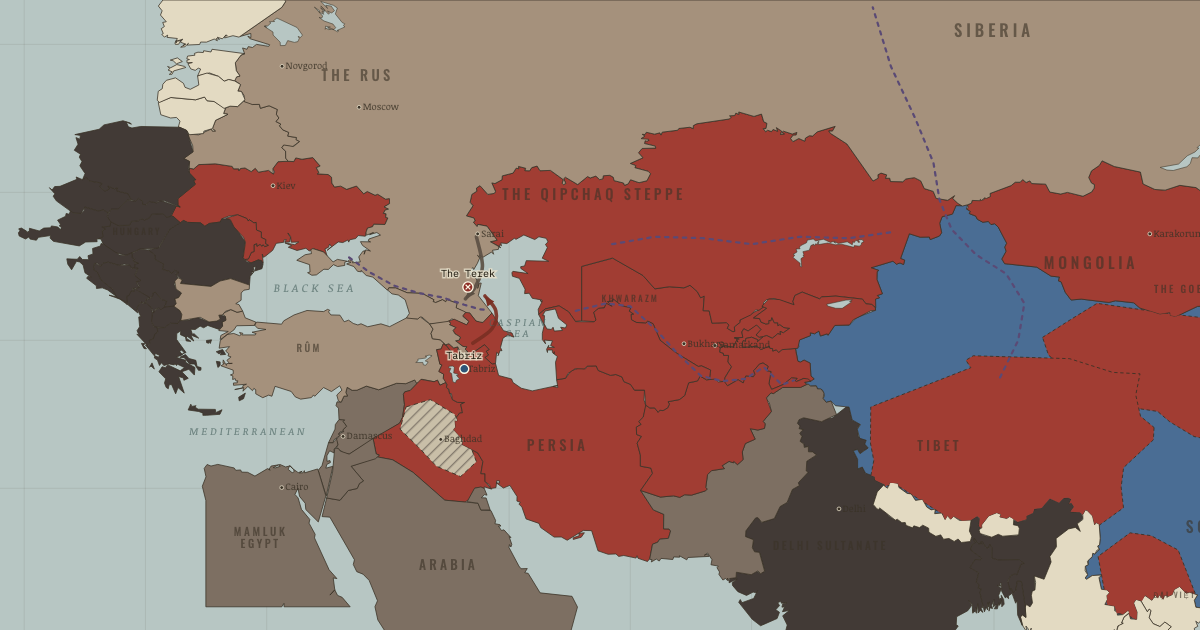
Möngke died in 1259 with no settled successor, and his supporters split. Khubilai was elected at Shangdu while Ariq Böke was raised by another assembly in Mongolia, and neither gathering included the whole ruling family. The civil war that followed was decided by armies and supply, because Khubilai’s access to north Chinese grain let him starve out Ariq Böke, who surrendered in 1264. Khubilai took the title of Great Khan, but the victory did not restore his effective command over every branch of the family.
The short answer
- An inheritance law for herds, not empires. Steppe custom pulled two ways at once: ultimogeniture (the youngest keeps the hearth) versus tanistry (the assembled family acclaims the ablest). For herds and pastures the ambiguity was survivable; for a continent it guaranteed that every khan’s death triggered a legitimacy auction with cavalry. Note the toll on this very atlas: 1227 pauses the west, 1241 saves Hungary, 1259 saves Syria, 1260 splits the state. The empire’s deadliest recurring enemy was its own funeral rites.
- Regionalization by success. Each family branch had governed its front for a generation — and been captured by it. Khubilai’s power base was Chinese grain, generals and taxes; Berke’s was the Volga trade and a Muslim merchant class; Hülegü’s, Persia’s bureaucrats. By 1260 the branches were solving different problems in different languages with different gods. The war only ratified what administration had already divided; empires, this chapter argues, are partitioned first by payroll and only later by treaty.
- Islam enters the family. Berke’s conversion turned a spoils dispute into something new: a Chinggisid obliged to avenge Baghdad against a Chinggisid who had burned it. Religion did not cause the Horde–Ilkhan war (pastures and plunder shares did that), but it made the Mamluk alliance thinkable and durable — and it announced the empire’s future: within sixty years three of the four khanates pray toward Mecca, and the conquerors of Islam have become its swords.
THE TURNING POINT
The Terek, January 1263. The battle itself was indecisive strategy and decisive symbolism: the first full war between Chinggisid states, fought weeks after Ain Jalut proved outsiders could win too. From this winter the khanates permanently point armies at each other — which is why the Mamluks survive, why Europe is never seriously threatened again, and why the dashed lines on your map matter more than any front drawn against a foreign enemy. The empire was undefeated; it was also over.
What it changed
The Mamluks are underwritten by Mongols. Every Ilkhan invasion of Syria for sixty years is cut short or deterred by the Horde at its back — the two-front trap the family war built. Baybars corresponds with Berke as brother-in-faith; Cairo’s slave markets restock from the Horde’s steppes. Ain Jalut (Ch. 8) won a battle; the Terek institutionalized the reprieve.
Four laboratories of assimilation. Cut loose from Karakorum, each khanate marries its region: the Yuan perform Chinese emperorship (Ch. 10), the Ilkhans become Persian patron-kings, the Horde turns Turkic-Muslim astride the fur and slave trades, Chagatai’s ulus stays closest to the steppe — and their divergence, more than any battle, is how “the Mongols” exit history: not defeated, but absorbed by what they ruled.
Kaidu’s forty-year veto. Ögedei’s grandson Kaidu turns Central Asia into a standing revolt against Khubilai (the Altai dashed line is his war zone into the 1300s), which quietly shapes the far side of the map: resources Khubilai might have aimed at Japan or Vietnam bleed north against cousins instead. When you weigh Chapter 11’s failures, remember a third of the Yuan army faces inward.
The full answer, argued
Some division was likely because regional branches already controlled distinct armies, revenues and advisers, while no binding succession rule existed. Möngke’s sudden death determined the timing and the particular rivals. Had he lived longer, central reforms might have delayed or reshaped the break. The careful distinction is between structural pressure toward regional rule and the contingent form of the 1260–64 civil wars. The first was strong; the second was not predetermined.
An interesting fact
Kaidu’s long revolt produced the era’s most improbable celebrity: his daughter Khutulun, described independently by Marco Polo and by Rashid al-Din — sources at opposite ends of the empire — as an undefeated wrestler who rode into battle beside her father and would marry only a man who could throw her. Polo says her stake was a hundred horses a bout and that she banked ten thousand; the number is surely Polo being Polo, but the woman is not invented. Four centuries later, filtered through a French teller of oriental tales, her story helped seed the riddling princess of Puccini’s Turandot — the family war’s strangest afterlife: an opera.
This is the study layer of Division of the Mongol Empire, chapter 9 of The Mongol Empire, 1206–1294; the full index of the atlas is here.
Related questions
THE FREE PRINTABLE STUDY GUIDE
Join the Dispatch — a short welcome series, then a letter when a new atlas opens — and the printable study guide for The Mongol Empire is yours now, free.
NO TRACKING · YOUR ADDRESS IS USED FOR THE DISPATCH AND NOTHING ELSE · UNSUBSCRIBE ANYTIME