Ancient Rome · AD 271
What mainly caused the Crisis of the Third Century?
The seminar question: “Was the third-century crisis primarily a military, an economic, or a biological event? Argue the priority — and defend why the question matters.”
Between 235 and 284 Rome had about 26 emperors, nearly all raised and then killed by their own soldiers. Goths raided across the Danube, Sasanid Persia captured Emperor Valerian at Edessa in 260, and plague and a debased coinage deepened the crisis, while breakaway regimes ruled in Gaul and at Palmyra.
Chapter 8 is part of membership. WW2 is free — every chapter. Try chapters 1–2 of any 2 other atlases (3 with a free account). Opening a new atlas uses one of them. Membership opens all 21 — Join.
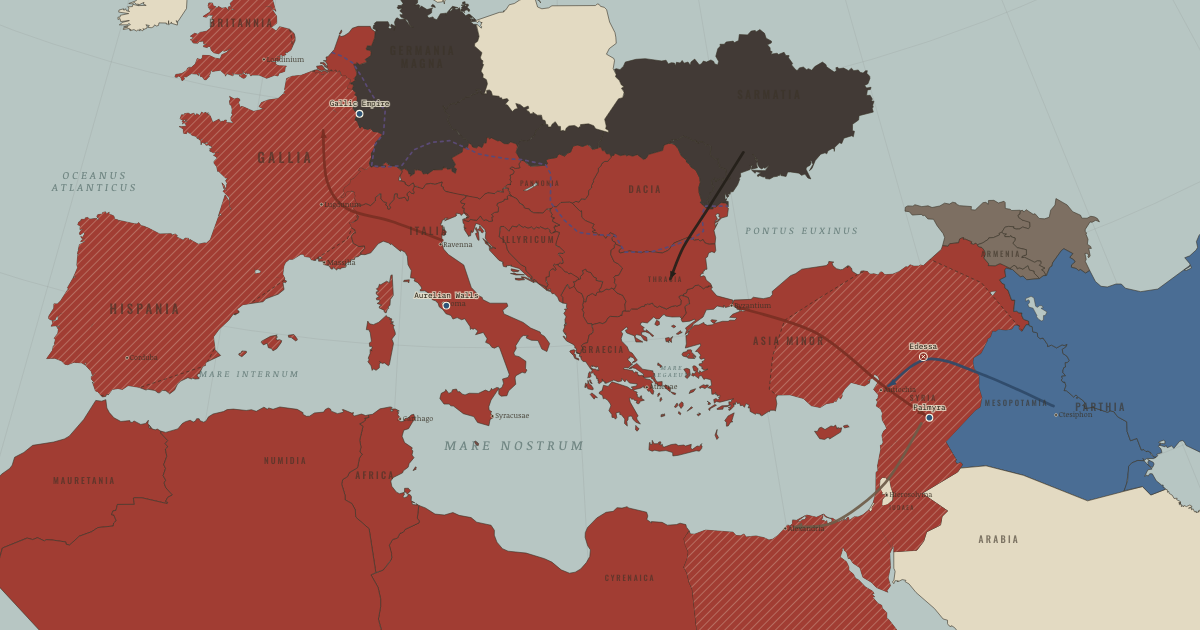
The speed of the collapse is easiest to grasp through a single number. Between 235 and 284 Rome had about twenty-six emperors, nearly all of them raised and then killed by their own soldiers, so that civil war became the empire’s largest single military activity. Into the vacuum poured the very shocks the lean second-century system had never been built to take at once. On the Danube the new Gothic confederations raided deep into the Balkans, killing the emperor Decius in battle in 251 and sacking Athens in 267 and 268. In the east something worse than the old Parthia had appeared. The Sasanid revolution had produced a centralised and ambitious Persian monarchy, whose king Shapur I struck into Syria and sacked Antioch itself. In 260, at Edessa, the Persians captured the emperor Valerian alive and held him until his death, and for a decade Rome could manage no reprisal at all.
The short answer
- The succession bug, at last fatal. Augustus’ unwritten monarchy had no legal way to transfer power, so the army’s acclamation filled the gap — and after 235, every frontier army learned it could mint an emperor and every emperor knew his rivals’ armies knew it. Emperors thus fought Romans first and invaders second, stripping frontiers to do it; each stripped frontier invited the next invasion, which raised the next usurper. This is the doom-loop at the crisis’ core — constitutional failure wearing military costume.
- Sasanid Persia: a peer, not a nuisance. Parthia had been a loose feudal power that raided and retired. The Sasanids (from 224) were a centralizing, ideological monarchy that fielded siege trains, took cities, and explicitly claimed the old Achaemenid lands — including Rome’s east. Rome now needed a permanent great-power front on the Euphrates at exactly the moment the Danube exploded. Two-front pressure against a no-reserve army: the Antonine design assumptions, both false at once.
- Inflation as constitutional solvent. Debasement was each emperor’s rational short-term fix — more coins for donatives tomorrow, someone else’s inflation next decade. Its systemic effect was to dissolve the fiscal glue of the Antonine bargain: soldiers’ real pay collapsed (making them mutinous and purchasable), city elites’ obligations became ruinous (making them evasive), and the state turned to coercion, which is expensive. Read modern hyperinflations and the sequence will feel familiar: currency, then trust, then order.
- Plague and the empty muster rolls. The Cyprian pandemic hit recruitment, tax rolls and cities for a dozen consecutive years across the exact span (250s–260s) when Goths, Persia, and usurpers peaked — the correlation is too tight for historians to ignore, even where causation is debated. Weigh it as a force multiplier: the same enemies against a healthy second-century empire had been mere frontier noise.
THE TURNING POINT
Edessa, 260 — an emperor in chains. Valerian’s capture is the crisis distilled into one scene: the world-empire’s head of state, taken alive on his own frontier, and the world-empire unable to respond — because the response apparatus was busy manufacturing usurpers. Yet look what the nadir reveals: Rome’s provinces did not defect to Persia or the Goths. Gaul built a spare Rome; Palmyra defended the east in Rome’s name before claiming it. Even at the bottom, there was no alternative civilization on offer — only competing bids to be Rome. That fact — legitimacy outliving capability — is why Aurelian could restore in five years what took twenty-five to lose, and it is worth remembering in Chapter 11, when the western provinces are offered an actual alternative.
What it changed
Dacia abandoned: the tide learns to ebb. Aurelian evacuated the exposed trans-Danubian province in 271–275, resettling its garrisons and officials south of the river (and keeping the name, with Roman face-saving, for a new “Dacia” safely inside the line). Strategically sound; symbolically epochal — the first mark on this map that Rome could subtract. Scrub to the next snapshot and watch Romania turn charcoal: the Latin speech survives the legions by two millennia, a preview of Chapter 12’s theme.
The army and coinage remade. The crisis forged the tools of the next century: mobile cavalry field armies held behind the frontier (the reserve the Antonines never had), soldier-emperors from the Danube provinces displacing the Italian senatorial class from command, and — after the silver economy’s ruin — Constantine’s gold solidus, so stable it anchors Mediterranean trade for 700 years. Systems rarely reform except by nearly dying; Chapter 9 is the reform.
Christianity’s crisis dividend. Amid plague and collapse, the church was one institution that continued to grow. It fed its poor and buried both its own dead and others. Its bishops ran an empire-wide network not owned by the state, while persecution under Decius and Valerian gave it martyrs and stronger internal coherence. By 300 Christians may have formed a tenth of the empire. That was enough for Diocletian to try destruction and for Constantine to conclude, with a politician’s eye, that the church might instead be employed.
The full answer, argued
Build each case, then test it. Military-constitutional: the succession doom-loop predates the invasions (235 begins with a mutiny, not a Goth), and the empire’s enemies won mainly when Rome’s armies were pointed at each other — the shocks were survivable, the simultaneity self-inflicted. Economic: debasement began under the “good” emperors (Marcus funded his wars that way) and by the 260s had dissolved pay, taxes and trust regardless of who ruled — no solvent state, no defense. Biological: the pandemics are the only factor big enough, new enough, and correctly timed to explain why the same structure that absorbed 69 and 193 failed after 250. The honest synthesis is a cascade — plague and Persia stressed a system whose constitutional flaw converted stress into civil war, whose fiscal flaw converted civil war into insolvency, which invited more stress. Why it matters: your causal ranking decides what you think saves empires — better rules, sounder money, or public health — and historians’ rankings have tracked their own centuries’ anxieties with suspicious fidelity. Notice that, and then rank anyway.
An interesting fact
Aurelian’s emergency walls turned out to be the best infrastructure investment of the century: they remained Rome’s working defenses for 1,600 years. Popes patched and re-crenellated them through the Middle Ages, and they were still the fortification that mattered on 20 September 1870, when Italian artillery blew the breach at Porta Pia that ended papal rule and made Rome the capital of a united Italy. Most of the nineteen-kilometer circuit stands today; Romans commute through the crisis-built gates every morning.
This is the study layer of Crisis of the Third Century, chapter 8 of The Rise and Fall of Rome, 264 BC – AD 476; the full index of the atlas is here.
Related questions
THE FREE PRINTABLE STUDY GUIDE
Join the Dispatch — a short welcome series, then a letter when a new atlas opens — and the printable study guide for Rome is yours now, free.
NO TRACKING · YOUR ADDRESS IS USED FOR THE DISPATCH AND NOTHING ELSE · UNSUBSCRIBE ANYTIME