Mongol Empire · 1224
Why did the Rus learn nothing from defeat at the Kalka?
The seminar question: “What did the Mongols and the Rus princes take from the encounter in 1223?”
Pursuing the defeated shah of Khwarazm, Jebe and Subötai led roughly 20,000 riders around the Caspian and through the Caucasus, splitting the Alans and Qipchaqs by diplomacy. At the Kalka River on 31 May 1223 a feigned retreat pulled a Rus and Qipchaq army apart before it was crushed, and the Mongols rode home with intelligence.
Chapter 5 is included with every paid plan. WW2 is free in full, and chapter 1 of every atlas is free. A free account opens 3 more chapters a day. Starter, at $9 a month, opens all 21 with no daily limit — see the plans.
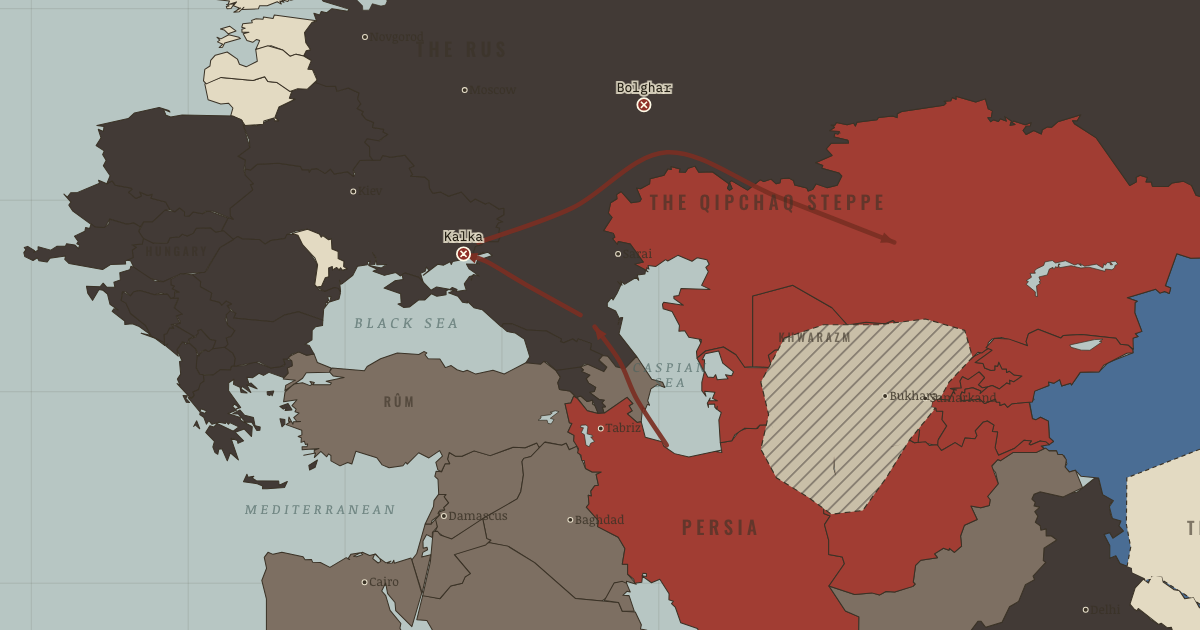
Jebe and Subötai’s expedition began with a fugitive. They had been sent after Shah Muhammad of Khwarazm, but his death did not bring them home. They continued around the Caspian, crossed the Caucasus and defeated Georgian forces before meeting an Alan–Qipchaq alliance on the steppe. The Mongols persuaded the Qipchaqs to abandon their allies. Once the Alans had been isolated and destroyed, the Mongols turned on the Qipchaqs. Their diplomacy had given them two separate enemies to fight where there might have been one coalition.
The short answer
- Reconnaissance with an army. Reconnaissance in force means gathering information with troops strong enough to fight. The pursuit of the shah became an expedition of this kind, though its course was not fixed by a flawless plan. Jebe and Subötai fought for passage and learned about routes, political relationships and enemy methods as they went. Officers, dispatch riders and assemblies gave Mongol commanders ways to carry that knowledge into later decisions. Subötai himself connected the raid to the invasion of 1236, whose army followed some of the same routes. The undertaking’s length and scale were striking among contemporary powers.
- The grassland route. The steppe had long provided a westward road for the Huns, Avars, Magyars and Qipchaqs. Mongol horsemen could travel along the grassland from the Caucasus toward the Dnieper, feeding their mounts on pasture. Grass thus helped supply an army far from home. The corridor did not remove every obstacle: the expedition still had to fight for passage and contend with the seasons.
- Princes without one command. The Rus princes had spent years fighting one another. Three commanders named Mstislav joined the response to the Mongols, yet none commanded the whole coalition, and the contingents moved at different speeds. At the Kalka, one force remained in a fortified camp while others fought. As at Otrar, the Mongols encountered opponents whose political divisions made it easier to separate them.
THE TURNING POINT
The Kalka and the years that followed. The defeat of 31 May 1223 revealed that a dangerous army could reach the Rus from the steppe. The years that followed offered an opportunity to watch the frontier, gather intelligence and organize a common defense. Instead, the raiders departed and the princes continued their rivalries; no shared frontier system emerged before the invasion. Chronicles could interpret the Tatars as divine punishment, giving the disaster meaning without providing a military plan. The thirteen-year interval matters because a response might have been built during it.
What it changed
Experience carried into another campaign. Subötai brought his experience of routes, conditions and opponents back with him in 1236. The Rus princes had established no common frontier defense in the intervening years. This difference helps explain the later campaign, although the evidence does not allow us to attribute each success to a particular piece of intelligence.
Qipchaqs seek refuge westward. The raid weakened Qipchaq power before the steppe was conquered. Survivors moved west in the 1230s, and a reported forty thousand tents sought refuge in Hungary. Their arrival created tensions within the kingdom and became part of Hungary’s conflict with the Mongols.
An imagined ally. News that a power in the east was defeating Muslim rulers reached crusading Europe with an appealing interpretation: some associated the victories with “Prester John” or King David. Some historians connect the rumors with the Fifth Crusade’s optimism at Damietta. Two decades later Mongol armies reached Legnica, and the supposed eastern ally appeared in a very different role.
The full answer, argued
Mongol commanders could carry what they had seen of routes, pasture and opponents into later decisions; Subötai returned with Batu. The Rus princes had witnessed a severe defeat, but their rivalries continued and no common frontier system followed. Religious accounts gave the disaster meaning without themselves organizing scouts or a united command. The difference lies in what each side could do with its experience, not in one side learning everything and the other nothing.
An interesting fact
The journey has been described as the first recorded circumnavigation of the Caspian Sea by an army. Modern estimates put it at roughly 8,000 kilometers and about a dozen battles over three years. The force received no reinforcement from home and sustained itself along the way. Military writers including Basil Liddell Hart later regarded the expedition as a remarkable feat and Subötai as an exceptional commander. Jebe disappears from surviving accounts on the return; the date and manner of his death remain uncertain.
This is the study layer of Jebe and Subutai’s great raid, chapter 5 of The Mongol Empire, 1206–1294; the full index of the atlas is here.
Related questions
THE FREE PRINTABLE STUDY GUIDE
Get the printable study guide for The Mongol Empire free. I’ll send you a few short letters, then one when a new atlas opens. That’s all. — Paul
NO TRACKING · YOUR ADDRESS IS USED FOR THE DISPATCH AND NOTHING ELSE · UNSUBSCRIBE ANYTIME