Chinese Revolution · 1949
Why did Mao win and Chiang lose the Chinese Civil War?
The seminar question: “Why did Mao win and Chiang lose — and was Communist victory inevitable once Japan surrendered?”
In April 1949 Communist forces crossed the Yangtze and took Nanjing, and on 1 October Mao proclaimed the People’s Republic of China in Peking. The Nationalist government withdrew to Taiwan with soldiers, refugees, gold and cultural collections, leaving the civil war unfinished across the Taiwan Strait.
Chapter 12 is part of membership. WW2 is free — every chapter. Try chapters 1–2 of any 2 other atlases (3 with a free account). Opening a new atlas uses one of them. Membership opens all 21 — Join.
Free printable Chinese Revolution study guide, sent by email ↓
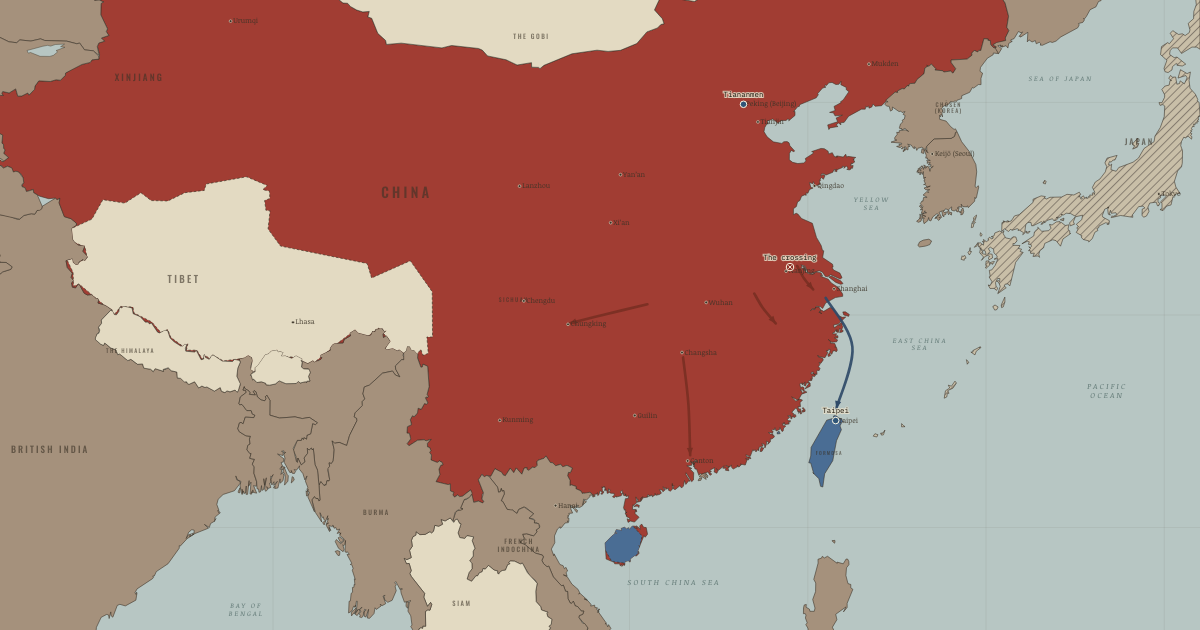
The 1949 victory settled control of most of mainland China, yet it did not amount to a complete territorial settlement. The last campaign was a river crossing that met almost no one. On the night of 20–21 April 1949 (the ✕ on the Yangtze), after peace terms lapsed, a million men crossed on junks and sampans along a five-hundred-kilometer front. Nanjing fell on the 23rd, its government buildings emptied and the capital taken by soldiers who photographed each other in the presidential chair. Through the rest of the year the red columns ran south and west, Shanghai in May, Changsha and Lanzhou in August, Canton in October and Chungking in November, as provincial armies defected by the group and the “liberation” of the southwest became a procession. Xinjiang’s garrison crossed over in September, so the grey-tan plate that had sat in the map’s corner since 1912 went red without a battle. On 1 October, from the Gate of Heavenly Peace (the ● at Peking), Mao proclaimed the People’s Republic of China. Thirty-eight years separated the accidental bomb at Wuchang from that balcony, and the succession to the Qing was finally settled. The tide chart that had shown nothing for twenty years, a heartbeat at Ruijin, a flatline in 1934 and a hill-country smudge through the Japanese war, now ended at the top of its scale.
The short answer
- The war against Japan as the great reordering. In 1937 the CCP was forty thousand survivors in loess hills. In 1945 it was a million troops and ninety million people under some form of its administration. The occupation destroyed the Nationalists’ tax base, army and urban legitimacy while creating the vacuum the Communists organized. No serious account makes 1949 comprehensible without 1937–45 — the argument is over mechanism: nationalism (Johnson), social program (Selden and after), or organization exploiting both.
- Land as the war-winning policy. From rent reduction to redistribution, the party attached its army to the majority’s deepest material interest and made every deed a conscription notice and a supply contract — Huaihai’s barrows are the policy’s battlefield form. The Nationalists, structurally tied to the landed and urban elites since 1927, could not copy it. Their own land-reform law of 1930 stayed paper. Note for the comparative essay: on Taiwan after 1949, unencumbered by mainland landlords, the KMT executed a sweeping land reform — proof the failure was political, not intellectual.
- Inflation as regime solvent. The fabi’s wartime collapse became the postwar hyperinflation and the gold-yuan confiscation of 1948 — a tax on trust itself, falling precisely on the officials, officers, teachers and shopkeepers who were the regime’s natural base. States can survive hatred from their victims. They rarely survive contempt from their own payroll. The silent defections of 1948–49 were priced in currency first.
- Two party-states, one succession. Both contenders were Leninist by architecture (Chapter 4), which is why the era ended in total victory rather than settlement: neither had institutional room for a loyal opposition, so China’s twentieth-century constitutional question — who inherits the Qing — was answered by annihilation. The PRC’s subsequent history of rule, and Taiwan’s eventual divergence, are both epilogues to that shared architecture.
THE TURNING POINT
Tiananmen, 1 October 1949. Choose the balcony over the battles because it marks the thing the whole atlas has been about: not a victory but a succession — the moment a state again existed that could claim, and increasingly enforce, the Qing inheritance from Kashgar to the sea (Taiwan and the treaty-port world excepted, each exception carrying its own future). Proclamations usually ratify rather than cause. This one is the era’s ratification, and its careful staging — the old gate, the new flag, “the Chinese people have stood up” — was the founding myth being minted in real time.
What it changed
The revolution starts governing. Within three years the new state does what no Chinese government had done in a century: unified currency, suppressed inflation, land reform completed nationwide (with a violence against landlords whose death toll is itself a debated, sobering ledger), and a war fought against the United Nations in Korea to a draw. The capacities this atlas watched being built in base areas scale to a fifth of humanity — in both their competence and their coercion.
Two Chinas institutionalize. The Taipei government keeps China’s UN seat until 1971 and its American alliance beyond that. The strait freezes into the Cold War’s longest unfinished front. Every crisis in it since — 1954, 1958, 1996, and counting — is a footnote to December 1949’s incomplete ending.
The model travels. Peasant war, base areas, united fronts, party-army fusion: the Chinese revolution becomes the twentieth century’s most exported insurgency manual — Vietnam above all, where a French war is already being fought with Mao’s doctrine as Chapter 12 closes. The era you have just scrubbed through is about to be replayed, with variations, across three continents.
The full answer, argued
Line up the explanations and make them compete. Chalmers Johnson: the Japanese occupation manufactured peasant nationalism, and the CCP was its only organized vehicle — powerful for north China, weaker for regions the war barely touched where the party also won. Mark Selden and successors: the “Yenan Way” — land policy, taxation, participatory institutions — built support the occupation alone cannot explain. The counter-evidence is how quickly coercion supplemented consent when policy needed it (Chen Yung-fa’s work on the base areas). Lloyd Eastman and the internalists: the Nationalists lost it — inflation, factionalism, command failure — a necessary condition, but collapse alone does not conquer Manchuria in fourteen months. Westad’s archival synthesis adds contingency: Soviet Manchuria policy, Chiang’s 1946 decision to fight there, even timing — remove any one and 1949 looks different, which is the strongest argument against inevitability. A defensible verdict: by 1945 the Nationalists could still have survived as a southern or coastal state under almost any competent strategy. By the end of 1948 nothing could have saved them. Between those dates lie choices, not fate. This is precisely why this era rewards study rather than moral shorthand. For the IB question beneath the question: Mao’s rise fits “conditions, methods, consolidation” only if you let the conditions include an invasion nobody chose and methods include twenty years of institutional learning that his rival’s party, by its 1927 choice of coalition partners, had forbidden itself.
An interesting fact
The founding ceremony’s flypast on 1 October 1949 had a shortage to hide: the new air force could muster only seventeen serviceable aircraft — a mixed bag of captured and defected P-51s, Mosquitos and trainers. The nine leading fighters were therefore ordered to circle back and fly over Tiananmen a second time, so the crowd counted twenty-six passes. Two of the fighters flew armed, because the war was not over — Nationalist bombers from Zhoushan still raided the coast, and would bomb Shanghai the following February. The improvisation is a fair miniature of the new state: theatrical confidence, real scarcity, and an unfinished war offshore.
This is the study layer of Communist victory in China (1949), chapter 12 of China in Revolution, 1911–1949; the full index of the atlas is here.
Related questions
THE FREE PRINTABLE STUDY GUIDE
Join the Dispatch — a short welcome series, then a letter when a new atlas opens — and the printable study guide for China in Revolution is yours now, free.
NO TRACKING · YOUR ADDRESS IS USED FOR THE DISPATCH AND NOTHING ELSE · UNSUBSCRIBE ANYTIME