Ancient Rome · AD 451
Why did the East survive when the Western Empire fell?
The seminar question: “Why did the East survive when the West fell? Rank geography, money and luck — and say what your ranking implies about the West’s last chances.”
Between 410 and 476 the Western Roman Empire lost provinces faster than it could replace their taxes. The decisive blow came on 19 October 439, when Geiseric’s Vandals took Carthage and Africa, which supplied Rome’s grain and much of the West’s revenue; a joint armada sent to recover it was destroyed off Cape Bon in 468.
Chapter 11 is part of membership. WW2 is free — every chapter. Try chapters 1–2 of any 2 other atlases (3 with a free account). Opening a new atlas uses one of them. Membership opens all 21 — Join.
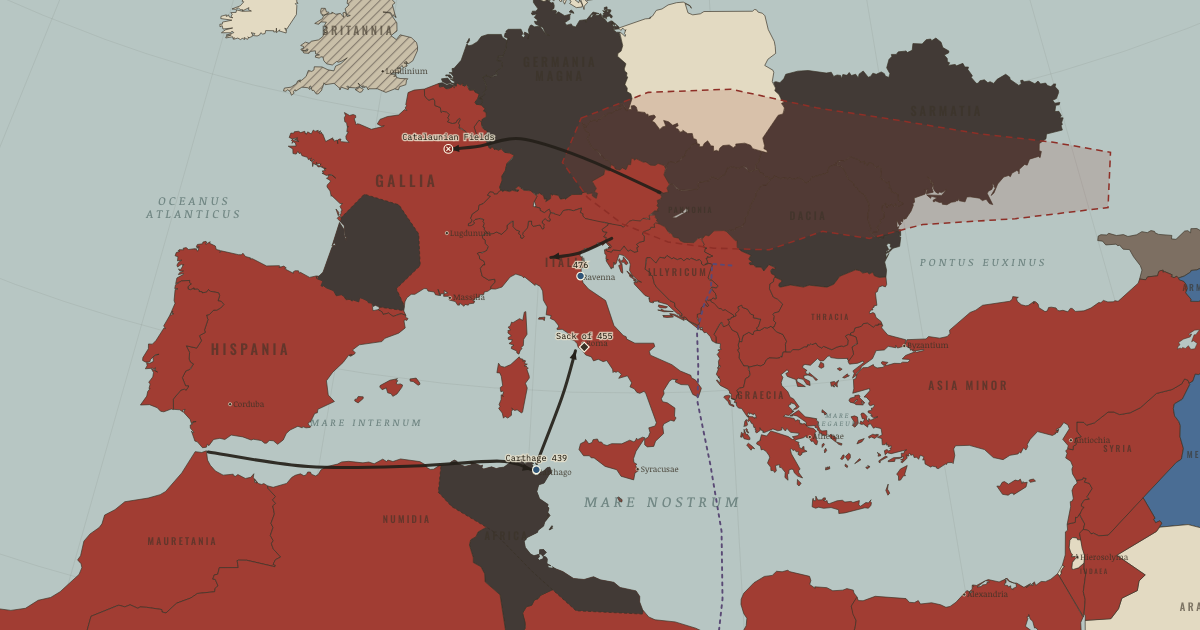
The single most important event on this map is the loss of Africa, and the way it happened shows how the West actually died. In 429 the Vandal king Geiseric ferried his whole people, perhaps eighty thousand of them, across the strait of Gibraltar and marched them east along the African coast, and on 19 October 439 he took Carthage without even a siege. Africa was to the West what Egypt was to the East. Its grain fed the city of Rome, its taxes may have furnished something like two-fifths of the West’s remaining revenue once Britain, Spain and much of Gaul had stopped paying, and it was the one province the wars had never touched. The army the West could afford was already too small before 439, and after the loss of Africa the accounts simply stopped balancing, because each province lost meant fewer soldiers, which meant the next province could not be defended either.
The short answer
- The fiscal amputation of 439 — THE mechanism. Run the arithmetic the court in Ravenna ran. A late Roman soldier cost roughly the taxes of five peasant households; the West’s establishment on paper needed the revenues of Africa, Gaul, Spain and Italy combined. By 440: Britain gone (410), most of Spain gone (Sueves/Vandals, 409–420s), Aquitaine ceded to the Visigoths (418), northern Gaul autonomous — and then Africa, the largest single item, gone in a day. Post-439 revenue perhaps halved against unchanged threats; the deficit was paid in land grants to federates, i.e., in more tax base. That is not decline as metaphor — it is a spreadsheet dying of subtraction, and it is why the “fall” accelerates so smoothly after 439 regardless of who wins any battle.
- Armies of federates, loyal to the paymaster of the month. By the 450s “the Roman army” in the West was a coalition of Gothic, Hunnic, Burgundian and other war-bands under Roman patrons — superbly effective when paid (Catalaunian Fields), and structurally indistinguishable from the enemy when not. Odoacer’s coup was not an invasion but a payroll dispute: the soldiers wanted land in lieu of arrears, the government had no third option, and the government was the cheaper thing to liquidate. Note the continuity: Marius’ client-army logic from Chapter 4, returned at last for the principal.
- The East chose triage — rationally. Constantinople paid Attila off (tons of gold — cheaper than war), fortified the Theodosian Walls, and after Cape Bon (468) declined to bleed further for the West. Callous, and correct: the East’s survival preserved Roman law, administration and the tax engine that would fund Justinian’s (brief) reconquest of Africa and Italy in the next century. When a system must lose something, it loses the part that already consumes more than it yields. States, like bodies, sacrifice the extremities to save the core — the dashed 395 line on your map turns out to have been a triage line.
- Nobody inside was willing to die for it. The dog that doesn’t bark in 476: no popular rising, no senatorial resistance, no province begging reunion. Salvian (c. 440) reports poor Romans fleeing to the Goths to escape Roman taxmen; aristocrats kept their estates by serving new kings who — crucially — ruled through Roman law, Roman officials and the Roman church. For most western elites the fall was a change of management that lowered costs. An empire is a bargain about protection; when the protection stopped and the bills didn’t, the customers quietly closed the account. Measure every state you study by this test, not by its monuments.
THE TURNING POINT
Carthage, 19 October 439. No battle — Geiseric struck while the garrison watched the hippodrome races, says the tradition, and the tradition’s plausibility is the point: the West’s richest city fell to a people who a decade earlier had been refugees crossing a strait in fishing boats. Mark the irony six centuries deep: Rome’s rise began with the taking of Carthage’s sea (Chapter 1), and its fall is sealed by losing Carthage to a sea-borne enemy Rome could no longer out-build — the fleets of 441, 460 and 468 all failed where the Republic’s five fleets had succeeded. Same strait, same city, the machine now running in reverse. If this atlas has a single geometric moral, it is drawn between the two Carthage markers on this map.
What it changed
Kingdoms, not chaos. What replaces the western state is not anarchy but successor kingdoms — Visigothic Spain, Frankish Gaul, Vandal Africa, Ostrogothic Italy — each a barbarian military elite ruling a Roman majority through Roman bishops, Roman landowners and Latin law-codes. The Franks’ kingdom becomes France; the map of western Europe you carry in your head is, to a first approximation, the settlement pattern of 418–511 with a millennium of compound interest. Fall and foundation are the same event viewed from different centuries.
The Church inherits the west. As imperial administration dissolved, bishops — city-based, literate, endowed, organized in the empire’s own diocesan skeleton — became the west’s civic infrastructure: food, ransom, justice, records. The Bishop of Rome, already claiming primacy, now faced no emperor across town; the medieval papacy grows in exactly the vacancy 476 created. Institutions survive states when they perform the states’ functions — Chapter 12 completes this thought.
The East banks the inheritance. Constantinople in 476 holds the unbroken sequence: Roman law (Justinian’s codification, 529–534, is the direct ancestor of most of the world’s civil law), Greek learning, the solidus economy, and an emperor in a line from Augustus that no one interrupts until 1204. Everything the west spends the Middle Ages painfully reassembling, the east simply keeps. When you close this atlas, remember its final map shows Rome surviving — eastward, Greek-speaking, and convinced, for another 977 years, that it is simply Rome.
The full answer, argued
Geography first, most historians say: Constantinople sat behind the Bosporus and the Theodosian Walls, so no land invader could reach the eastern core or its Anatolian-Syrian-Egyptian tax base — while the West’s wealth (Africa, Italy, southern Gaul) lay open behind long river frontiers. Money second, and entangled: the protected east was also the richer, more urbanized, more monetized half, so it could pay Attila off, buy armies, and absorb defeats (it lost fleets at Cape Bon and recovered; the West lost Africa and never did). Luck third but real: the East drew no Geiseric, its Gothic crisis was exported west by diplomacy in 488 (Theodoric aimed at Italy), and its emperors happened not to be children during the worst decades. The implication for the West: within this ranking, its last real chance was fiscal-geographic — hold or retake Africa. Which is precisely what the courts of 441–468 believed: they staked three armadas on it. Strategy was not the failure; the sea battles were. History’s verdicts often ride on afternoons.
An interesting fact
History scripted the last act’s casting with suspicious neatness: the West’s final emperor bore the name of Rome’s founder and the diminutive of its first emperor — Romulus, called Augustulus, “little Augustus.” The pension was real: 6,000 solidi a year and the old villa of Lucullus on the Bay of Naples, where the deposed boy simply went on living — a letter of Cassiodorus from around 507–511 confirms a grant to one “Romulus,” so he may have outlived his empire by thirty years. Constantinople, meanwhile, never recognized him at all: on the legal ledger the last western emperor was Julius Nepos, holding court in Dalmatia until his murder in 480.
This is the study layer of Fall of the Western Roman Empire, chapter 11 of The Rise and Fall of Rome, 264 BC – AD 476; the full index of the atlas is here.
Related questions
THE FREE PRINTABLE STUDY GUIDE
Join the Dispatch — a short welcome series, then a letter when a new atlas opens — and the printable study guide for Rome is yours now, free.
NO TRACKING · YOUR ADDRESS IS USED FOR THE DISPATCH AND NOTHING ELSE · UNSUBSCRIBE ANYTIME