MAPS OF HISTORY · IB HISTORY · THE AMERICAN CIVIL WAR
IB HISTORY · 1840 – 1877 · 13 CHAPTERS
IB History: The American Civil War — notes, maps and essay questions
How a war of conquest made slavery the question no compromise could settle — then four years that killed more Americans than every other war combined, emancipation, and what Reconstruction won and lost.
IB notes for this atlas are in preparation. Meanwhile, this page gathers the study notes every one of its 13 chapters already carries: why each episode happened, the moment it turned on, what it changed, and the question historians still argue about. It also shows where the atlas fits the IB course.
WW2 is free — every chapter. Try chapters 1–2 of any 2 other atlases (3 with a free account). Opening a new atlas uses one of them. Membership opens all 21 — Join.
Where it fits the course
The atlas is filed under Paper 2 (Conflict) and Paper 3 for Higher Level (the Americas, (1840–1877)). Its IB notes, with evidence lists, primary sources and model essay plans, are in preparation. These are the IB History pages for the parts of the course it serves:
- Paper 2 · Conflict
- Paper 3 · The Americas · HL (1840–1877)
Why it began
Causation questions start at the beginning. These are the causes the atlas’s opening chapters argue, each in a few sentences you can test against your own reading.
Chapter 1: Manifest Destiny and the Mexican War
Land hunger and an ideology of destiny. Americans were moving west faster than their government could follow, so Washington came under pressure to secure land its citizens had already entered. Thousands took the Oregon Trail in the 1840s, the brown arrow on the map. Expansionists dressed this movement in the language of Manifest Destiny, the belief that Providence had given the continent to the United States. The idea joined real hopes, such as Pacific ports for the China trade, to a racial conviction that Mexicans and Native peoples should give way.
Polk’s determination to have California. The most direct cause was a president who wanted California badly enough to take it. Polk entered office in 1845 with a short list of goals, and California, with its harbours at San Francisco and San Diego, stood near the top. He first tried to buy it, sending John Slidell to Mexico City authorised to offer up to $25 million by most accounts, and the Mexican government refused to receive him. Polk then moved Taylor’s army to the Rio Grande, into land that Mexico held and Texas claimed, which turned a diplomatic refusal into an armed standoff.
A Mexican state at its weakest. Mexico in 1846 was in no condition to fight a long war. Its treasury was empty, its army was led by generals who also made and unmade governments, and its northern states had been devastated by Comanche and Kiowa raids. Mexican leaders could not sell territory without being overthrown, as Herrera discovered when Paredes toppled him for being willing to talk. Weakness made war more likely, because it left Mexico able neither to deter Polk nor to bargain with him.
Texas and the politics of slavery. Texas joined the Union as a slave state, and its annexation was argued in the language of slavery from the start. In 1844 Secretary of State Calhoun told the British minister that annexation would protect slavery from British abolitionism, and the Senate rejected the treaty that June partly for that reason. When annexation passed by joint resolution in 1845, Northern opponents saw the “slave power,” the slaveholders’ supposed grip on the federal government, enlarging itself. The war inherited that suspicion, which is why Northern congressmen moved at once to keep slavery out of its conquests.
Chapter 2: A House Dividing
Slavery as capital, not merely labor. Emancipation somewhere threatened property values everywhere: an enslaved person in Virginia was worth more because Mississippi and the territories were open markets. That is why the South fought over distant Kansas. Closing the frontier didn’t just limit slavery, it started the clock on its financial collapse. Follow the money and the politics of 1850–60 stop looking irrational.
Two economies, two civilizations. The free states built factories, railroads, public schools and cities of immigrants. The South built the world’s most profitable plantation economy on bound labor. Each section believed the other was betraying the Founders. The tariff, homesteads, railroads. Every national question became a proxy for the one question underneath.
The machinery of compromise breaks. Compromise had worked when both sections could win something. Kansas–Nebraska destroyed the one fixed rule (the 36°30′ line). Dred Scott destroyed the possibility of any new rule. And the caning of Senator Sumner on the Senate floor (1856) showed that even the forum itself was failing. Institutions do not usually die at once. They die rule by rule.
The sectional math of 1860. Free-state population had grown until it could elect a president alone. Lincoln carried every northern state and lost every slave state. The first purely sectional victory in American history. The South’s choice was now to live as a permanent political minority inside the Union, or to leave it. Secession was, among other things, a refusal to lose an election.
Chapter 3: Secession Winter
A four-month vacuum of power. The Constitution then left presidents-elect waiting until March. Buchanan held that secession was illegal but that coercion was also illegal. A doctrine of perfect paralysis. Into that vacuum the Deep South organized a government, seized arsenals and forts, and made secession a fact before anyone in Washington could contest it. Institutional dead time is when revolutions happen.
The secessionists’ own words. The ordinances and declarations are primary sources without ambiguity: Mississippi. “our position is thoroughly identified with the institution of slavery, the greatest material interest of the world.” Alexander Stephens, the Confederacy’s vice-president, called slavery the “cornerstone” of the new state. Later generations rewrote the cause. The founders of the Confederacy did not.
Sumter as a designed dilemma. Lincoln’s resupply announcement transferred the decision to Charleston: fire on food, or watch the fort stand. Davis chose war partly because the Confederacy needed the upper South and believed a fight would bring it in. Which it did, at the price of making the Confederacy the aggressor in Northern eyes and uniting a divided North overnight. Both presidents got the war they expected. Only one got the opening he wanted.
Why the border stayed. Lincoln suspended habeas corpus in Maryland, tolerated a rump legislature in Missouri, and famously kept hands off Kentucky’s declared “neutrality” until the Confederacy blundered first by occupying Columbus. “I hope to have God on my side,” he is said to have remarked, “but I must have Kentucky”. With it came the Ohio River line, Missouri’s rivers, and 400,000 white men of military age plus, later, tens of thousands of Black recruits.
Chapter by chapter
The atlas has 13 chapters. For each, the causes it explains and the moment it turns on; the title opens the chapter’s free page with the full explanation, a discussion question and the map.
1. Manifest Destiny and the Mexican War
CHAPTER 1 · 1840–1850
Why it happened: Land hunger and an ideology of destiny · Polk’s determination to have California · A Mexican state at its weakest · Texas and the politics of slavery
The turning point: The Wilmot Proviso, 8 August 1846.
2. A House Dividing
CHAPTER 2 · 1850–1860
Why it happened: Slavery as capital, not merely labor · Two economies, two civilizations · The machinery of compromise breaks · The sectional math of 1860
The turning point: 6 November 1860 — the election.
3. Secession Winter
CHAPTER 3 · NOV 1860–MAY 1861
Why it happened: A four-month vacuum of power · The secessionists’ own words · Sumter as a designed dilemma · Why the border stayed
The turning point: Fort Sumter, 12–14 April 1861.
4. The Illusions of 1861
CHAPTER 4 · APR–DEC 1861
Why it happened: Ninety-day thinking · Asymmetry of objectives · Armies before soldiers
The turning point: Bull Run, 21 July 1861.
5. The Anaconda and the Rivers
CHAPTER 5 · NOV 1861–JUN 1862
Why it happened: Geography as strategy · The blockade’s slow arithmetic · Grant emerges · Ironclads make the blockade possible
The turning point: Shiloh, 6–7 April 1862.
6. The Virginia Deadlock
CHAPTER 6 · MAR–AUG 1862
Why it happened: McClellan’s mathematics of caution · Interior lines and the Valley · Lee’s gamble on the offensive
The turning point: Gaines’ Mill and the Seven Days, 25 June–1 July 1862.
7. Antietam and Emancipation
CHAPTER 7 · SEP 1862–JAN 1863
Why it happened: Why Lee invaded · Why the Proclamation waited · The border-state calculus · McClellan’s last battle
The turning point: Antietam, 17 September 1862.
8. The Twin Turning
CHAPTER 8 · MAY–JUL 1863
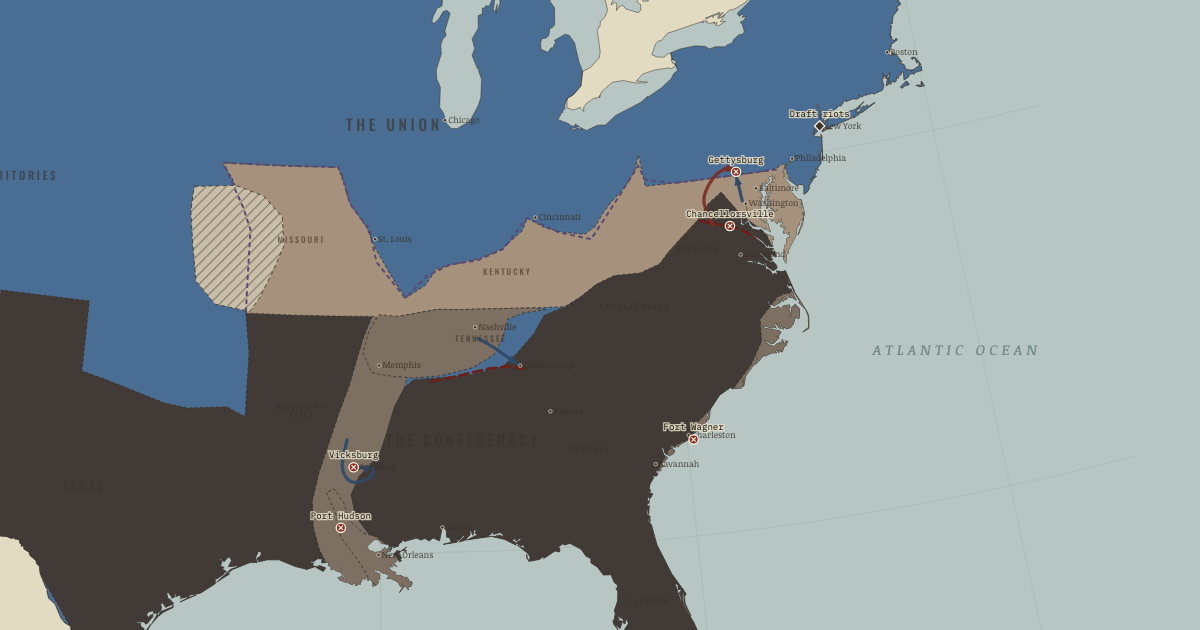
Why it happened: Why Lee rolled the dice again · Vicksburg as a problem of approach · Two societies under strain
The turning point: Vicksburg, 4 July 1863.
9. Hard War
CHAPTER 9 · SEP 1863–SEP 1864
Why it happened: Grant’s theory of simultaneity · The trench ascendancy · The clock behind everything · Race war inside the war
The turning point: The Brock Road crossroads, 7 May 1864.
10. The Ballot and the March
CHAPTER 10 · SEP–DEC 1864
Why it happened: Why the election was the real front · The march as calculated demonstration · Hood’s inversion
The turning point: 8 November 1864 — the Union votes.
11. Appomattox
CHAPTER 11 · JAN–APR 1865
Why it happened: Why the end came fast · The terms as war aims achieved · Why no guerrilla war?
The turning point: Appomattox Court House, 9 April 1865.
12. Reconstruction — The Unfinished Revolution
CHAPTER 12 · 1865–1877
Why it happened: Land was the revolution not attempted · Johnson’s presidency as the pivot · The occupation the North would not sustain · The courts as counter-revolution’s partner
The turning point: Colfax, Easter Sunday 1873.
13. Memory and Meaning
EPILOGUE · MEMORY AND MEANING
Why it happened: Why the Lost Cause won the memory war for so long · What the numbers do to interpretation · The war as the modern state’s forge
The turning point: Gettysburg, 19 November 1863.
Essay questions, argued
Every chapter ends with a discussion question that historians still argue about, with our answer in brief. Use them as essay practice: plan your own answer, then read how we would argue it.
DISCUSSION QUESTION · CHAPTER 1
Was the Mexican War a war for slavery?
The case for yes begins with Texas, which entered as a slave state after Calhoun had defended annexation as protection for slavery, and it gains force from Southern enthusiasm for the war. The case for no rests on Polk’s aims, which centred on California’s harbours, on the Northern Democrats who backed the war, and on the Southern Whigs who opposed it for fear of what new land would do to the Union. Geography weakened the slavery motive too, since few planters expected cotton to grow in most of the Mexican Cession, the land Mexico gave up in 1848. The stronger verdict separates motive from consequence. The war was fought chiefly for land and ports, yet once won it forced the question of slavery’s expansion onto every vote that followed, so slavery decided what the war meant even where it did not decide why it began. The same distinction serves for many wars, whose causes and consequences often turn out to be different things.
The chapter behind it: Manifest Destiny and the Mexican War. Every chapter’s question is on the discussion questions page.
DISCUSSION QUESTION · CHAPTER 5
The Anaconda Plan was ridiculed in 1861 and essentially followed thereafter. Why do slow strategies get adopted only after fast ones fail?
Because publics, editors and politicians pay the costs of slowness immediately (taxes, casualty lists with nothing to show, elections) while its benefits are statistical and deferred. Falling Southern imports never made a headline the way Bull Run did. Democracies especially must buy time for attrition with visible victories, which is partly what the river campaigns were: the anaconda with drama attached. Notice the pattern’s recurrence. Blockades, sanctions, containment. The slow strategy is usually announced as a complement to decisive battle and quietly becomes the main effort once decisive battle disappoints. Scott was not overruled. He was pre-validated and had to wait for the war to admit it.
The chapter behind it: The Anaconda and the Rivers. Every chapter’s question is on the discussion questions page.
DISCUSSION QUESTION · CHAPTER 9
Was Grant a “butcher” — and what would answering that question rigorously require?
Require comparison, not recoil. Compute both ledgers: Overland losses were enormous absolutely, but Lee’s were worse as a share of force, and Lee’s were irreplaceable. By June 1864 the Army of Northern Virginia could no longer maneuver in the open, which was the campaign’s purpose. Compare careers: Grant’s Vicksburg and Chattanooga were masterpieces of economy. McClellan’s “careful” war produced Antietam’s single day and two more years of fighting. And the gentlemanly seesaw of 1861–63 killed steadily without ending anything. The harder truth: against an entrenched enemy who must be conquered rather than persuaded, the choice was never bloody-versus-bloodless but shorter-versus-longer bleeding. Say that, and then keep the number 55,000 in view anyway. Strategic judgment that stops feeling its costs becomes the butchery it denies.
The chapter behind it: Hard War. Every chapter’s question is on the discussion questions page.
DISCUSSION QUESTION · CHAPTER 13
Was the Civil War “irrepressible” — or a failure of politics that better statesmen could have avoided?
Take the avoidable case seriously: wars require decisions, and you can name each one (Kansas–Nebraska, Dred Scott, secession itself, Sumter) and imagine it otherwise. A generation of “blundering” historians did. Then test the counterfactuals against the structure: every compromise on offer. Crittenden, compensated emancipation, extended lines. Required one section to accept slavery’s eventual death or the other to accept its permanence, which is not a middle but a winner. Peaceable exits existed only if four million people remained property indefinitely. That is a price, not a solution, and the enslaved themselves. Running, resisting, and finally soldiering. Were actors who foreclosed it. The mature answer: the CONFLICT was irrepressible because it was zero-sum at its core. The WAR’s timing, length and horror were contingent on choices this atlas has charted. Distinguishing a conflict from its war. What had to happen from what was chosen. Is perhaps the discipline this entire subject exists to teach.
The chapter behind it: Memory and Meaning. Every chapter’s question is on the discussion questions page.
What it changed
Consequence questions need the end of the story. The final chapter, Memory and Meaning, sets out what the period left behind:
What stayed settled. No state has attempted secession since. The Thirteenth Amendment has never been seriously challenged. “the Union” stopped being a debating point and became the weather. Constitutional questions truly closed by force are rare in history. This atlas shows the price of closing one.
What stayed open. Citizenship’s content. The vote, the school, the jury, the deed. Remained contested from Colfax to Selma along precisely the lines this map drew. Read any twentieth-century civil-rights map beside this one: the geography rhymes, county by county. That planned atlas is this one’s sequel in spirit.
Revision tools
The atlas ends with a map quiz that asks you to find places and moments on the map itself (part of membership and of the Exam Sprint). The quick quiz and the discussion questions with our answers are free pages on this site, and the printable study guide gathers every chapter’s notes into one document for revision.
Read next
- The American Revolution and the Age of Revolutions · THE AGE OF REVOLUTIONS
- America industrialises after the war · THE INDUSTRIAL REVOLUTION
Maps of History is independent and is not affiliated with or endorsed by the International Baccalaureate Organization. IB course names describe alignment only; paper, theme and section names follow the new course outline and may change when the final guide is published.
THE DISPATCH
A short welcome series, then a letter when a new atlas opens — and the printable study guide for The American Civil War is yours now, free.
NO TRACKING · YOUR ADDRESS IS USED FOR THE DISPATCH AND NOTHING ELSE · UNSUBSCRIBE ANYTIME