ON THIS DAY ·
Third Battle of Seoul
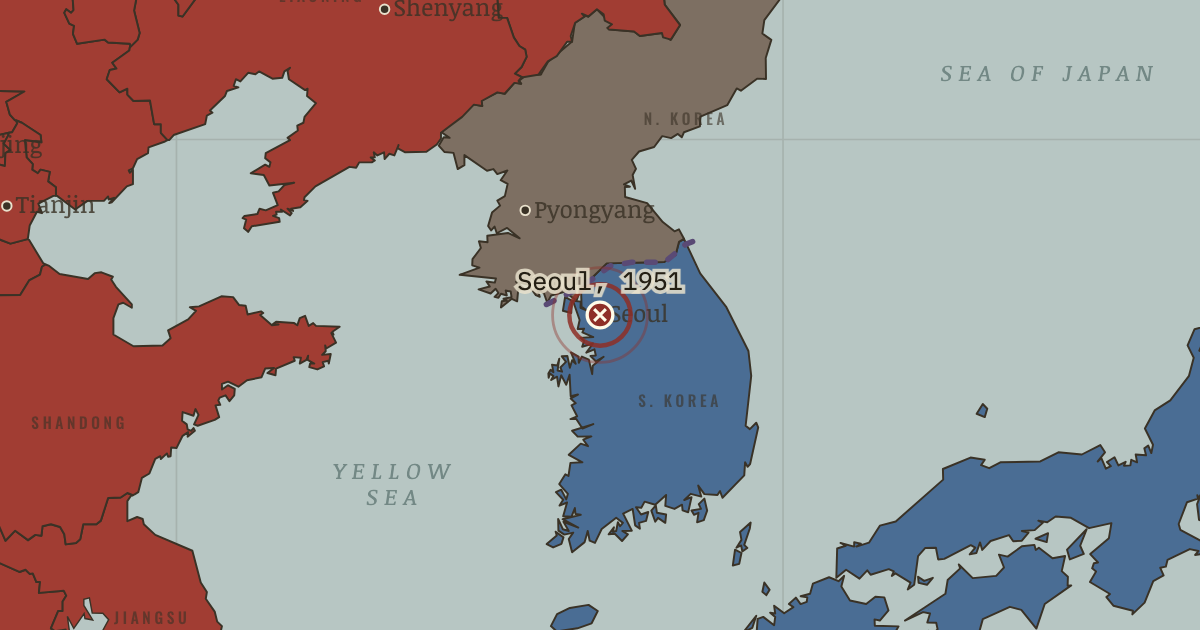
4 Jan 1951 — Peng Dehuai’s third offensive retakes Seoul, the high-water mark of the Chinese intervention. Long supply lines and American firepower stop the next push; in March the city changes hands for the fourth time, and from mid-1951 the front settles near the 38th parallel, where the war began.
WW2 is free — every chapter. Try chapters 1–2 of any 2 other atlases (3 with a free account). Opening a new atlas uses one of them. Membership opens all 21 — Join.
The moment in context
China entered the Korean War because Mao judged that the risks of staying out were greater than the risks of fighting. The arrows show how close the danger came: after the landing at Incheon in September 1950, United Nations forces crossed the 38th parallel, the line dividing the two Koreas, and pushed north towards the Yalu, the river border with Manchuria, China’s industrial north-east. Zhou Enlai, the premier and foreign minister, warned through the Indian ambassador that China would act, and Washington dismissed the warning as bluff. The general Lin Biao declined to command, so Mao gave the task to Peng Dehuai, a veteran of the civil war. The Chinese People’s Volunteers, as the army was called in Korea, crossed at Andong by night on 19 October, and by late November they had trapped American columns at the Chosin Reservoir and along the Chongchon River. In January 1951 they retook Seoul, which marked the high point of an intervention that had surprised the world’s strongest army.
From Korean War and Mao’s mass campaigns, chapter 2 of The People’s Republic under Mao, 1949–1976 (1953).
The place: Third Battle of Seoul — map and full story →
Teach this in 5 minutes
- Why it happened — Kim Il-sung’s war and Stalin’s consent. The Korean War began with North Korea’s invasion of the South on 25 June 1950, which Stalin approved in April and Mao accepted when Kim Il-sung…
- The turn — The Yalu, 19 October 1950. The crossing of the Yalu was the hinge because it turned the new state’s first year from consolidation into permanent emergency. Before October 1950…
- What it changed — A general with the prestige to object. Korea made Peng Dehuai the most respected soldier in China, the man who had held off the Americans with a peasant army. That reputation gave him the…
Then ask the room: Did the Korean War strengthen or weaken Mao’s new state? The argued answer is on the chapter page →
The atlas that shows it
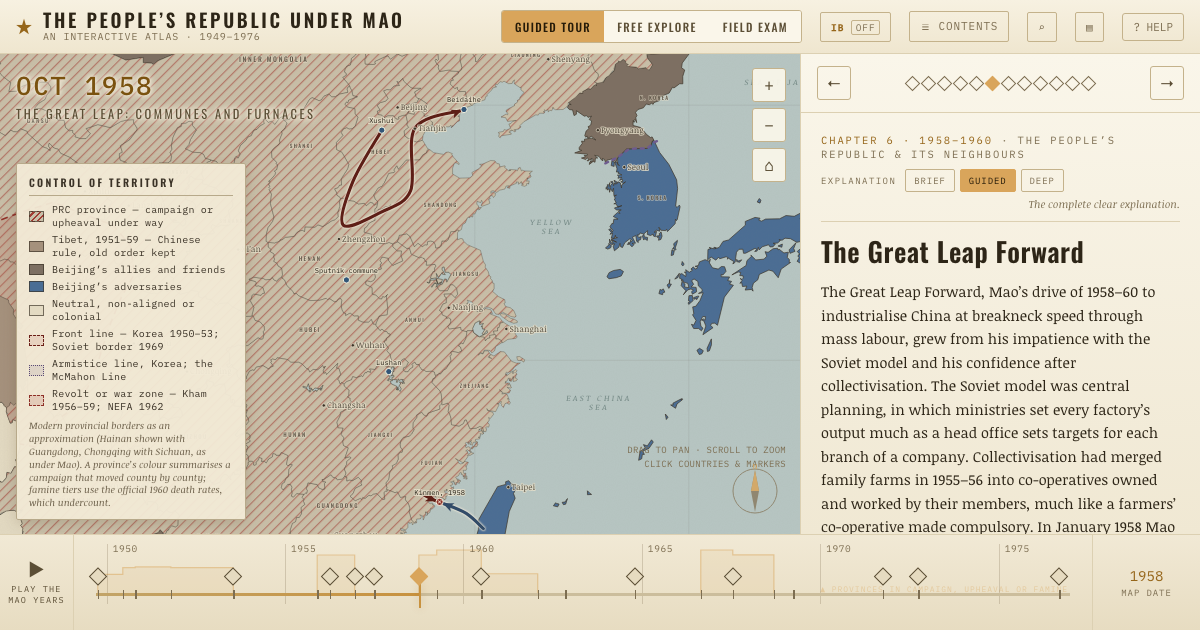
THE FREE PRINTABLE STUDY GUIDE
Join the Dispatch — a short welcome series, then a letter when a new atlas opens — and the printable study guide for The People’s Republic under Mao is yours now, free.
NO TRACKING · YOUR ADDRESS IS USED FOR THE DISPATCH AND NOTHING ELSE · UNSUBSCRIBE ANYTIME