Mao’s China · CHAPTER 2 ·
Korean War and Mao’s mass campaigns
Chapter 2 of The People’s Republic under Mao, 1949–1976: “Korea and the Campaigns”
North Korea invaded the South in June 1950, and on 19 October Chinese troops crossed the Yalu as the “Chinese People’s Volunteers”. They pushed UN forces back to near the 38th parallel at a cost of about 200,000 to 400,000 Chinese dead, while the war gave the Party reason to destroy its remaining opponents at home.
WW2 is free — every chapter. Try chapters 1–2 of any 2 other atlases (3 with a free account). Opening a new atlas uses one of them. Membership opens all 21 — Join.
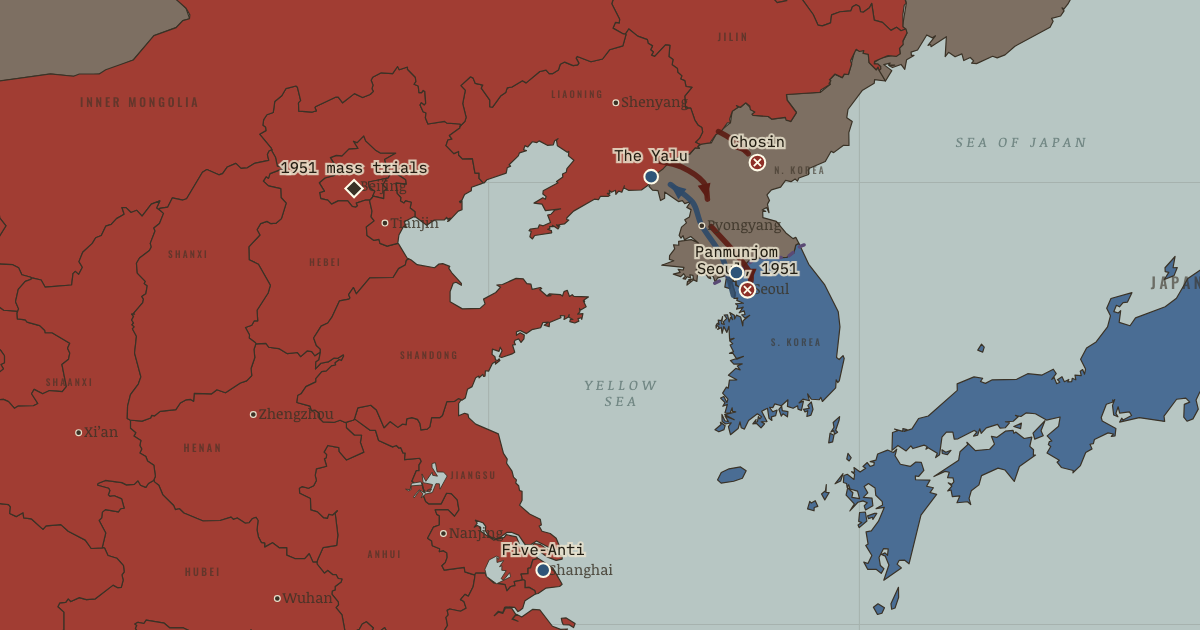
The map above is the world of China, July 1953 — Armistice in Korea; land reform complete.
Part of IB History: The People’s Republic under Mao →
BRIEF EXPLANATION — THE ESSENTIAL ARGUMENT
The Korean War made Mao’s new state stronger at home even as it cost China dearly abroad, because a war against the United States gave the Communist Party, which now ruled alone, both the reason and the public mood to destroy its remaining opponents. North Korea invaded the South in June 1950 with the approval of Stalin, the Soviet dictator, and with Mao’s agreement. By October American-led United Nations forces had crossed the 38th parallel, the line dividing the two Koreas, and were driving towards the Yalu River on China’s border. On 19 October Chinese troops crossed the Yalu as the “Chinese People’s Volunteers”, a name that let Beijing fight the world’s strongest power without formally declaring war. In three years of fighting they pushed the UN forces back to roughly where the war began, at a cost of somewhere between about 200,000 and 400,000 Chinese dead, and the armistice of July 1953, a ceasefire agreement that has never become a peace treaty, left Korea divided. Fighting the United States to a standstill gave the new state a prestige that it would spend at home.
At home the war powered three campaigns, each a burst of organised mobilisation aimed at a named enemy, much like a national emergency in which ordinary rules are suspended. The Campaign to Suppress Counter-revolutionaries, launched in October 1950 against anyone accused of working for the old regime or its foreign allies, held mass trials in stadiums and executed 712,000 people by the Party’s own count. The Three-Anti campaign of 1951–52 attacked corruption, waste and bureaucracy among officials, and the Five-Anti campaign of 1952 turned on the private businessmen whom the coalition of 1949 had promised to protect. On the map the arrows trace the advance and retreat in Korea, the dotted line marks the armistice, and the provinces turn solid red as land reform is completed. By 1953 the Party faced no organised opposition anywhere in China, and the campaign, with its quotas, accusations and confessions, had become its normal way of governing.
The full story
China entered the Korean War because Mao judged that the risks of staying out were greater than the risks of fighting. The arrows show how close the danger came: after the landing at Incheon in September 1950, United Nations forces crossed the 38th parallel, the line dividing the two Koreas, and pushed north towards the Yalu, the river border with Manchuria, China’s industrial north-east. Zhou Enlai, the premier and foreign minister, warned through the Indian ambassador that China would act, and Washington dismissed the warning as bluff. The general Lin Biao declined to command, so Mao gave the task to Peng Dehuai, a veteran of the civil war. The Chinese People’s Volunteers, as the army was called in Korea, crossed at Andong by night on 19 October, and by late November they had trapped American columns at the Chosin Reservoir and along the Chongchon River. In January 1951 they retook Seoul, which marked the high point of an intervention that had surprised the world’s strongest army.
The war then became a test of endurance that China could survive and could not win. Chinese armies, short of artillery, trucks and air cover, attacked in waves and lost heavily to American firepower; Mao’s own son Mao Anying was killed in an air raid on Peng’s headquarters in November 1950. From mid-1951 the front settled near the 38th parallel, and two more years of talks stalled above all on prisoners, because about 14,000 of the 21,000 Chinese captives refused to go home and chose Taiwan instead. The armistice signed at Panmunjom, a village on the front line, on 27 July 1953 left Korea divided along the line shown on the map. Beijing’s official count of its dead rose from 183,108 in 2010 to 197,653 in 2020, while other estimates run to about 400,000. Because China had fought the United States to a standstill, the new state drew enormous prestige from a war it had not won.
At home the war turned suspicion into policy through the campaign, the method by which the Communist Party, now the sole ruler of China, mobilised the nation against a named enemy, much like a wartime emergency drive in which ordinary rules are suspended. A Party order of 10 October 1950, the “Double Tenth” directive, launched a hunt for “counter-revolutionaries”, a label covering former Nationalist officials, leaders of secret societies such as Shanghai’s Green Gang, bandits and anyone accused of sabotage, and Mao suggested that executions should run at about one per thousand people. Cities held public trials in stadiums, broadcast on radio, and a 1954 report counted 712,000 executed, 1.29 million imprisoned and 1.2 million placed under police watch. The Three-Anti campaign then purged officials for corruption, and the Five-Anti campaign, named for five “poisons” such as bribery and tax evasion, fined and humiliated businessmen until private firms depended on the state; in Shanghai hundreds of owners took their own lives. Each campaign used the same tools of quotas, mass meetings and forced confession, and the Party learned that a method which worked in wartime could be used in peacetime too.
DEEP EXPLANATION — EVIDENCE & INTERPRETATION
Why did Mao send troops to Korea?
For decades the standard account, set out by Allen Whiting in 1960, treated the intervention as a defensive reaction: American troops approaching the Yalu threatened Manchuria’s factories and power stations, and Beijing acted only when its warnings were ignored. Chinese and Russian documents released after the Cold War complicated that picture. Chen Jian, in China’s Road to the Korean War (1994), shows that Mao was preparing forces in Manchuria from the summer of 1950 and pressed a reluctant Politburo to fight, because he believed a revolutionary China had to confront American power somewhere and that war would rally the country behind the new state. Stalin’s role also looks different now: he had approved Kim Il-sung’s invasion, urged Chinese intervention, and then hesitated over the air cover he had promised, so the Volunteers went in without it. Most historians now combine the explanations. Security fears were real, but Mao chose war when other leaders hesitated, and he valued what the war could do inside China as well as on the peninsula.
The campaign as a way of governing
Historians use the word campaign, yundong in Chinese, for a particular technique of rule, and the years 1950–53 show it fully formed. A campaign named a target, set quotas for how many enemies each area should find, sent work teams to mobilise the public through meetings and accusations, extracted confessions, and then ended with a “rectification” that blamed local officials for excesses. Julia Strauss calls the result “paternalist terror”: the centre demanded results, local cadres competed to supply them, and the centre then posed as the force that restored moderation. Yang Kuisong’s study of the Party’s own documents shows Mao setting execution ratios in early 1951 and then, in late April, slowing the killing when it ran ahead of plan, and he argues that the real total exceeded the official 712,000. The method was efficient at producing obedience and very poor at correcting its own errors, because officials learned that the safest course was to overfulfil every target.
How the Five-Anti campaign broke private business
The Common Program of 1949 had promised private businessmen a place in the new order, and the Five-Anti campaign of 1952 shows how that promise was emptied without being formally withdrawn. Firms were investigated for five offences: bribery, tax evasion, theft of state property, cheating on government contracts and stealing state economic secrets. Employees were encouraged to denounce their bosses at meetings, and owners were classified from “law-abiding” to “completely lawless”, with the great majority found guilty of something and fined, often heavily enough to transfer their working capital to the state. Many owners were humiliated in public, and in Shanghai hundreds killed themselves in the first months of 1952. Private firms survived on paper, but they now depended on state orders, state credit and state approval. When the remaining enterprises were turned into “joint state-private” companies in January 1956, the change met almost no resistance, because the campaign of 1952 had already done the decisive work.
Key places on the map
On this day
Why it happened
Kim Il-sung’s war and Stalin’s consent. The Korean War began with North Korea’s invasion of the South on 25 June 1950, which Stalin approved in April and Mao accepted when Kim Il-sung visited Beijing in May. Mao expected a quick northern victory and planned to invade Taiwan the same year. Instead, the war brought the American Seventh Fleet into the Taiwan Strait and an American army to the Korean peninsula, which turned a civil war between Koreans into a direct threat on China’s doorstep.
MacArthur crossed the parallel. The UN landing at Incheon on 15 September 1950 broke the North Korean army, and the decision to pursue it across the 38th parallel in early October put American troops on the road to the Yalu. Zhou Enlai’s warning through the Indian ambassador, K. M. Panikkar, was dismissed in Washington as bluff. General MacArthur assured President Truman that China would not intervene, or would be crushed if it did, and that miscalculation decided the course of the next three years.
Mao wanted the confrontation. Archival research shows that Mao had his own reasons to fight, beyond defending the border. He believed revolutionary China had to stand up to American power to win respect abroad and loyalty at home, he owed North Korea a debt for Korean soldiers who had fought in the Chinese civil war, and he feared that a hostile Korea would threaten the industrial north-east. When much of the Politburo hesitated in early October, Mao overruled them, and his personal authority carried the decision.
A state that felt surrounded by enemies. The new government still faced armed opposition in 1950: Nationalist units and bandit gangs in the south-west, secret societies in the countryside, and agents sent from Taiwan. The Party claimed it had to suppress about a million “bandits” in its first years. Once China was at war with the United States, every one of these could be presented as part of a foreign plot, which made it easy to treat suspicion as evidence and to turn a security operation into a national campaign.
THE TURNING POINT
The Yalu, 19 October 1950. The crossing of the Yalu was the hinge because it turned the new state’s first year from consolidation into permanent emergency. Before October 1950 the Party was still courting businessmen, intellectuals and foreign governments; after it, China was at war with the United States, cut off from Western trade by an embargo, and bound to the Soviet Union for weapons and loans. The Double Tenth directive against counter-revolutionaries came nine days before the crossing, and the two decisions belong together, since a state fighting abroad could demand total loyalty at home. From then on, the campaign was the state’s normal instrument of government.
What it changed
A general with the prestige to object. Korea made Peng Dehuai the most respected soldier in China, the man who had held off the Americans with a peasant army. That reputation gave him the standing to send Mao a frank letter about the Great Leap Forward in 1959, and it is part of why Mao treated the letter as so dangerous. The war produced the critic whom the Leap would destroy.
The campaign becomes the method of rule. The tools tested in 1950–53, namely quotas, mass meetings, forced confessions and later “corrections” of excess, were used again against intellectuals in 1957, peasants in 1958 and the Party itself in 1966. Officials learned that overfulfilling a campaign target was safe and that caution could be labelled sympathy with the enemy. Each new campaign therefore ran hotter than the centre had planned, and each ended by blaming the officials who had obeyed.
Locked into the Soviet camp. The war left China under an American-led trade embargo from 1951 and dependent on Soviet weapons, which it had to pay for, and on Soviet loans and advisers. The First Five-Year Plan, launched in 1953, was therefore built on the Soviet model with Soviet equipment, so the decision to fight in Korea also shaped how China would industrialise. The war turned a political preference for the Soviet model, declared in 1949, into a dependence China could not escape.
Taiwan behind an American shield. The fleet that Truman sent into the strait in June 1950 never left, and in 1954 Washington signed a defence treaty with the Nationalists. Korea therefore cost Mao the chance to finish the civil war, and the question of Taiwan stayed at the centre of Chinese foreign policy until the Nixon visit of 1972 and beyond. Beijing shelled the offshore islands in 1954 and 1958 to test that American commitment.
DISCUSSION QUESTION — Did the Korean War strengthen or weaken Mao’s new state?
The costs were heavy and should not be minimised: between about 200,000 and 400,000 Chinese soldiers died, much of the budget went on the war, China owed the Soviet Union for its weapons, and the American fleet put Taiwan out of reach. Yet inside China the war strengthened the regime in ways that peace could not have done. It allowed the Party to present the campaigns against counter-revolutionaries, corrupt officials and businessmen as patriotic defence, it raised donations and recruits from every province, and it gave the new state a prestige no Chinese government had held since the Opium Wars, because a peasant army had fought the United States to a draw. Chen Jian argues that this domestic mobilisation was one of Mao’s aims from the start, while others stress that the decision was a gamble whose costs fell on soldiers and families. The answer therefore depends on the measure: as a state, China emerged harder, more unified and more feared; as a society, it emerged poorer, more isolated and more afraid. The general lesson is that external war often strengthens a new authoritarian regime by turning dissent into treason.
An interesting fact
The war was paid for partly by a national donation drive in which factories, villages and schools raised money to “buy” aircraft and guns for the front. Its most famous donor was Chang Xiangyu, a star of Henan opera, who toured China for six months in 1951 performing a play about the woman warrior Hua Mulan and gave the proceeds for a MiG-15 fighter. The aircraft, with her troupe’s name painted on its nose, now stands in the China Aviation Museum north of Beijing. Donation drives of this kind, repeated in later campaigns, made patriotism something citizens performed in public and could be measured by what they gave.
Related
THE FREE PRINTABLE STUDY GUIDE
Join the Dispatch — a short welcome series, then a letter when a new atlas opens — and the printable study guide for The People’s Republic under Mao is yours now, free.
NO TRACKING · YOUR ADDRESS IS USED FOR THE DISPATCH AND NOTHING ELSE · UNSUBSCRIBE ANYTIME