ON THIS DAY ·
Hujum unveiling campaign
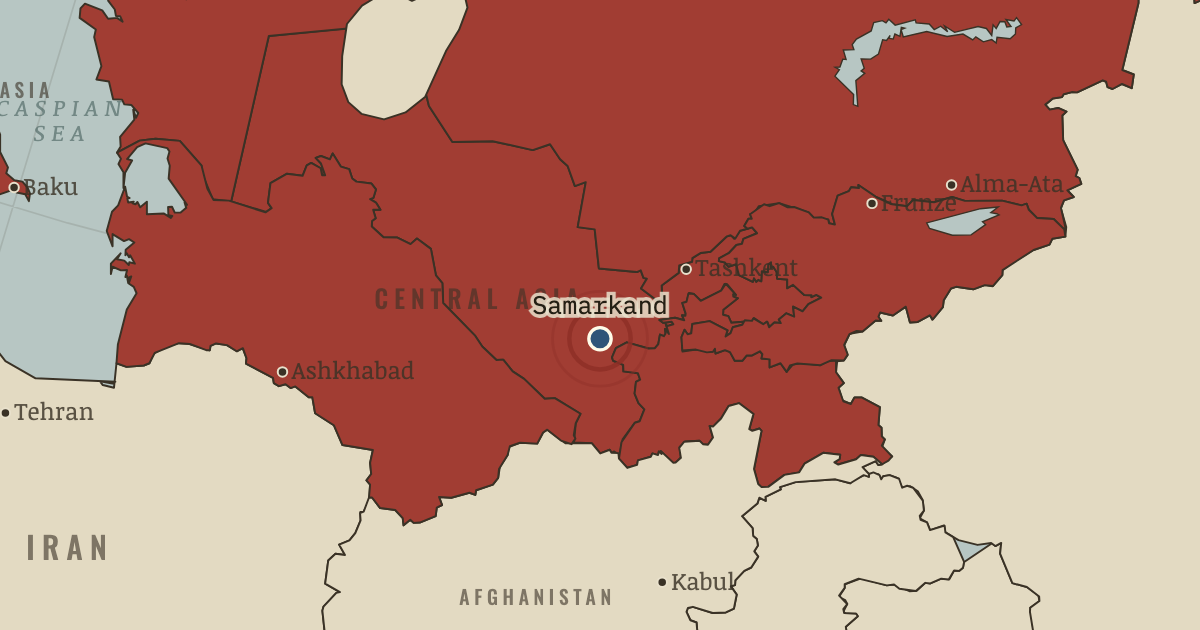
8 Mar 1927 — On International Women’s Day, thousands of women in Samarkand, then the Uzbek capital, and other cities cast off and burned their paranji veils in a party campaign called the hujum (“assault”). A violent backlash followed, in which hundreds of unveiled women were murdered.
WW2 is free — every chapter. Try chapters 1–2 of any 2 other atlases (3 with a free account). Opening a new atlas uses one of them. Membership opens all 21 — Join.
Free printable Stalin’s Soviet Union study guide, sent by email ↓
The moment in context
The movement from village to town remade Soviet society within a decade, and the map’s arrows show its main channels. Peasants fleeing collectivisation, the forced merger of their farms into state-run collectives, and famine, and others recruited by factories, poured into Moscow, the Donbas mines, Magnitogorsk and the new industrial towns. Housing could not keep up: families lived in one room of a kommunalka, a communal apartment in which several families shared a kitchen and toilet, much like a permanent house-share with strangers, while builders at Magnitogorsk lived in tents, barracks and earth dugouts. Food was rationed from 1929 to 1935, with better rations for industrial workers and officials, and the privileged shopped in “closed” stores open only to them. The internal passport system of 1932, an identity document that worked like a residence permit, tried to control who could live in the cities. For many new arrivals, urban life was hard but still better than the collective farm they had left.
From Women and daily life under Stalin, chapter 9 of The Soviet Union under Stalin, 1924–1953 (1940).
The place: Hujum unveiling campaign — map and full story →
Teach this in 5 minutes
- Why it happened — Industrialisation needed millions of new workers. The Five-Year Plans created jobs faster than towns could absorb people, and the industrial workforce more than doubled between 1928 and 1932.…
- The turn — Ivanovo and the law of June 1936. The decree of 27 June 1936 is the hinge of the Great Retreat because it showed the state reversing the revolution’s promise of personal freedom in…
- What it changed — A society of new cities and new classes. Stalin’s revolution created an urban society: by 1939 one Soviet citizen in three lived in a town, against one in five in 1926, and a new educated…
Then ask the room: To what extent did Stalin’s policies improve the lives of Soviet women? The argued answer is on the chapter page →
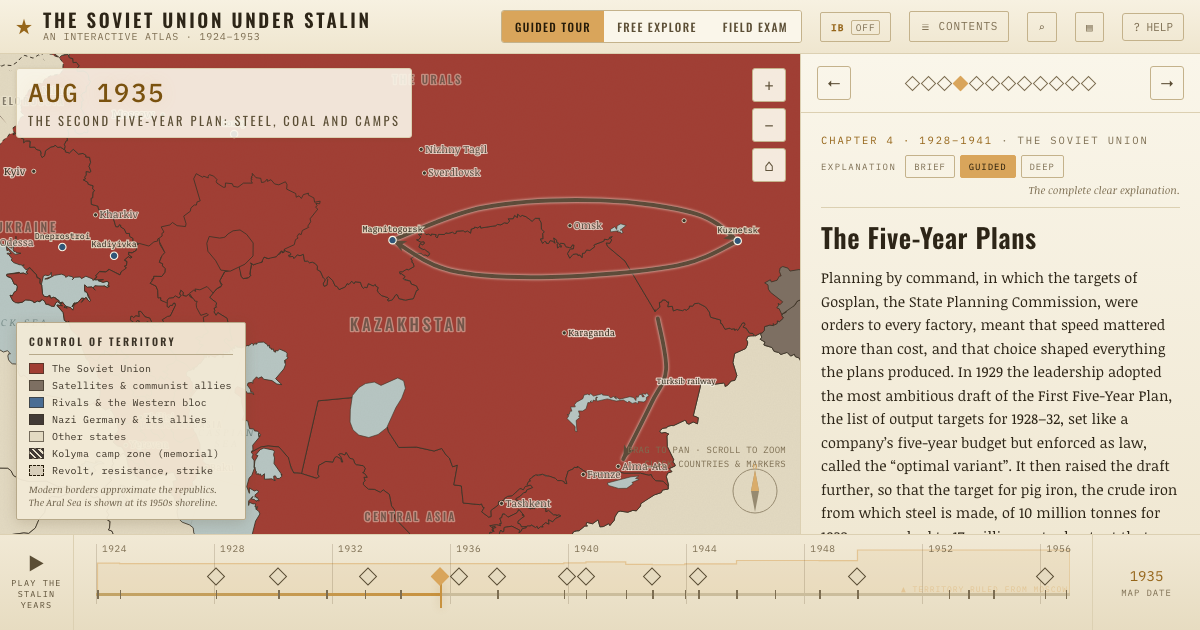
The atlas that shows it
THE FREE PRINTABLE STUDY GUIDE
Join the Dispatch — a short welcome series, then a letter when a new atlas opens — and the printable study guide for The Soviet Union under Stalin is yours now, free.
NO TRACKING · YOUR ADDRESS IS USED FOR THE DISPATCH AND NOTHING ELSE · UNSUBSCRIBE ANYTIME