Stalin’s Soviet Union · CHAPTER 9 ·
Women and daily life under Stalin
Chapter 9 of The Soviet Union under Stalin, 1924–1953: “Daily Life, Women and Family”
Industrialisation drew millions of peasants into Soviet cities, and the urban population grew from about 26 million in 1926 to 56 million in 1939. Newcomers gained jobs, schooling and promotion but faced communal flats, rationing until 1935 and harsh labour laws, while women carried a double burden of work and home.
Chapter 9 is part of membership. WW2 is free — every chapter. Try chapters 1–2 of any 2 other atlases (3 with a free account). Opening a new atlas uses one of them. Membership opens all 21 — Join.
Free printable Stalin’s Soviet Union study guide, sent by email ↓
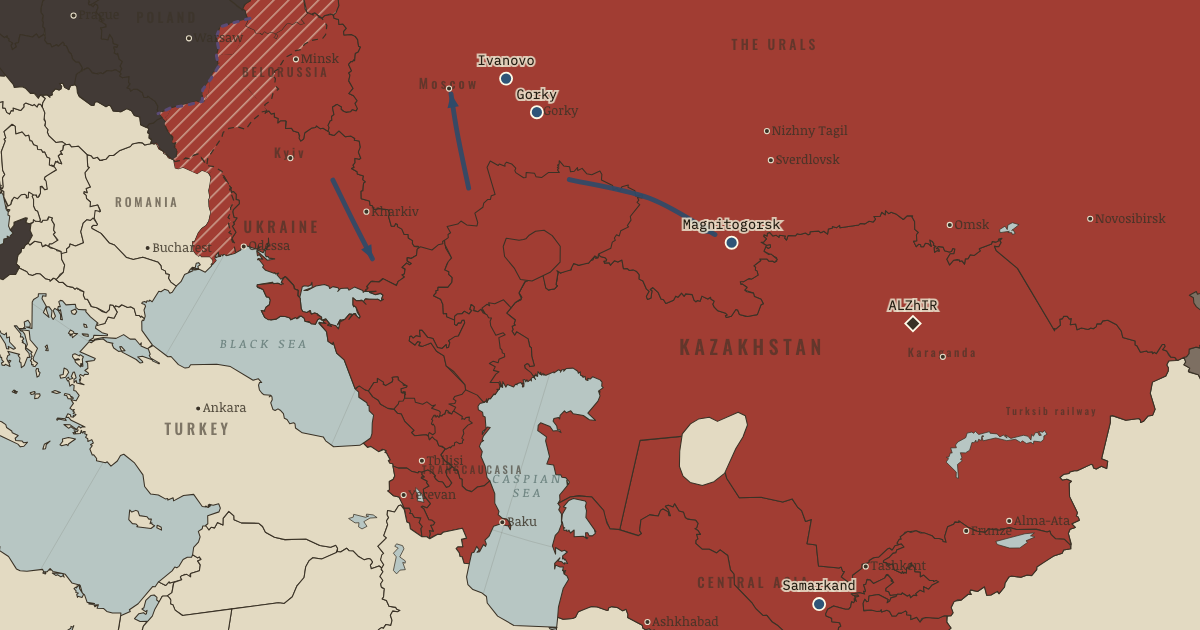
The map above is the world of The Soviet Union, June–August 1940 — The labour decree; the Baltic states annexed.
Part of IB History: The Soviet Union under Stalin →
BRIEF EXPLANATION — THE ESSENTIAL ARGUMENT
Stalin’s revolution changed daily life more than any other event in the Soviet century, and whether it improved lives depended on who you were. The arrows on the map show the great movement that drove the change: millions of peasants leaving the villages for cities and building sites, so that the urban population roughly doubled from about 26 million in 1926 to 56 million in 1939. Newcomers found jobs, schools and a chance to rise, since the regime needed engineers, managers and teachers from working-class and peasant families. They also found overcrowded barracks, communal apartments in which each family lived in a single room, food rationing until 1935, endless queues and harsh labour laws. A young worker who trained as an engineer might live better than his parents, while a collective farmer, paid like a sharecropper from whatever the state left, a deportee or the wife of an arrested man lived far worse.
Women’s lives show the contradictions most clearly. The revolution had promised equality: women gained the vote, easy divorce and, from 1920, legal abortion, and in the 1930s millions entered factories, offices and universities, so that by the end of the decade women made up about two-fifths of industrial workers. Yet they also kept the cooking, cleaning, queuing and childcare, a “double burden” that left little time for anything else. In June 1936 a new law banned abortion and made divorce harder, part of what the sociologist Nicholas Timasheff called the “Great Retreat” to traditional values. In Central Asia the regime campaigned against the veil, provoking a violent backlash. The state treated women as workers and mothers at once, which widened their opportunities while multiplying their duties.
The full story
The movement from village to town remade Soviet society within a decade, and the map’s arrows show its main channels. Peasants fleeing collectivisation, the forced merger of their farms into state-run collectives, and famine, and others recruited by factories, poured into Moscow, the Donbas mines, Magnitogorsk and the new industrial towns. Housing could not keep up: families lived in one room of a kommunalka, a communal apartment in which several families shared a kitchen and toilet, much like a permanent house-share with strangers, while builders at Magnitogorsk lived in tents, barracks and earth dugouts. Food was rationed from 1929 to 1935, with better rations for industrial workers and officials, and the privileged shopped in “closed” stores open only to them. The internal passport system of 1932, an identity document that worked like a residence permit, tried to control who could live in the cities. For many new arrivals, urban life was hard but still better than the collective farm they had left.
The plans also created real social mobility, which explains why many people supported the regime despite its hardships. Literacy rose sharply, and the number of students in higher education multiplied, as the state trained a new technical class drawn from workers and peasants, the vydvizhentsy or “promoted ones”, first-generation graduates fast-tracked into management. A worker’s son could become a factory director in ten years, especially after the Great Terror, the mass arrests and shootings of 1937–38, emptied senior posts. From 1935, when rationing ended, the regime promised that “life has become better”, and parks, the Moscow Metro, cinemas and holiday resorts offered new pleasures to some. Yet pay differences between workers widened sharply. Managers and Stakhanovites, record-breaking workers rewarded as models for others much like an employee of the month, earned many times more than unskilled workers. The labour law of June 1940 made leaving a job or arriving more than twenty minutes late a crime. The new society offered advancement in exchange for discipline, and the exchange was enforced by the courts.
Women gained new roles while carrying old burdens, and the law of June 1936 shows the regime choosing the family over individual freedom. The share of women among industrial workers rose from under a third in 1929 to about two-fifths by 1940, and in Ivanovo’s textile mills women made up most of the workforce. Women became engineers, doctors, pilots and tractor drivers, celebrated in propaganda. At home, though, they did almost all the housework, and shortages turned shopping into hours of queuing. Worried about a falling birth rate, the state in 1936 banned abortion, raised divorce fees and rewarded mothers of large families. Births rose briefly, then fell as illegal abortions spread. The state’s claim to direct women’s lives reached furthest at the margins. In Uzbekistan the hujum (“assault”) of 1927 pressed women to unveil in public, and from 1937 the wives of arrested men were sent to camps such as ALZhIR, the Akmolinsk camp for wives of “traitors to the motherland”. Stalinism gave women more public roles and less private choice.
DEEP EXPLANATION — EVIDENCE & INTERPRETATION
A “Great Retreat”?
The regime turned from revolutionary experiment back towards traditional values in the mid-1930s, a shift the émigré sociologist Nicholas Timasheff called the “Great Retreat” in 1946. His examples were the family law of 1936, the return of school uniforms and exams, ranks in the army, the rehabilitation of Russian history and a conservative taste in art. The idea remains influential, and the family law of 1936 is its strongest evidence, though historians have since refined it. David Hoffmann’s Stalinist Values (2003) argues that the state used traditional institutions, such as the family and patriotism, for the modern goals of mobilisation and population growth. Wendy Goldman’s Women, the State and Revolution (1993) shows that the 1920s experiment had already left many women abandoned by husbands who used easy divorce to avoid child support, so some women welcomed stricter rules. The 1936 law was therefore both a conservative turn and a response to real problems, imposed in a way that ignored women’s own choices.
Who gained and who lost?
Gains and losses under Stalinism were sharply unequal, and Sheila Fitzpatrick’s Everyday Stalinism (1999) shows why: urban life was a world of shortage in which survival depended on connections, known as blat, and on patrons in offices and factories. Officials, engineers, Stakhanovites, the military and the cultural elite received apartments, dachas and access to closed shops; Fitzpatrick and others describe a new privileged class emerging, which Trotsky in exile called a bureaucratic caste. Young people from workers’ and peasants’ families gained education and promotion on an unprecedented scale. The losers included collective farmers, who were paid little and could not leave, the “former people” of the old elites, the families of the arrested and the deported nations. Real wages for urban workers fell in the early 1930s and recovered only partly by 1937. Evidence from diaries and letters shows that people’s judgements depended on their trajectory: those who rose were more likely to accept the system that had raised them.
Work and punishment
The regime’s answer to the chaos of a new workforce was discipline enforced by law, and its harshest step came in 1940. Workers changed jobs constantly in the early 1930s in search of better pay and housing, and absenteeism was common. In December 1938 the state introduced labour books, a record of every worker’s employment that managers held. The decree of 26 June 1940, issued as war approached, lengthened the working day from seven to eight hours and replaced the six-day cycle with a seven-day week that left Sunday as the only rest day. It also banned leaving a job without permission and made absence from work a criminal offence, a rule applied to lateness of more than twenty minutes. Within months the courts had convicted close to a million people under it. Historians estimate about a million convictions a year in the early 1940s, most of them sentences of up to six months of corrective labour at their workplace with a quarter of their pay withheld. Those who quit faced two to four months in prison. Historians such as Donald Filtzer show that managers often ignored the law to keep workers, which reveals how far practice diverged from rules. Even so, the law turned the workplace into a site of criminal justice and lasted until 1956.
Key places on the map
On this day
Why it happened
Industrialisation needed millions of new workers. The Five-Year Plans created jobs faster than towns could absorb people, and the industrial workforce more than doubled between 1928 and 1932. Collectivisation and famine pushed peasants out of the villages at the same time. The result was a mass migration that overwhelmed housing, transport and food supply, and shaped urban life for a generation, since new towns such as Magnitogorsk were built faster than homes for the people who worked in them.
The state needed a new technical elite. The regime distrusted the engineers and specialists trained before 1917, many of whom were tried as “wreckers” in 1928–31. It set out to train its own technical class from workers and peasants, expanding schools and institutes and promoting the young. The Terror then removed many of the first generation of Soviet managers, which opened still more posts to the newly trained and made rapid promotion a normal expectation for the young.
A falling birth rate worried the leadership. Famine, upheaval and easy divorce and abortion had lowered the birth rate, and a state preparing for war wanted soldiers and workers. Stalin and his colleagues saw a strong family as the basis of a strong state. The decree of June 1936 banned abortion except on medical grounds, made divorce costlier and offered payments to mothers of large families. A public discussion of the draft drew many letters opposing the ban, which the final law ignored, so consultation served as display.
Shortage shaped every choice. Because heavy industry came first, consumer goods, housing and food were always scarce. Daily life became a search for goods through queues, closed shops, markets and personal connections. The state rationed what it could not provide and rewarded those it valued most with better rations, housing and holidays, which turned access to goods into a form of political control and made personal connections, called blat, essential to getting anything done.
THE TURNING POINT
Ivanovo and the law of June 1936. The decree of 27 June 1936 is the hinge of the Great Retreat because it showed the state reversing the revolution’s promise of personal freedom in family life. Abortion, legal since 1920, was banned, divorce became expensive, and motherhood was rewarded as a duty. In textile cities such as Ivanovo, where most workers were women, the law fell on women already working full shifts and queuing for food. Births rose in 1937 and then fell again as illegal abortions spread, which suggests women resisted quietly. The law marked the moment when the regime defined women’s equality as the right and duty to work, while taking away women’s choice over whether to bear children.
What it changed
A society of new cities and new classes. Stalin’s revolution created an urban society: by 1939 one Soviet citizen in three lived in a town, against one in five in 1926, and a new educated class of engineers, managers and specialists had risen from workers and peasants. This group became the backbone of the Soviet state and its most loyal supporters, and some, like Brezhnev, governed it until the 1980s.
Women’s double burden became permanent. Women stayed in the workforce in large numbers through the war, when they replaced men in factories and fields, and afterwards. The expectation that they would also run the household did not change, and shortages kept housework exhausting. Soviet sociologists in the 1960s measured the double burden, and it remained a feature of Soviet life until 1991, so equality at work never became equality at home.
Harsh labour laws fed the Gulag. The labour laws of 1938–40 and the theft laws of 1947 sent millions of ordinary workers to prison or corrective labour, often for minor offences. Absence or theft could mean years in a camp. These laws explain why most Gulag prisoners were not political prisoners, and why the camps kept growing after the Terror ended: the law itself produced prisoners.
Expectations the regime could not meet. The promise that “life has become better” raised hopes that housing, food and goods could not satisfy. After the war, veterans and workers expected rewards for victory, and the gap between promise and reality fuelled the grumbling recorded in police reports. Khrushchev’s housing programme of the late 1950s, the famous five-storey blocks, was a response to this backlog, an admission that the promise of 1935 had gone unmet for twenty years.
DISCUSSION QUESTION — To what extent did Stalin’s policies improve the lives of Soviet women?
The answer depends on which women, and which part of their lives, are measured. In the public sphere the gains were real: millions of women entered industry, education and the professions, female literacy rose sharply, and by 1940 women made up about two-fifths of industrial workers, with some becoming engineers, doctors and pilots. In the private sphere the picture is darker. Women carried a double burden of paid work and housework in a society of shortages; the 1936 decree removed the right to abortion and made divorce harder; and the wives of arrested men were themselves imprisoned in camps such as ALZhIR. Peasant women on collective farms and women of the deported nations gained little. Historians weigh this differently: Goldman stresses the state’s use of the family to cut its own costs, while Hoffmann sees a modernising mobilisation that used traditional forms. A balanced answer concludes that Stalinism expanded women’s opportunities as workers while restricting their choices as individuals. The transferable insight is that legal equality and real freedom can move in opposite directions under the same regime.
An interesting fact
The census of January 1937, which Stalin personally reviewed, asked every adult a question that the regime soon regretted: “Are you a believer?” After nearly a decade of church closures and campaigns by the League of the Militant Godless, about 57 per cent of respondents aged 16 and over answered yes. Among peasant women the share was far higher. The figure was one reason the census was declared defective and suppressed. The religion question was never asked again in a Soviet census, and the results became known only after the archives opened in the early 1990s.
Related
THE FREE PRINTABLE STUDY GUIDE
Join the Dispatch — a short welcome series, then a letter when a new atlas opens — and the printable study guide for The Soviet Union under Stalin is yours now, free.
NO TRACKING · YOUR ADDRESS IS USED FOR THE DISPATCH AND NOTHING ELSE · UNSUBSCRIBE ANYTIME