ON THIS DAY ·
Ping-pong diplomacy
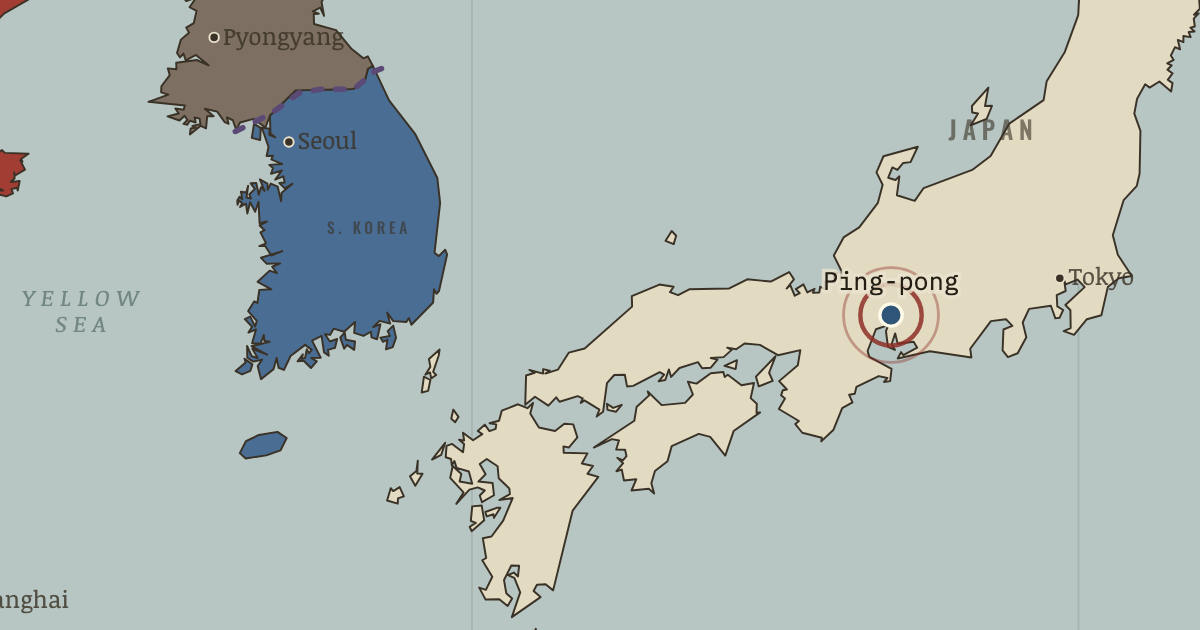
4 Apr 1971 — At the world championships in Nagoya, the American player Glenn Cowan boards the Chinese team’s bus and is greeted by its star, Zhuang Zedong. Days later Mao approves an invitation to the US team; on 14 April Zhou Enlai receives them in Beijing. Washington read the signal at once.
WW2 is free — every chapter. Try chapters 1–2 of any 2 other atlases (3 with a free account). Opening a new atlas uses one of them. Membership opens all 21 — Join.
The moment in context
The split between China and the Soviet Union grew from ideology and pride and was sealed by conflicts of national interest. Mao had resented Stalin’s treatment of him, yet he defended Stalin’s legacy against Khrushchev’s secret speech of 1956, partly because an attack on one leader’s personality cult, the official worship of a living leader, much like the reverence owed a divine king, could become an attack on his own. In 1958 Khrushchev proposed a joint naval fleet and a radio station on Chinese soil, which Mao denounced as a return to foreign privileges, and Mao shelled Kinmen, a Nationalist-held island, without consulting Moscow. In June 1959 the Soviets withdrew their promise to supply a sample atomic bomb. In 1960 Beijing attacked Soviet “revisionism”, its word for abandoning revolution while keeping its name, a charge much like heresy in a church. Khrushchev answered by recalling every Soviet expert within weeks, leaving plants such as the uranium works at Lanzhou unfinished. Two parties that claimed the same faith now fought over who would lead it.
From Sino-Soviet split and Nixon in China, chapter 11 of The People’s Republic under Mao, 1949–1976 (1972).
The place: Ping-pong diplomacy — map and full story →
Teach this in 5 minutes
- Why it happened — Mao and Khrushchev read 1956 differently. Khrushchev’s denunciation of Stalin and his policy of peaceful coexistence with the West struck Mao as a retreat from revolution. Mao’s own speech…
- The turn — Zhenbao Island, March 1969. The fighting on Zhenbao Island is the hinge because it turned an ideological quarrel into a military threat that Mao could not ignore. Beijing…
- What it changed — Nixon in Beijing. Nixon’s week in China in February 1972 ended two decades of American refusal to deal with the People’s Republic. The Shanghai Communiqué stated each…
Then ask the room: Why did Mao, the champion of world revolution, welcome Richard Nixon to Beijing in 1972? The argued answer is on the chapter page →
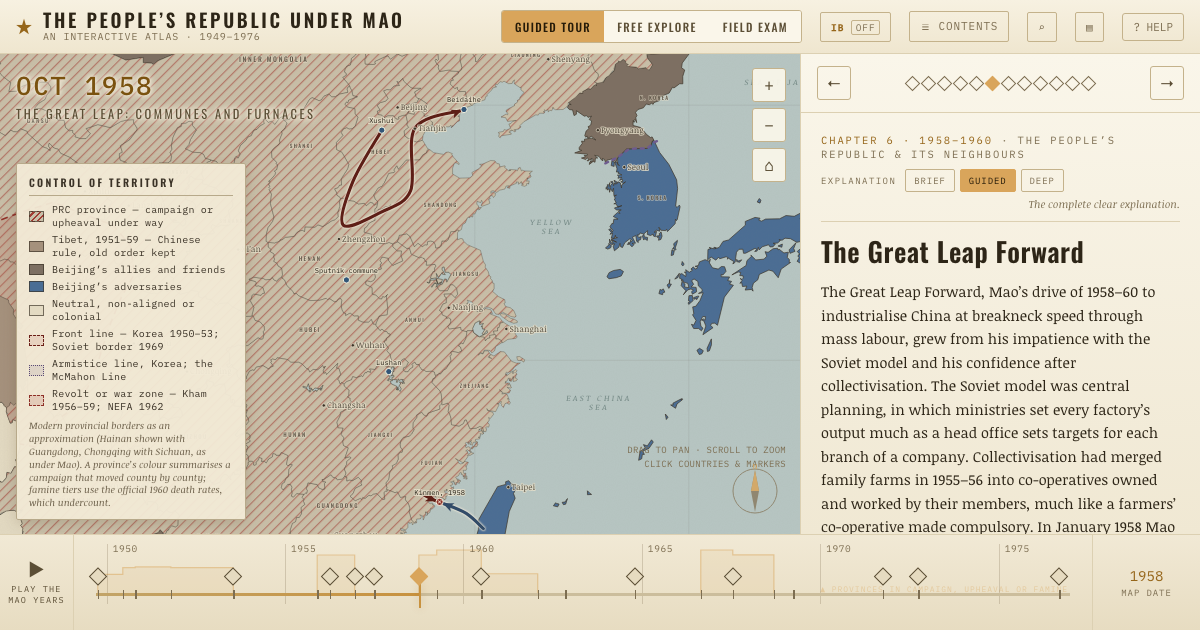
The atlas that shows it
THE FREE PRINTABLE STUDY GUIDE
Join the Dispatch — a short welcome series, then a letter when a new atlas opens — and the printable study guide for The People’s Republic under Mao is yours now, free.
NO TRACKING · YOUR ADDRESS IS USED FOR THE DISPATCH AND NOTHING ELSE · UNSUBSCRIBE ANYTIME