Mao’s China · CHAPTER 11 ·
Sino-Soviet split and Nixon in China
Chapter 11 of The People’s Republic under Mao, 1949–1976: “From Soviet Ally to Nixon”
Between 1960 and 1972 China went from Soviet ally to enemy and from America’s enemy to partner. Moscow recalled all 1,390 of its experts in 1960, the two parties denounced each other in public by 1964, troops clashed at Zhenbao Island in 1969, and Mao welcomed Richard Nixon to Beijing in 1972.
Chapter 11 is part of membership. WW2 is free — every chapter. Try chapters 1–2 of any 2 other atlases (3 with a free account). Opening a new atlas uses one of them. Membership opens all 21 — Join.
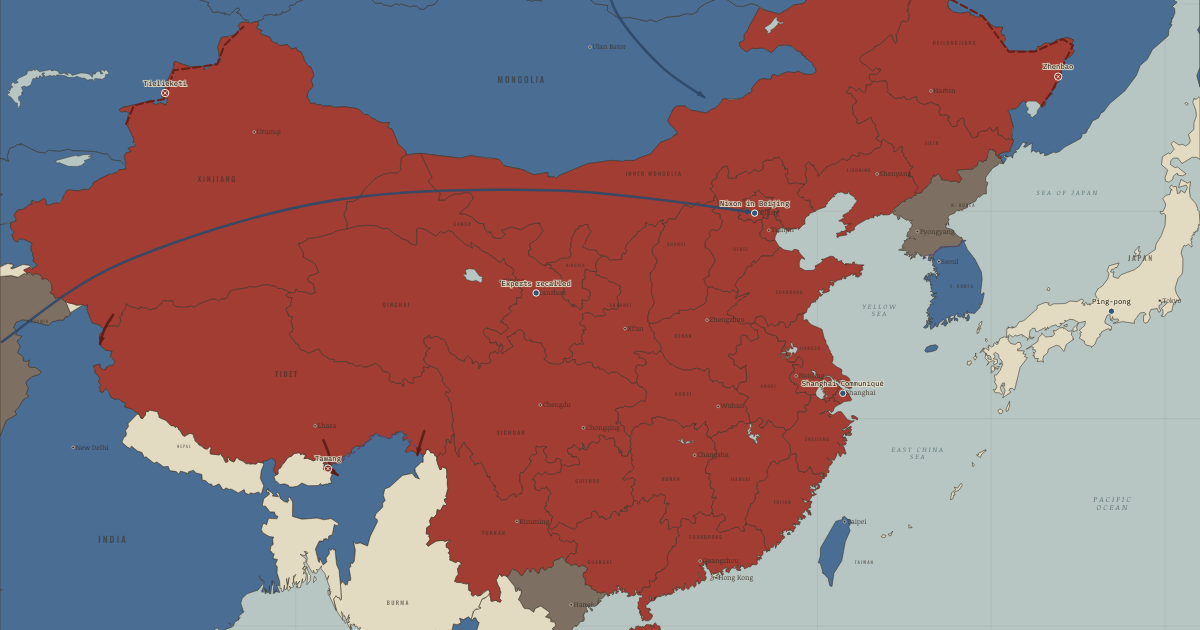
The map above is the world of China, September 1972 — Nixon, then Tanaka: the ring broken.
Part of IB History: The People’s Republic under Mao →
BRIEF EXPLANATION — THE ESSENTIAL ARGUMENT
China went from the Soviet Union’s ally to its enemy, and from America’s enemy to its partner, within twelve years, because Mao ranked the survival of his state above the solidarity of the Communist world. The split with Moscow began as a quarrel over ideas. After 1956 Mao saw Khrushchev, the Soviet leader, betraying the revolution when he criticised Stalin and sought “peaceful coexistence”, rivalry with the West without war. Khrushchev in turn saw the Great Leap Forward, Mao’s 1958 drive for instant industrialisation, as reckless fantasy. It became a quarrel over power when Moscow withdrew its promise of nuclear help in 1959 and recalled all 1,390 of its experts in 1960. By 1964 the two Communist parties were denouncing each other in public, and from 1966 Soviet divisions were stationed in Mongolia. On the map the rim turns blue around China, with India an enemy after the border war of 1962 and the Soviet Union and Mongolia hostile from 1964, so that by the mid-1960s China faced hostile neighbours along most of its land frontier.
The danger peaked in 1969, when Chinese and Soviet troops fought on Zhenbao Island in the Ussuri River and on the Xinjiang border, and Moscow quietly asked how Washington would react to a strike on China’s nuclear sites. Mao concluded that the Soviet Union, which had invaded Czechoslovakia in 1968, was now the greater threat, and that the United States could help to contain it. A secret channel through Pakistan brought Henry Kissinger, Nixon’s national security adviser, to Beijing in July 1971, along the blue arrow from the west, and in February 1972 President Nixon met Mao. In September 1972 Japan recognised the People’s Republic, and on the map it turns parchment. The ring of enemies was broken by the oldest rule of statecraft: the enemy of my enemy can be my partner.
The full story
The split between China and the Soviet Union grew from ideology and pride and was sealed by conflicts of national interest. Mao had resented Stalin’s treatment of him, yet he defended Stalin’s legacy against Khrushchev’s secret speech of 1956, partly because an attack on one leader’s personality cult, the official worship of a living leader, much like the reverence owed a divine king, could become an attack on his own. In 1958 Khrushchev proposed a joint naval fleet and a radio station on Chinese soil, which Mao denounced as a return to foreign privileges, and Mao shelled Kinmen, a Nationalist-held island, without consulting Moscow. In June 1959 the Soviets withdrew their promise to supply a sample atomic bomb. In 1960 Beijing attacked Soviet “revisionism”, its word for abandoning revolution while keeping its name, a charge much like heresy in a church. Khrushchev answered by recalling every Soviet expert within weeks, leaving plants such as the uranium works at Lanzhou unfinished. Two parties that claimed the same faith now fought over who would lead it.
China’s borders turned hostile one after another, and the map shows the ring closing. In October 1962 the People’s Liberation Army, the army of China’s ruling Communist Party, attacked India on two fronts: across the McMahon Line, the Himalayan border drawn by Britain in 1914 that China never accepted, and in Ladakh. It routed Indian forces, then declared a ceasefire and withdrew from the north-east while keeping Aksai Chin, the plateau crossed by China’s road from Xinjiang to Tibet. Open polemics in 1963–64 called the Soviet leaders traitors, Mao spoke publicly of territories the tsars had taken, and Soviet troops entered Mongolia under a treaty of 1966. The Soviet invasion of Czechoslovakia in August 1968, justified by the claim that Moscow could intervene in any socialist state, frightened Beijing, because the same claim could cover China. In March 1969 Chinese troops ambushed a Soviet patrol on Zhenbao Island, and Soviet tanks and rockets struck back. After a Chinese patrol was destroyed at Tielieketi in Xinjiang in August, the army was put on war alert, and China now faced a nuclear superpower on its longest border with no powerful ally.
Fear of the Soviet Union made the United States useful, and both governments moved carefully. Richard Nixon had written in 1967 that China could not be left outside the family of nations forever, and he wanted Chinese help in leaving Vietnam on acceptable terms. In 1969 four marshals advised Mao to play the American card against Moscow. Signals followed: an American journalist beside Mao on the Tiananmen rostrum in October 1970, an American table-tennis team invited in April 1971, and the secret flight in July of Henry Kissinger, Nixon’s national security adviser. In October 1971 the United Nations gave China’s seat, held until then by the Nationalist government on Taiwan, to the People’s Republic. Nixon’s visit in February 1972 ended with the Shanghai Communiqué, a joint statement in which Washington acknowledged the Chinese position that there is one China. The revolutionary who had denounced American imperialism for two decades now sought it as a counterweight.
DEEP EXPLANATION — EVIDENCE & INTERPRETATION
Why did the alliance break?
Historians agree that the split had several causes and disagree about which mattered most. Lorenz Lüthi’s The Sino-Soviet Split, based on archives in Moscow, Beijing and Eastern Europe, gives ideology the decisive role: Mao’s turn to radical policies at home in 1958 made him hostile to Soviet moderation, and he used the quarrel to rally support for his line inside China. Sergey Radchenko’s Two Suns in the Heavens stresses status, since Mao refused to accept second place in the Communist world and each leader read the other’s moves as bids for leadership. Shen Zhihua and others emphasise national interest: the nuclear agreement withdrawn in 1959, the proposals for a joint fleet, Soviet neutrality towards India, and the border treaties of the tsars that Beijing called “unequal”. The documents suggest that ideology framed the conflict, national interest supplied its material grievances, and personal pride made compromise impossible. Either way, the split ended the illusion of a single Communist bloc and opened the way for triangular diplomacy.
The war scare of 1969
The clashes of 1969 were the closest the two Communist powers came to full war, and new evidence has changed the account of how they began. Chinese troops planned the ambush on Zhenbao Island on 2 March; Lyle Goldstein, using Chinese military sources, argues that Beijing meant a limited strike to deter Soviet pressure along the border. The Soviet response on 15 March, with tanks and multiple rocket launchers, was far heavier. That summer Soviet diplomats sounded out American officials about a strike on China’s nuclear facilities, and the American government let it be known that it would oppose one. Zhou Enlai met the Soviet premier, Alexei Kosygin, at Beijing airport in September, and border talks began, yet Beijing still evacuated senior leaders and ordered the army onto alert in October. Mao’s order to dig tunnels and store grain against war came out of this scare. The danger was real enough to change Chinese strategy for a decade.
Who gained from the Nixon visit?
The meeting of February 1972 was hailed in both countries as a triumph, and historians have tried to weigh what each side actually gained. Margaret MacMillan’s Nixon and Mao shows a summit carefully staged on both sides, with Mao offering philosophy and Zhou Enlai negotiating the details. China gained protection against the Soviet Union, recognition as a great power, the UN seat that it had won in October 1971, and an American statement that it did not challenge the view that there is one China. The United States gained leverage over Moscow, which signed arms agreements with Nixon in May 1972, and hoped for help in ending the Vietnam War, which China gave only in part. Taiwan was the clear loser, as country after country switched recognition to Beijing. The American government’s record of the conversation, published in its Foreign Relations series, shows how much was left vague on purpose, and full diplomatic relations waited until 1979.
Key places on the map
On this day
Why it happened
Mao and Khrushchev read 1956 differently. Khrushchev’s denunciation of Stalin and his policy of peaceful coexistence with the West struck Mao as a retreat from revolution. Mao’s own speech in Moscow in 1957, in which he said that even a nuclear war that killed half of humanity would leave socialism victorious, alarmed the Soviet leaders. Each side began to suspect the other’s judgement, and every later disagreement was read through that suspicion. Because both claimed to speak for the same doctrine, a difference of policy became a question of who was the true heir of Lenin.
National interests collided. Moscow wanted naval facilities in China and a voice in its defence; Beijing wanted the atomic bomb and full independence. In 1958 Mao rejected a joint fleet and shelled Kinmen without warning Moscow; in 1959 the Soviets withdrew the promise of a sample bomb and stayed neutral in China’s border dispute with India. The alliance had stopped serving either side’s interests well before it formally ended. Each concession one side asked for looked to the other like an attempt at control.
The Leap divided the comrades. Khrushchev mocked the communes as a mistake the Soviet Union had tried and abandoned decades earlier, and Mao believed that Soviet leaders had encouraged Peng Dehuai’s criticism at Lushan. The withdrawal of the experts in July 1960, at the height of the famine, convinced many Chinese that Moscow had abandoned them when they were weakest, and Beijing later blamed the famine partly on Soviet “perfidy”. Blaming Moscow also helped the leadership avoid blaming itself.
The Brezhnev Doctrine frightened Beijing. Soviet tanks crushed the reform movement in Czechoslovakia in August 1968, and Moscow claimed the right to intervene in any socialist country that strayed. Beijing, which Moscow regarded as having strayed far, took the doctrine as a threat to China itself. With Soviet divisions massing on the border and in Mongolia, the Cultural Revolution’s anti-Soviet rhetoric turned into real military fear. China had a small nuclear force and a vast but poorly equipped army, so the threat could not be met by China alone.
THE TURNING POINT
Zhenbao Island, March 1969. The fighting on Zhenbao Island is the hinge because it turned an ideological quarrel into a military threat that Mao could not ignore. Beijing planned the ambush of 2 March as a warning; the heavy Soviet response of 15 March, the clash at Tielieketi in August and the Soviet questions about a nuclear strike showed that Moscow might answer with overwhelming force. Mao now judged the Soviet Union the more dangerous enemy, and the logic of balance led towards Washington. Within two years Kissinger was in Beijing. The road to the Nixon visit began on a frozen river island on the Ussuri.
What it changed
Nixon in Beijing. Nixon’s week in China in February 1972 ended two decades of American refusal to deal with the People’s Republic. The Shanghai Communiqué stated each side’s views openly and found a formula on Taiwan, and the two countries opened liaison offices in 1973. Full diplomatic relations followed in January 1979, under Deng Xiaoping. American trade, technology and students then became central to the reforms that followed Mao.
China takes its seat at the UN. On 25 October 1971 the General Assembly voted 76 to 35 to give China’s seat, including a permanent place on the Security Council, to the People’s Republic, and the representatives of the Republic of China left. The vote showed how many governments had been waiting for an American signal. For Beijing it was the formal end of two decades of isolation, and for Taipei the beginning of a long loss of recognition.
The ring opens. Japan established relations with Beijing in September 1972 and broke them with Taiwan; West Germany, Australia and many others followed within months, and the Philippines and Thailand in 1975. On the map, the blue ring of 1964 breaks open on the east, while the Soviet border remains a front line. China had escaped encirclement without ending its quarrel with Moscow.
A Cold War triangle. With Washington, Moscow and Beijing each able to play the other two against each other, the Cold War became a triangle. The Soviet Union hurried into arms agreements with the United States in May 1972, and Vietnam, angered by China’s dealings with its enemy, drifted towards Moscow, a rift that led to war between China and Vietnam in 1979. The triangle gave China more room to manoeuvre than either alliance or isolation had done.
DISCUSSION QUESTION — Why did Mao, the champion of world revolution, welcome Richard Nixon to Beijing in 1972?
Security explains most of the decision. By 1969 the Soviet Union had invaded Czechoslovakia under a doctrine that threatened China, massed dozens of divisions on the border, fought at Zhenbao and Tielieketi, and sounded out Washington about a nuclear strike; an opening to the United States was the obvious counterweight. Mao’s four marshals advised exactly that. Opportunity mattered too, because Nixon needed help leaving Vietnam and wanted leverage over Moscow, so both sides gained from the meeting. Domestic politics played a part as well: after Lin Biao’s death in 1971 Mao relied more on Zhou Enlai, who favoured the opening, and the visit restored the prestige the Cultural Revolution had damaged. Ideology did not disappear, since Mao described the opening as exploiting contradictions among enemies, as he had during the Second World War. Lüthi and Radchenko both stress how Mao fitted realpolitik into revolutionary language. The lesson for authoritarian regimes is that survival usually outranks ideology when the two collide, and ideology is then reinterpreted to fit.
An interesting fact
Henry Kissinger’s secret journey to Beijing in July 1971 was codenamed Polo, after Marco Polo. Pakistan’s president, Yahya Khan, arranged it: during an official visit to Pakistan, Kissinger pretended to be ill with a stomach complaint so that he could disappear for two days, supposedly resting at a hill station. Before dawn on 9 July he boarded a Pakistani airliner at Chaklala airport, near Islamabad, and flew over the Himalaya to Beijing, accompanied by Chinese navigators. When Nixon announced the trip on 15 July, almost no one in the American government had known about it.
Related
THE FREE PRINTABLE STUDY GUIDE
Join the Dispatch — a short welcome series, then a letter when a new atlas opens — and the printable study guide for The People’s Republic under Mao is yours now, free.
NO TRACKING · YOUR ADDRESS IS USED FOR THE DISPATCH AND NOTHING ELSE · UNSUBSCRIBE ANYTIME