ON THIS DAY ·
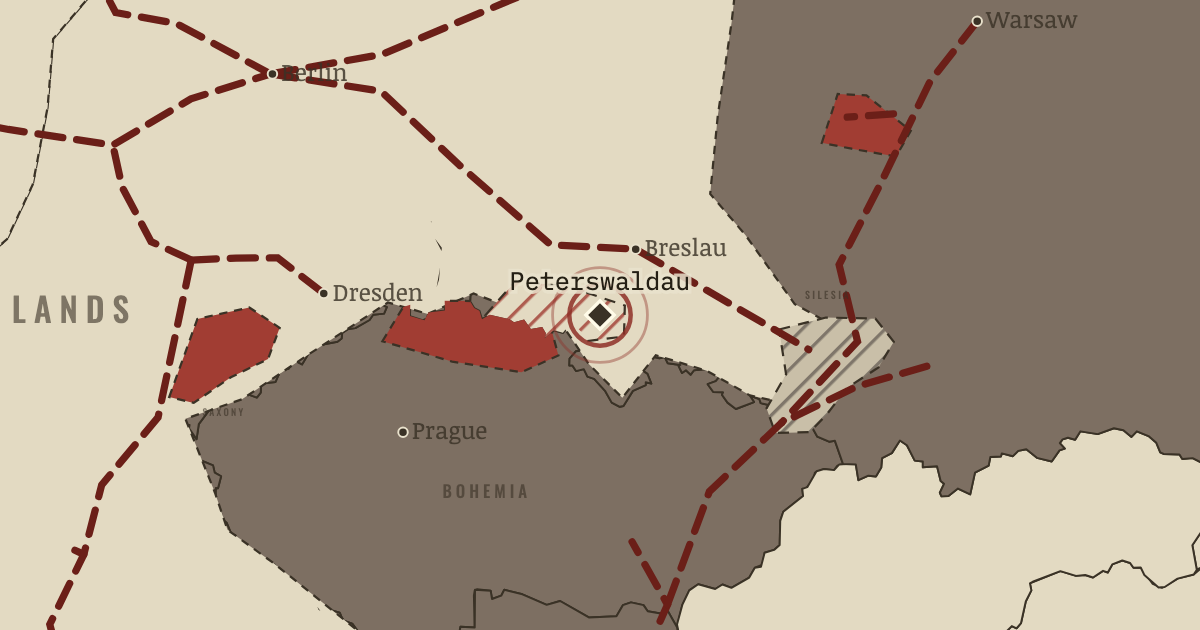
Silesian weavers’ revolt
4–6 Jun 1844 — Silesian linen weavers, ruined by machine-spun competition and wage cuts, wreck a merchant’s house; at Langenbielau troops fire on the crowd and kill eleven. Remember them.
WW2 is free — every chapter. Try chapters 1–2 of any 2 other atlases (3 with a free account). Opening a new atlas uses one of them. Membership opens all 21 — Join.
Free printable Industrial Revolution study guide, sent by email ↓
The moment in context
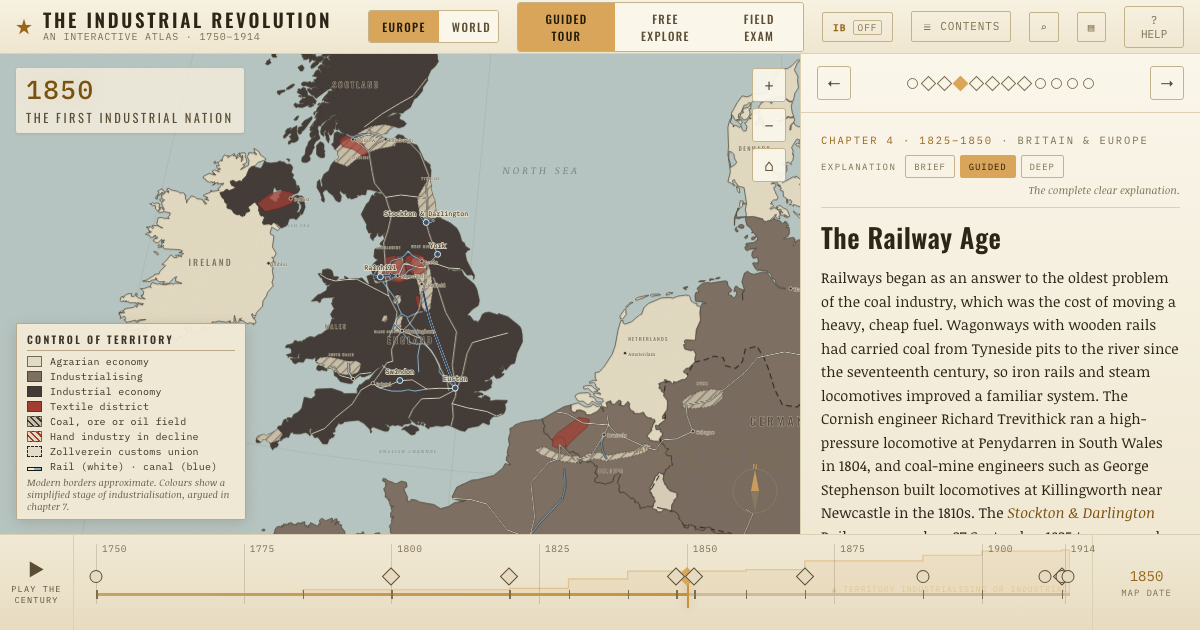
Belgium industrialised first on the continent because it held the same ingredients as Britain and had a government willing to use them. The coal belt running from Mons through Charleroi to Liège had been worked for centuries, and Liège had a long tradition of metalworking. Britain banned the emigration of skilled artisans until 1824 and the export of textile machinery until 1843, yet skills travelled anyway. William Cockerill, a Lancashire mechanic, built spinning machines at Verviers from 1799, and his son John founded a giant machine works and ironworks at Seraing in 1817, soon one of the largest industrial plants in the world. After winning independence from the Netherlands in 1830 the Belgian state planned and paid for a national railway network, beginning with the line from Brussels to Mechelen on 5 May 1835. In proportion to its size Belgium became the most industrialised country on the continent, the first proof that Britain’s lead could be copied.
From Industrial Revolution in Europe, chapter 7 of The Industrial Revolution, 1750–1914 (1870).
The place: Silesian weavers’ revolt — map and full story →
Teach this in 5 minutes
- Why it happened — Coal and old industrial skills. The continent’s first industrial regions combined coal or fast water with long traditions of craft. The Sambre–Meuse valley had mined coal and…
- The turn — Cockerill at Seraing, 1817. The Lancashire-born engineer John Cockerill’s works at Seraing are the hinge because they show how industry left Britain. Cockerill, trained in his…
- What it changed — Germany overtakes. The German customs union known as the Zollverein, the Ruhr coalfield and the railways laid the foundations on which a united Germany, created in…
Then ask the room: Did continental Europe industrialise by imitating Britain, or by finding its own path? The argued answer is on the chapter page →
The atlas that shows it
THE FREE PRINTABLE STUDY GUIDE
Join the Dispatch — a short welcome series, then a letter when a new atlas opens — and the printable study guide for The Industrial Revolution is yours now, free.
NO TRACKING · YOUR ADDRESS IS USED FOR THE DISPATCH AND NOTHING ELSE · UNSUBSCRIBE ANYTIME