Industrial Revolution · CHAPTER 7 ·
Industrial Revolution in Europe
Chapter 7 of The Industrial Revolution, 1750–1914: “The Continent Follows”
Belgium led the continent: John Cockerill opened an ironworks at Seraing in 1817, and in 1835 the Brussels–Mechelen line became the continent’s first state-built steam railway. In the German states the Zollverein customs union of 1834 created one market, and from the 1840s railways and Ruhr coal powered a boom.
Chapter 7 is part of membership. WW2 is free — every chapter. Try chapters 1–2 of any 2 other atlases (3 with a free account). Opening a new atlas uses one of them. Membership opens all 21 — Join.
Free printable Industrial Revolution study guide, sent by email ↓
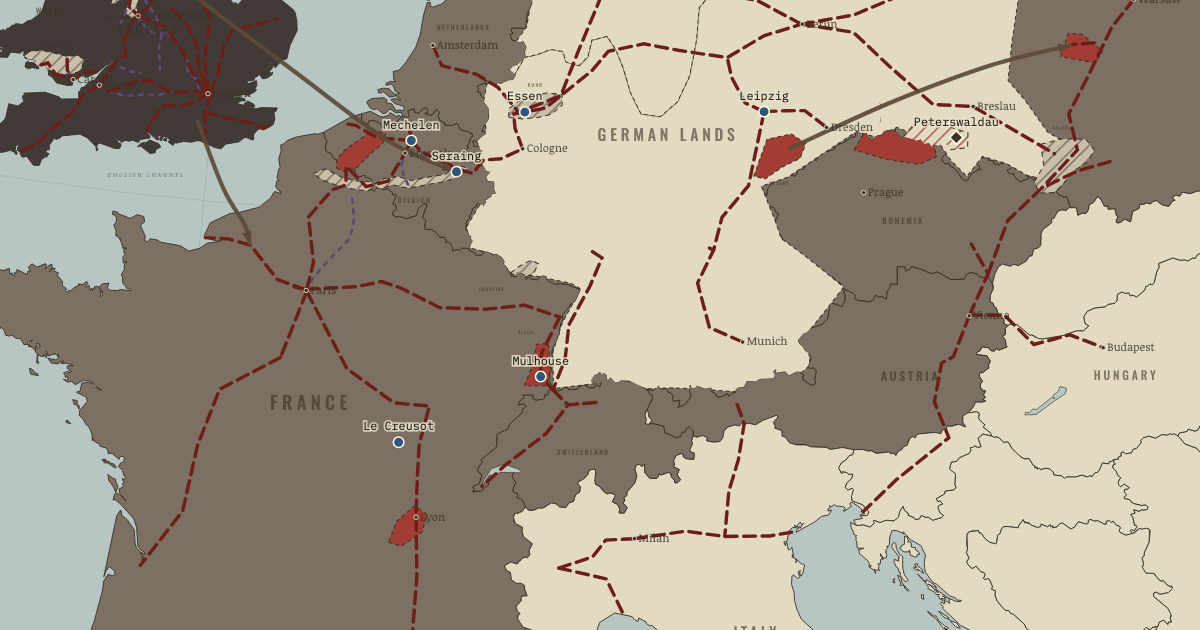
The map above is the world of The Industrial Revolution in Europe, 1870 — The Continent follows.
Part of IB History: The Industrial Revolution →
BRIEF EXPLANATION — THE ESSENTIAL ARGUMENT
Industrialisation spread from Britain to continental Europe, and the way it spread shows that those who followed a pioneer could shorten, borrow and change its path. Belgium went first, because it had coal, iron, skilled workers and a government that built railways. In 1817 John Cockerill, son of a Lancashire mechanic, opened a vast machine works and ironworks at Seraing near Liège, and in 1835 the line from Brussels to Mechelen became the continent’s first state-built steam railway. In the German states the Zollverein, a customs union founded in 1834 that abolished tariffs between its members, much like today’s European single market, joined a divided country into one market, and from the 1840s railways and the coal of the Ruhr around Essen powered a boom, which showed how quickly industry could fill a market created by politics.
Followers adapted what they borrowed, and the economist Alexander Gerschenkron argued that the later a country started, the more it relied on banks and the state to catch up. France industrialised more slowly and steadily, with fewer giant factories and a strong tradition of skilled, high-quality work, while the Alsatian cotton district around Mulhouse and ironworks such as Le Creusot matched Britain’s best. On the map the coalfields of Belgium, northern France, the Ruhr and Silesia appear as hatched patches, the dashed outline shows the Zollverein growing, and the white railway lines spread across the continent. Growth also had victims, since the red-striped Silesian linen district was ruined by machine-spun competition, and its weavers rose in 1844 at Peterswaldau, a reminder that one region’s industrial gain could be another’s ruin.
The full story
Belgium industrialised first on the continent because it held the same ingredients as Britain and had a government willing to use them. The coal belt running from Mons through Charleroi to Liège had been worked for centuries, and Liège had a long tradition of metalworking. Britain banned the emigration of skilled artisans until 1824 and the export of textile machinery until 1843, yet skills travelled anyway. William Cockerill, a Lancashire mechanic, built spinning machines at Verviers from 1799, and his son John founded a giant machine works and ironworks at Seraing in 1817, soon one of the largest industrial plants in the world. After winning independence from the Netherlands in 1830 the Belgian state planned and paid for a national railway network, beginning with the line from Brussels to Mechelen on 5 May 1835. In proportion to its size Belgium became the most industrialised country on the continent, the first proof that Britain’s lead could be copied.
The German states industrialised through a common market and the railway, and the Zollverein, a German customs union, made both possible. In 1834 Prussia, the largest German state, led eighteen states with about 23 million people into a customs union that abolished internal tariffs, and the dashed outline on the map shows it growing to cover almost all of the future German Empire. The economist Friedrich List, who promoted the railway from Leipzig to Dresden opened in 1839, argued in his National System of Political Economy (1841) that new industries needed protection by tariffs, taxes that make imported goods dearer, until they could compete with Britain’s, an argument later followed from the United States to Japan. Railway building, which created demand for coal, iron and machines all at once, became the leading sector of German growth from the 1840s. Deep shafts opened the Ruhr coalfield, and the Krupp works at Essen grew from a struggling family steel foundry into one of the largest firms in Europe. A protected market and a railway boom could build industrial giants within a generation.
France and the rest of the continent followed other paths, and the map shows that everywhere industrialisation came region by region. France had less coal and a large peasant population that stayed on the land, so it industrialised more gradually, concentrating on high-quality goods such as Lyon silk and on great centres such as the Schneider brothers’ ironworks at Le Creusot and the cotton mills of Mulhouse in Alsace. In Saxony, Bohemia, Catalonia and the Polish city of Łódź, textile districts grew inside largely farming countries, like islands of industry in a rural sea. The costs fell hardest on handworkers. In June 1844 the linen weavers of Peterswaldau and Langenbielau in Silesia, whose earnings had collapsed under competition from machine-spun yarn, wrecked a merchant’s house; troops fired on the crowd and killed eleven. The continent followed Britain, yet its industrial revolution was its own, built on borrowed machines, state action and regional strengths.
DEEP EXPLANATION — EVIDENCE & INTERPRETATION
Gerschenkron and the advantages of backwardness
The most influential theory of how industrialisation spread holds that latecomers industrialised differently because they were late, and the economic historian Alexander Gerschenkron set it out in Economic Backwardness in Historical Perspective (1962). He argued that the further behind a country was when it began, the faster it grew once it started, because it could borrow mature technology, and the more it needed special institutions to substitute for missing capital and skills. In Britain private savings and partnerships financed industry. In Germany great investment banks such as the Darmstädter Bank, founded in 1853, and later the Deutsche Bank funded mines, railways and heavy industry. In Russia, the most backward of the three, the state itself became the chief investor, as chapter 8 notes. Gerschenkron also predicted that late starters would favour heavy industry and very large plants. Later research has qualified the scheme. Comparative studies edited by the economic historians Richard Sylla and Gianni Toniolo found that banks and states mattered in ways too varied for a simple ranking of backwardness to capture, and the economic historian Sidney Pollard emphasised regions over nations. The core insight survives: followers do not repeat the pioneer’s path, because the pioneer’s existence changes the problem they face.
Industrial regions and national averages
Industrialisation spread across Europe region by region, and national statistics hide this, as the economic historian Sidney Pollard argued in Peaceful Conquest (1981). The industrial regions of the nineteenth century, such as the Sambre–Meuse coal belt, the Ruhr, Saxony, Upper Silesia, northern France and Catalonia, often shared the mines, mills and crowded towns of Lancashire and differed sharply from the rural provinces of their own countries, and coal deposits explain much of their location. This atlas makes the point visible by painting coalfields and textile districts as shapes over the borders. The country colours follow a deliberately simple rule. A country turns grey-tan, industrialising, when factory industry and railways are clearly spreading, roughly when the economic historian Paul Bairoch’s index of industrialisation per person passes about 15 (with Britain in 1900 set at 100), and charcoal, an industrial economy, when the index passes about 40, roughly Britain’s level in the 1840s. Bairoch’s figures are reconstructions from fragmentary data, the economist W. W. Rostow’s idea of a sudden take-off has been heavily criticised, and the thresholds are a judgement, so the colours are approximate stages. They are useful precisely because the regions drawn over them show where the averages mislead.
Was France a failure?
Older histories treated France as a laggard whose industrialisation failed to match Britain’s or Germany’s. The economic historians Patrick O’Brien and Caglar Keyder argued in Economic Growth in Britain and France 1780–1914 (1978) that France followed a different path that suited its resources: with less coal, a slower-growing population and many peasant landowners, it concentrated on skilled, high-value production, and its output per industrial worker grew at a respectable rate. The economic historian Paul Bairoch’s index of industrialisation per person put France at about 20 in 1860 against Britain’s 64, yet French income per head rose steadily through the century. French industry was strong in silk, luxury goods and engineering and later in cars and electricity, and French banks financed railways across Europe. The Cobden–Chevalier treaty of 1860 cut tariffs between Britain and France and exposed French industry to British competition, which spurred modernisation in some trades and hurt others. The debate matters beyond France, because it questions whether Britain’s path of coal, cotton and giant factories should be treated as the normal route to modern growth, or as one route among several.
Key places on the map
On this day
Why it happened
Coal and old industrial skills. The continent’s first industrial regions combined coal or fast water with long traditions of craft. The Sambre–Meuse valley had mined coal and worked iron since the Middle Ages, and Flanders, Saxony and Alsace had old textile industries. Where coal, skill and water transport met, British techniques could be adopted quickly, which is why the hatched coalfields and red districts on the map lie close together. Where any one of them was missing, industry came later.
Borrowed machines and migrant experts. Britain guarded its lead by banning the emigration of artisans until 1824 and the export of textile machinery until 1843, but machines were smuggled and men moved. British mechanics, engineers and navvies, the labourers who dug canals and railways, built mills and railways from Liège to Rouen, and continental entrepreneurs toured Lancashire to copy what they saw. The Cockerills, a Lancashire family of mechanics who built Belgium’s first spinning machines and the Seraing ironworks; the Irish mining engineer William Mulvany in the Ruhr; and the English contractor Thomas Brassey’s railway gangs in Normandy all carried British know-how abroad. Such migrants let followers skip the pioneers’ costly experiments.
Governments built markets and railways. Continental governments took a direct hand in starting industry. Belgium planned its railways, and Prussia, the largest German state, led the Zollverein, a customs union that abolished taxes on goods moving between its German members, much as the European Union does today. Prussia also ran state mines in the Saar and Silesia, and France laid out its main railway lines in a law of 1842 before leasing them to private companies. The economist Friedrich List’s case for protecting infant industries, young industries not yet able to compete, gave this activism a theory. States took on the risks that private investors would not yet bear.
Peace and new borders after 1815. The peace of 1815, agreed by Europe’s great powers at Vienna after Napoleon’s defeat, ended a generation of war, blockade and occupation, and the settlement redrew borders in ways that shaped industry. Prussia, the largest German state, gained the Rhineland and Westphalia, including the Ruhr and the Saar, and the new Kingdom of the Netherlands, from which Belgium broke away in 1830, gained the coal and iron of Liège and Hainaut. Peace allowed capital, goods and people to cross borders again. The diplomats who redrew Europe’s borders in 1815 were also deciding, largely without realising it, which states would own the coal of the industrial age.
THE TURNING POINT
Cockerill at Seraing, 1817. The Lancashire-born engineer John Cockerill’s works at Seraing are the hinge because they show how industry left Britain. Cockerill, trained in his father’s workshop at Verviers, won the backing of William I, king of a Netherlands that then included Belgium, and turned the former summer palace of the prince-bishops of Liège, the churchmen who had ruled the city until 1795, into works that made steam engines, locomotives, ships and iron with local coal and local workers trained in British methods. Seraing became a school as well as a factory, and engineers trained there spread across the continent. From this moment industrialisation was a European process, because Britain’s laws against exporting machines and skilled workers could not stop knowledge that travelled in engineers’ heads.
What it changed
Germany overtakes. The German customs union known as the Zollverein, the Ruhr coalfield and the railways laid the foundations on which a united Germany, created in 1871, overtook Britain in steel and chemicals by the 1890s. Political unification grew partly out of the economic unification of the Zollverein, which had already tied the smaller German states to Prussia, the largest of them. The new empire’s industrial strength would rest on science and big business as much as on coal.
The workers’ question crosses borders. Industrial distress made the protection of workers a European political question within a generation. The Silesian weavers’ revolt of 1844 inspired a poem by the German writer Heinrich Heine and, half a century later, the dramatist Gerhart Hauptmann’s play The Weavers (1892), and in the 1880s Germany, under its chancellor Otto von Bismarck, introduced state insurance against sickness, accidents and old age, partly to undercut the socialists. The social question had become a European one, shared by workers and feared by governments across the continent.
A model for late developers. The German economist Friedrich List’s case for protecting infant industries, those too young to face foreign competition, and the German partnership of banks and state, became templates for later industrialisers. The United States raised tariffs to shelter its factories, and Japan’s Meiji leaders, in power from 1868, barred by unequal treaties imposed by the West from raising tariffs until 1911, studied Germany and used the state to found industries. Both refused to leave industry to the free market that Britain, secure in its lead, recommended to everyone, advice List had compared to kicking away a ladder after climbing it.
DISCUSSION QUESTION — Did continental Europe industrialise by imitating Britain, or by finding its own path?
Imitation was everywhere at the start. The continent’s first steam engines, spinning mills and railways were British in design, often British-built and sometimes British-run, from the Cockerill family’s ironworks at Seraing in Belgium to the railways the English contractor Thomas Brassey built in Normandy, and continental entrepreneurs measured themselves against Lancashire. Yet the conditions in which they worked were different, and so were their solutions. Belgium and Prussia, the largest German kingdom, used their governments to plan railways and run mines, German banks financed heavy industry on a scale British banks never attempted, and the German economist Friedrich List’s protectionism, the sheltering of young industries behind tariffs, rejected the free trade Britain recommended. France’s more gradual, skill-based path, which the economic historians Patrick O’Brien and Caglar Keyder argue suited its resources, shows that there was more than one road. The economic historian Alexander Gerschenkron’s insight that backwardness changes the method of industrialisation explains much of this variety, and even British institutions, from patents to joint-stock companies, firms owned by many shareholders, were copied selectively. The best answer is that the continent borrowed Britain’s technology and invented its own institutions, a combination that later industrialisers, from the United States to Japan, would repeat.
An interesting fact
Germany’s first railway locomotive was English. The Adler, or Eagle, which opened the six-kilometre line from Nuremberg to Fürth on 7 December 1835, was built by the locomotive makers Robert Stephenson & Co. in Newcastle and shipped to Bavaria in pieces. With it came an English engine driver, William Wilson, whom the company paid more than its own director, because nobody in Bavaria knew how to drive a locomotive. Wilson stayed, trained German drivers and died in Nuremberg in 1862. For years most of the line’s trains were still pulled by horses because coal was expensive, which shows that Germany could import the railway long before it could cheaply fuel one.
Related
THE FREE PRINTABLE STUDY GUIDE
Join the Dispatch — a short welcome series, then a letter when a new atlas opens — and the printable study guide for The Industrial Revolution is yours now, free.
NO TRACKING · YOUR ADDRESS IS USED FOR THE DISPATCH AND NOTHING ELSE · UNSUBSCRIBE ANYTIME