ON THIS DAY ·
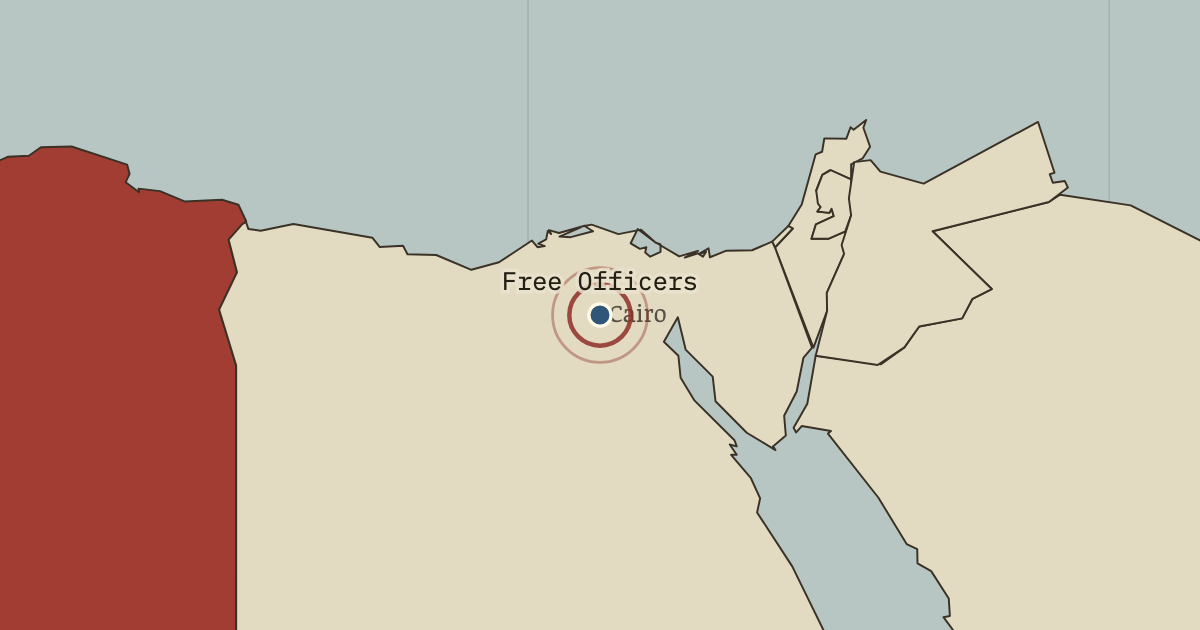
Egyptian revolution
23 Jul 1952 — Gamal Abdel Nasser’s officers depose the king. Arab nationalism has a capital and a champion; within four years he will nationalize the Suez Canal and defy three empires at once.
WW2 is free — every chapter. Try chapters 1–2 of any 2 other atlases (3 with a free account). Opening a new atlas uses one of them. Membership opens all 21 — Join.
Free printable Decolonization of Africa study guide, sent by email ↓
The moment in context
Nasser nationalized the Suez Canal in July 1956 to fund the Aswan Dam after Washington withdrew its loan, and to assert that Egypt, rather than London or Paris, owned the ground beneath Egypt. For Britain and France the canal meant more than a waterway; it was a route to their remaining possessions and a symbol of great-power standing. Their secret plan with Israel recaptured the canal zone quickly, but the operation depended on money and oil that only the United States could guarantee. When Eisenhower opposed the invasion and let sterling come under pressure, Britain found it could not sustain the campaign and folded within days.
From Suez Crisis and North Africa, chapter 2 of The Decolonization of Africa, 1945–1994 (MAR 1956).
The place: Egyptian revolution — map and full story →
Teach this in 5 minutes
- Why it happened — Suez: the canal as a symbol of who rules. Nasser nationalized the canal to fund the Aswan Dam after Washington pulled its loan. And to assert that Egypt, not London and Paris, owned the…
- The turn — Suez, November 1956. The military plan works flawlessly and the political result is catastrophe: within a week the invaders are forced into a UN-supervised retreat by…
- What it changed — Empire loses its nerve. Suez broke something psychological. Harold Macmillan, Chancellor during the crisis, became the Prime Minister who three years later told South…
Then ask the room: Suez was a clear military victory for Britain and France. In what sense was it one of the most important defeats in the history of empire? The argued answer is on the chapter page →
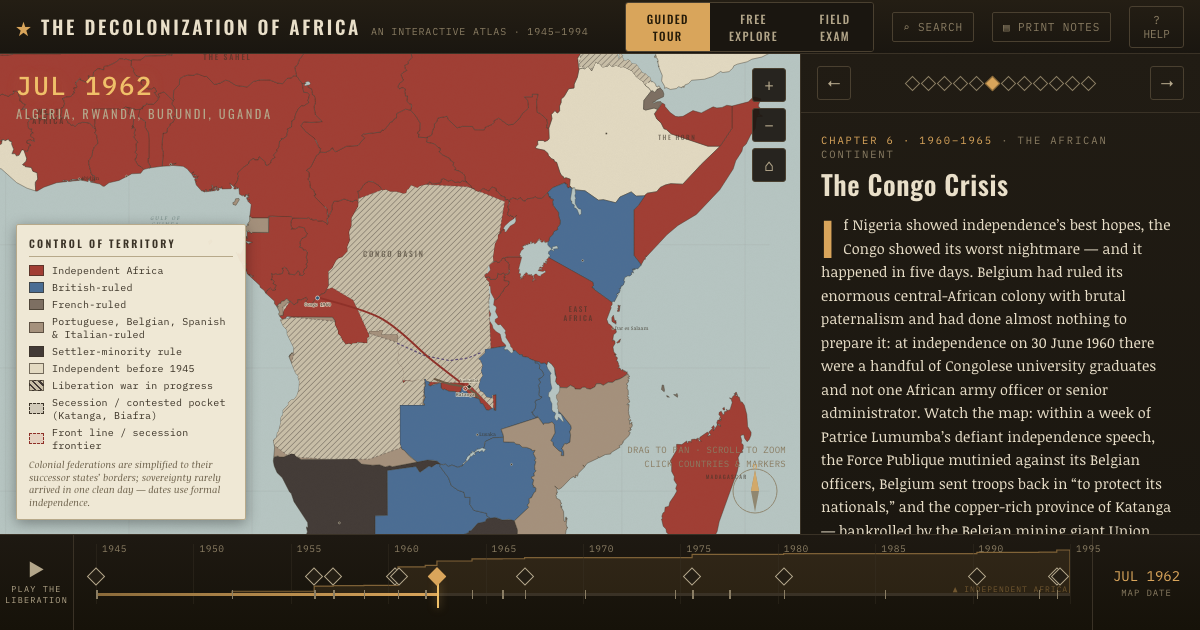
The atlas that shows it
THE FREE PRINTABLE STUDY GUIDE
Join the Dispatch — a short welcome series, then a letter when a new atlas opens — and the printable study guide for The Decolonization of Africa is yours now, free.
NO TRACKING · YOUR ADDRESS IS USED FOR THE DISPATCH AND NOTHING ELSE · UNSUBSCRIBE ANYTIME