ON THIS DAY ·
Bizerte crisis
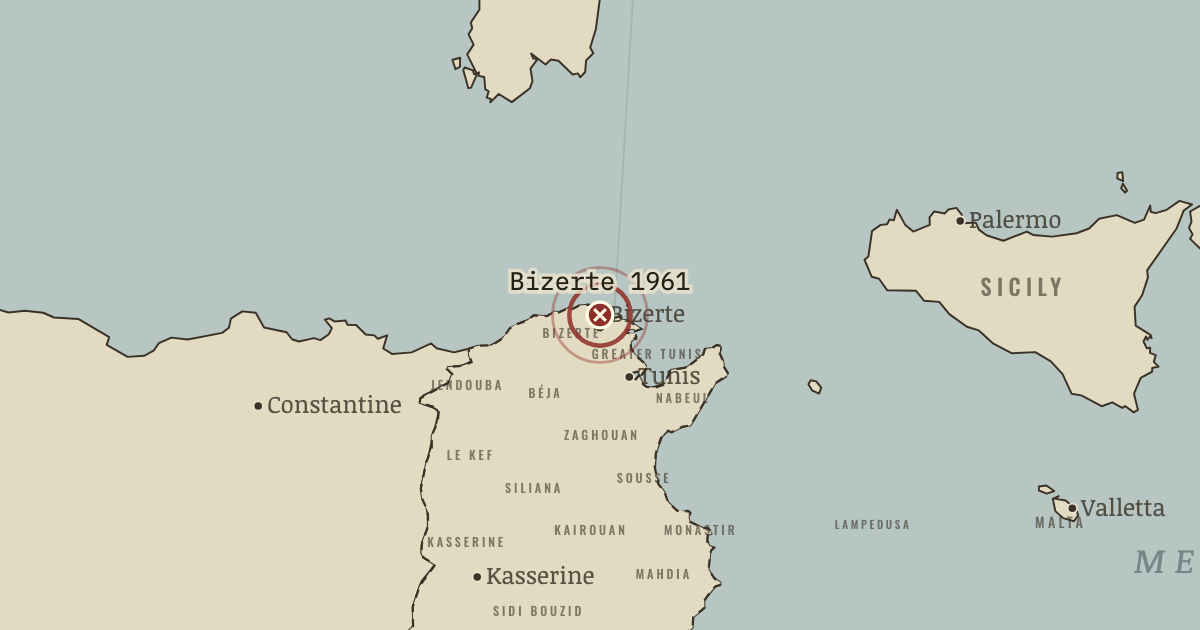
19–23 Jul 1961 — Bourguiba blockades the French naval base at Bizerte; French paratroopers break the siege. Tunisia’s official count is 630 dead, and some estimates exceed 1,000. France finally leaves the base in October 1963.
WW2 is free — every chapter. Try chapters 1–2 of any 2 other atlases (3 with a free account). Opening a new atlas uses one of them. Membership opens all 21 — Join.
Free printable Feminism and the Tunisian Revolution study guide, sent by email ↓
The moment in context
The Personal Status Code was possible because Bourguiba’s state depended less on traditional authorities than any of its neighbours. It was decreed on 13 August 1956 and took effect on 1 January 1957, before Tunisia even had a constitution. The sociologist Mounira Charrad explains why Tunisia went further than Morocco or Algeria. The Neo-Destour was a party of urban professionals and townsmen of the Sahel, the coastal plain around Sousse and Monastir, and it had defeated a rival nationalist faction backed by rural notables and conservative clergy. It therefore did not need the support of tribal kin groups, whose power rested on family law that kept property and marriages within the lineage. Bourguiba presented the Code as a modern reading of Islamic law, drawing on reformers such as Tahar Haddad, whose 1930 book on women in the Sharia had been condemned by the religious establishment. On the map Tunisia is blue while Algeria, then a French colony at war, and Libya remain parchment, because their family law still allowed polygamy, a contrast that came from the structure of each state more than from its religion.
From Tunisia under Bourguiba, chapter 7 of Protest and Change: Second-Wave Feminism and Tunisia, 1945–2015 (1956).
The place: Bizerte crisis — map and full story →
Teach this in 5 minutes
- Why it happened — A nationalist party that owed little to tradition. Tunisia’s family law was reformed quickly because the party that won independence had little attachment to religious tradition. The Neo-Destour…
- The turn — The Personal Status Code, 13 August 1956. The Code is the hinge of this chapter because it defined the relationship between the Tunisian state and women for the next sixty years. By…
- What it changed — The most liberal family law in the Arab world. The Code was extended under Bourguiba and Ben Ali, for example in 1993, when mothers gained new rights over their children. It became part of…
Then ask the room: Was the Personal Status Code a victory for Tunisian women, or a tool of Bourguiba’s state? The argued answer is on the chapter page →
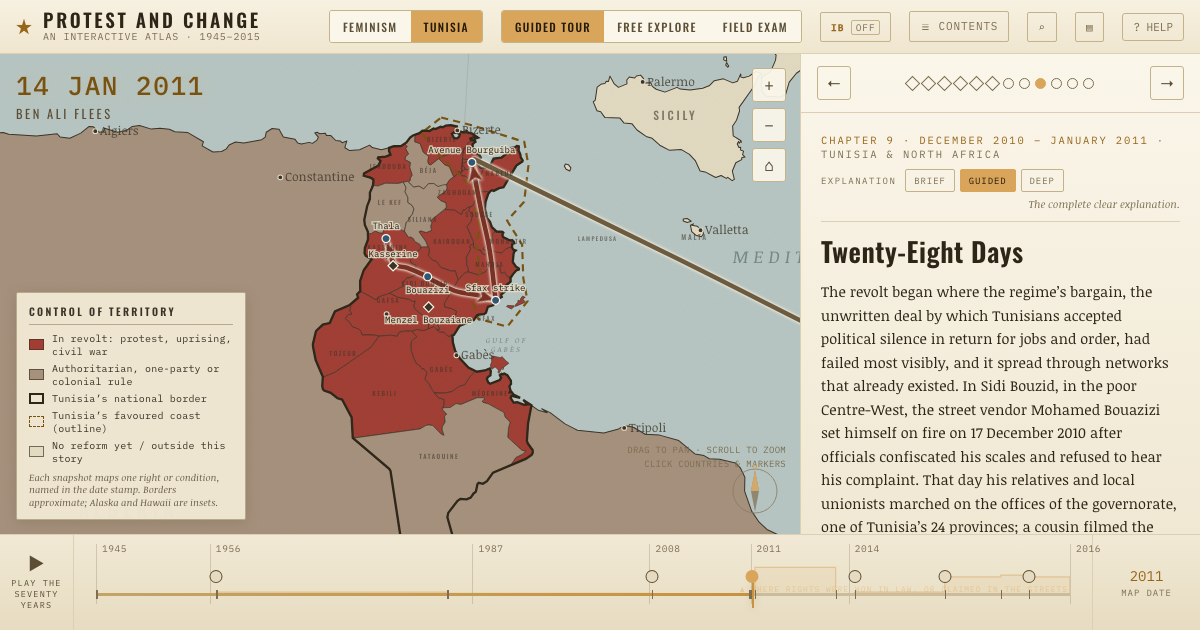
The atlas that shows it
THE FREE PRINTABLE STUDY GUIDE
Join the Dispatch — a short welcome series, then a letter when a new atlas opens — and the printable study guide for Protest and Change is yours now, free.
NO TRACKING · YOUR ADDRESS IS USED FOR THE DISPATCH AND NOTHING ELSE · UNSUBSCRIBE ANYTIME