ON THIS DAY ·
Tangshan earthquake
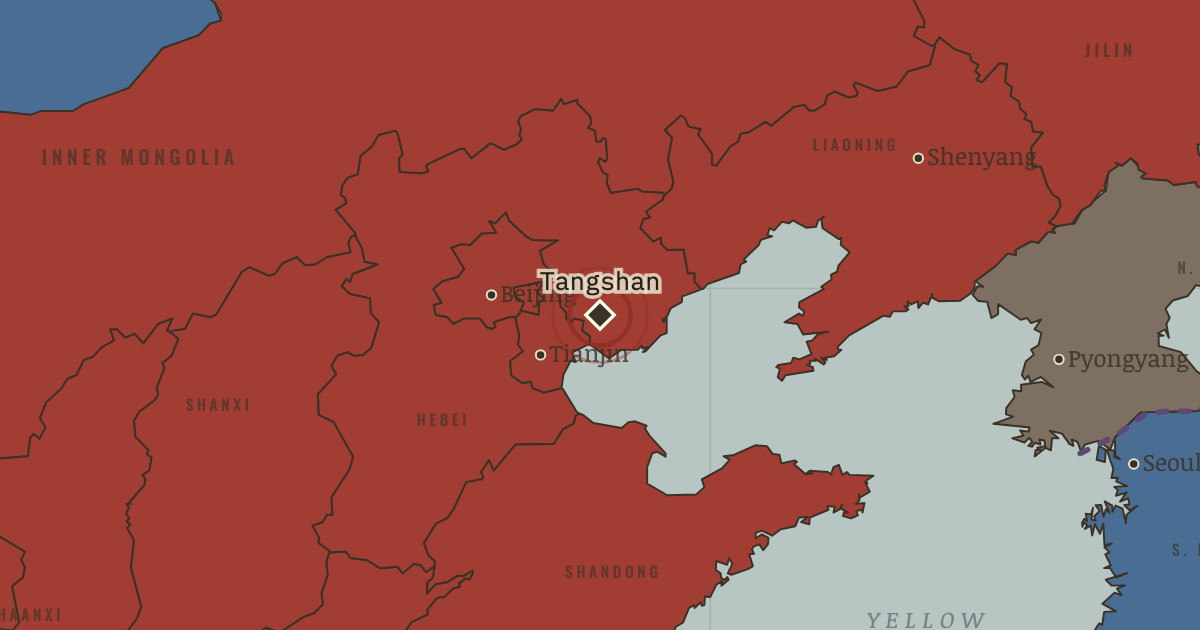
28 Jul 1976 — An earthquake of magnitude 7.6 (7.8 on the Chinese scale) destroys the industrial city of Tangshan before dawn. The official count is 242,000 dead; other estimates are higher. The government refused foreign aid. Many people read the disaster, by an old tradition, as a sign that the Mandate of Heaven was passing.
WW2 is free — every chapter. Try chapters 1–2 of any 2 other atlases (3 with a free account). Opening a new atlas uses one of them. Membership opens all 21 — Join.
The moment in context
The answer to this atlas’s question is that Mao’s party-state reached every village through the Party’s local organisation, the campaigns and an army loyal to the leader. The same machinery unified China and raised life expectancy, and it also produced the famine and the Cultural Revolution, Mao’s assault on his own party from 1966, because nothing inside it could stop a mistake made at the top. A party-state is one in which a single party controls the government at every level, much like a company whose owner appoints every manager, and the campaigns were bursts of mass mobilisation that made citizens accuse and police one another. The chart below counts their cost: one to two million dead in land reform, roughly 700,000 to two million in the campaign against counter-revolutionaries, 15 to 45 million in the famine, and roughly 750,000 to two million in the Cultural Revolution. Altogether somewhere between about 17 million and 50 million people died, and every figure is a range because the regime never fully counted its victims.
From Death and legacy of Mao Zedong, chapter 12 of The People’s Republic under Mao, 1949–1976 (1976).
The place: Tangshan earthquake — map and full story →
Teach this in 5 minutes
- Why it happened — A succession Mao never settled. Mao had destroyed two chosen successors, Liu Shaoqi and Lin Biao, and in his last years he balanced radicals against veterans without letting either…
- The turn — 6 October 1976. The arrest of the Gang of Four is the hinge because it ended the Maoist project without a mass movement and without a shot. Hua Guofeng, Ye Jianying…
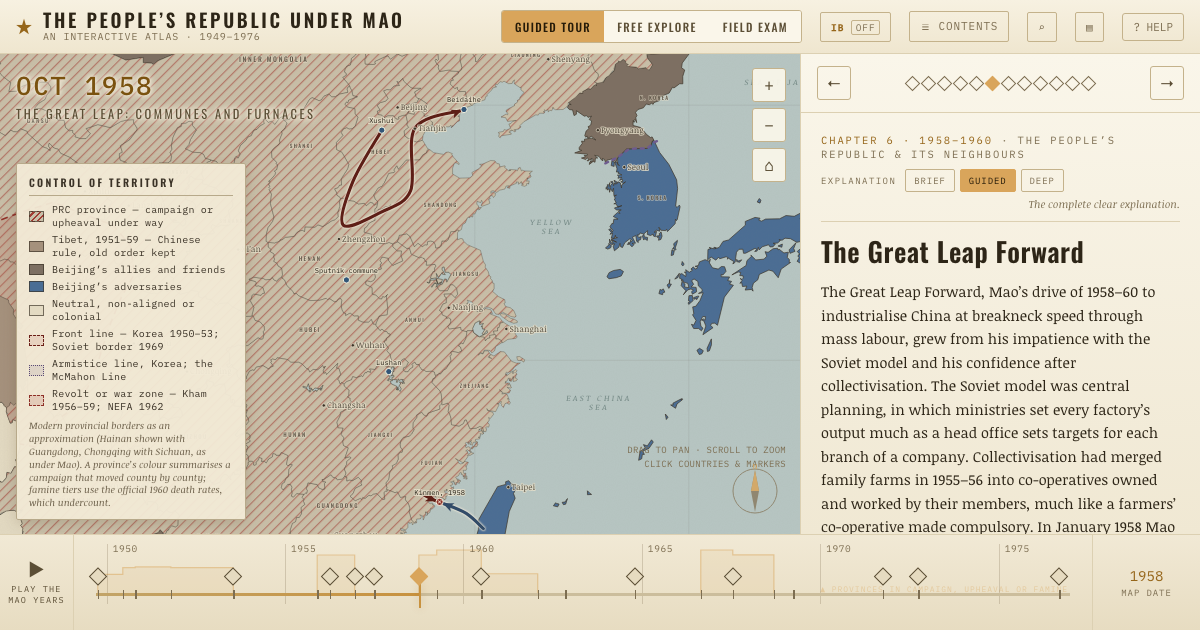
- What it changed — The communes dismantled. Mao’s successors undid his central rural institution within six years. From 1978, beginning with secret contracts such as Xiaogang’s, households…
Then ask the room: Should Mao’s rule be judged chiefly by what it built or by what it cost? The argued answer is on the chapter page →
The atlas that shows it
THE FREE PRINTABLE STUDY GUIDE
Join the Dispatch — a short welcome series, then a letter when a new atlas opens — and the printable study guide for The People’s Republic under Mao is yours now, free.
NO TRACKING · YOUR ADDRESS IS USED FOR THE DISPATCH AND NOTHING ELSE · UNSUBSCRIBE ANYTIME