Mao’s China · EPILOGUE ·
Death and legacy of Mao Zedong
Chapter 12 of The People’s Republic under Mao, 1949–1976: “Mao’s Death and Legacy”
Mao died in 1976 after twenty-seven years in which his party-state reached every village, unified China and raised life expectancy, but also produced the famine and the Cultural Revolution. Estimated deaths from his campaigns and the famine range from about 17 to 50 million; the Gang of Four fell on 6 October 1976.
Chapter 12 is part of membership. WW2 is free — every chapter. Try chapters 1–2 of any 2 other atlases (3 with a free account). Opening a new atlas uses one of them. Membership opens all 21 — Join.
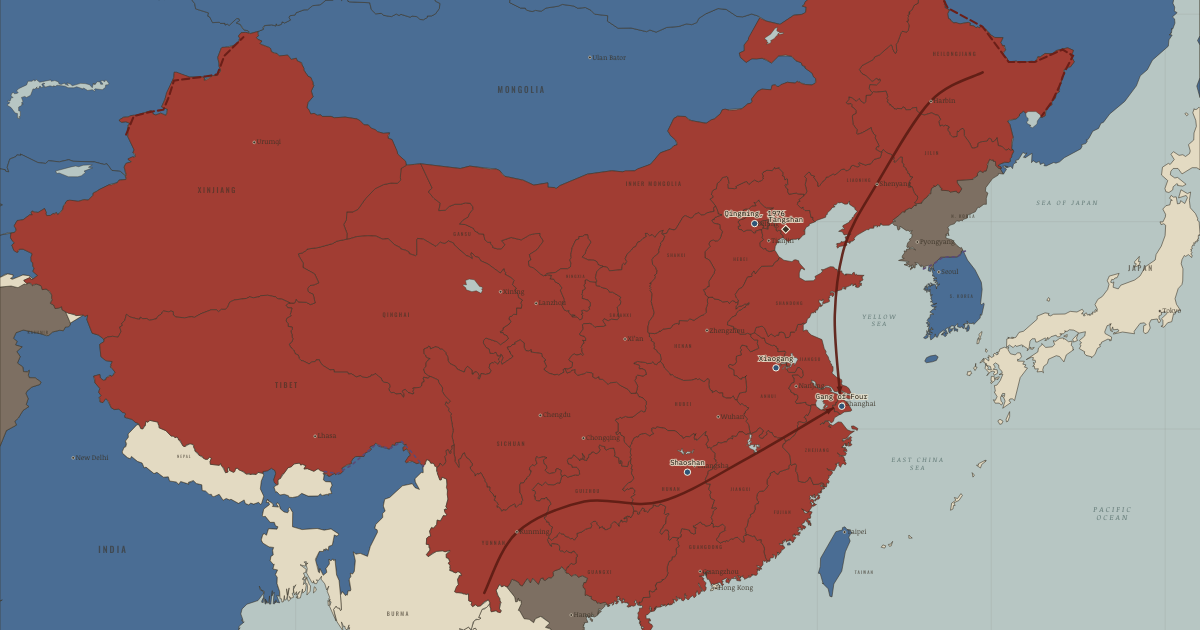
The map above is the world of China, September 1976 — Mao dies.
Part of IB History: The People’s Republic under Mao →
BRIEF EXPLANATION — THE ESSENTIAL ARGUMENT
Mao’s party-state held power for twenty-seven years by reaching into every village, and it used that power both to rebuild the lives of the people it ruled and to destroy millions of them. A party-state is one in which a single party controls the government at every level, much like a company whose owner appoints every manager. It held power by combining three things the map has shown chapter by chapter. The first was a party that reached into every village, through land reform, through farming collectives and the giant communes of 1958, collective farms that ran whole districts, and through the army-backed local governments of 1967–68. The second was a cycle of campaigns, bursts of mass mobilisation that made citizens accuse and police one another, much like a permanent wartime emergency, and the third was a leader whose authority stood above the party and was backed by the army. That combination unified China, built heavy industry and raised life expectancy dramatically. The same combination produced the famine and the Cultural Revolution, Mao’s assault on his own party in 1966, because nothing inside the system could stop a mistake made at the top. The events of 1976 showed how much the system rested on one man, because once he weakened, grief turned into protest and the succession into a contest.
The succession to Mao was settled by force, within a month of his death on 9 September 1976. On 6 October Hua Guofeng, Mao’s chosen heir, and the army veteran Ye Jianying had Mao’s widow Jiang Qing and her three radical allies, the “Gang of Four”, arrested, and the Cultural Revolution was over in all but name. Deng Xiaoping, twice purged by Mao, returned in 1977, and from December 1978 his reforms dismantled the communes and opened China to foreign trade. In 1981 the Party ruled that Mao’s “merits are primary and his errors secondary” and blamed him for the Cultural Revolution, while keeping his portrait on the Gate of Heavenly Peace in Beijing. Historians outside the Party are harsher, and they divide over whether the achievements or the deaths should weigh more. The cost chart below sets the campaigns’ dead side by side, from one to two million in land reform to between 15 and 45 million in the famine, and every bar is a range because the regime never fully counted its victims.
The full story
The answer to this atlas’s question is that Mao’s party-state reached every village through the Party’s local organisation, the campaigns and an army loyal to the leader. The same machinery unified China and raised life expectancy, and it also produced the famine and the Cultural Revolution, Mao’s assault on his own party from 1966, because nothing inside it could stop a mistake made at the top. A party-state is one in which a single party controls the government at every level, much like a company whose owner appoints every manager, and the campaigns were bursts of mass mobilisation that made citizens accuse and police one another. The chart below counts their cost: one to two million dead in land reform, roughly 700,000 to two million in the campaign against counter-revolutionaries, 15 to 45 million in the famine, and roughly 750,000 to two million in the Cultural Revolution. Altogether somewhere between about 17 million and 50 million people died, and every figure is a range because the regime never fully counted its victims.
The struggle to succeed Mao was decided by force, because his authority had held the factions together and nothing else could. After the fall of Lin Biao, the chosen heir who died fleeing China in 1971, Mao balanced two camps. One was the radicals around his wife Jiang Qing, whom he warned in 1975 not to act as a “gang of four”; the other was the veteran administrators led by Zhou Enlai and the rehabilitated Deng Xiaoping. When Zhou died in January 1976, crowds in Tiananmen Square turned Qingming, the festival for honouring the dead, into a protest against the radicals, the largest spontaneous demonstration of the Mao era, and on 5 April militia cleared the square. The Politburo, the Party’s inner cabinet of about twenty, blamed Deng and dismissed him again, and Mao chose the little-known Hua Guofeng as his successor. Mao died on 9 September, aged 82. Hua had Mao’s endorsement and no power base of his own, so he allied with Marshal Ye Jianying and Wang Dongxing, commander of the leadership’s guard unit, and on 6 October they arrested the Gang of Four. Mao’s revolution ended in a palace coup by the security forces, a final lesson in where power in his system lay.
Mao’s successors kept his party-state and abandoned his campaigns, and their choices still shape China. Deng Xiaoping, restored in 1977, outmanoeuvred Hua and launched reforms in December 1978. Peasants at Xiaogang in Anhui had already begun dividing collective land among households, and by 1984 the communes, the giant collective farms of 1958 that ran whole districts like company towns, were gone. The sent-down youth, the urban young sent to villages after 1968 in a kind of labour conscription, came home along the arrows that reverse their journeys. The Party’s Resolution of 1981 condemned the Cultural Revolution, praised Mao’s leadership before 1957, treated the famine as an error among others, and kept his portrait on the gate and his body in its mausoleum. The state Mao built survived him by abandoning much of what he had believed.
DEEP EXPLANATION — EVIDENCE & INTERPRETATION
The Party’s verdict of 1981
The Resolution on Certain Questions in the History of Our Party, adopted in June 1981, is the Communist Party’s official judgement on Mao, and it is best read as a political settlement. Deng Xiaoping supervised its drafting and insisted on two things: Mao’s contributions must remain primary, because the Party’s legitimacy rested on him, and the Cultural Revolution must be condemned, because Deng and his allies had been its victims. The text calls the Cultural Revolution responsible for “the most severe setback and the heaviest losses” since 1949 and states that chief responsibility lies with Mao. It treats the Great Leap more briefly, blaming errors, natural calamities and Soviet perfidy together, and it gives no death toll for the famine. Deng often repeated a formula that Mao had applied to Stalin and, by his own wish, to himself: seven parts achievement, three parts error. Later leaders, including Xi Jinping in a new resolution of 2021, have reaffirmed it. The Resolution served the reformers’ purpose, which was to reject Mao’s late policies while keeping the Party he founded, and it remains the price the Party pays for keeping Mao as its founder.
How historians judge Mao
Scholarly judgements of Mao fall along a spectrum, and the differences come from method as well as values. At one end, Jung Chang and Jon Halliday’s biography, The Unknown Story, presents a leader driven by power and cruelty who caused some 70 million deaths in peacetime. Many specialists, in a collection edited by Gregor Benton and Lin Chun, accepted its research into his ruthlessness while criticising its selective use of sources. Frank Dikötter’s trilogy, drawn from provincial archives, emphasises the human cost of every campaign. Andrew Walder’s China Under Mao explains the outcomes through the organisation of a Leninist party-state, arguing that its structure turned errors at the top into disasters below. Social historians such as Gail Hershatter and Ralph Thaxton reconstruct how villagers and women lived through the campaigns and resisted them in small ways. Maurice Meisner and Philip Short give weight to industrialisation, literacy and health, while some Chinese writers, such as Mobo Gao, defend Mao’s egalitarian aims. The best accounts hold cost and achievement in view together.
Measuring achievement against cost
Any balance sheet of Mao’s rule has to compare things that cannot easily be compared, and the evidence pulls in both directions. China’s population grew from about 540 million in 1949 to over 930 million in 1976, life expectancy rose from perhaps 35–40 years to the mid-60s, literacy spread widely, and a base of heavy industry, railways and nuclear weapons was built. Against that stand deaths in the campaigns and the famine that on the low estimates exceed 17 million and on the high ones reach about 50 million, together with tens of millions persecuted and a generation’s education lost. A comparison with India sharpens the problem, because it shows what the same decades cost under a different political system. The economists Jean Drèze and Amartya Sen argued in 1989 that China’s health achievements meant that India’s higher ordinary death rate cost, roughly every eight years, as many lives as China’s famine; they also argued that India’s free press and elections prevented famines that China’s system could not. Drèze and Sen credited China’s health record to public action and blamed its famine on the absence of a free press and an opposition, and this atlas draws the further conclusion that both flowed from the same concentration of power.
Key places on the map
On this day
Why it happened
A succession Mao never settled. Mao had destroyed two chosen successors, Liu Shaoqi and Lin Biao, and in his last years he balanced radicals against veterans without letting either win. He chose Hua Guofeng in 1976 because Hua belonged to neither camp. When Mao died, no institution had the authority to decide between the factions, so the succession was decided by whoever controlled the guards and the army. A regime that had no rule for passing power on had to settle the question by force.
Zhou Enlai’s death and popular anger. Zhou Enlai had become a symbol of moderation and competence, and the radicals’ attempts to limit public mourning for him in January 1976 angered millions. At the Qingming festival in April, wreaths and poems in Tiananmen Square attacked Jiang Qing and praised Zhou and Deng. The protest showed that many people blamed the radicals for a decade of chaos and wanted it to end. Mourning a dead leader was one of the few forms of political expression the system could not easily forbid.
Veterans who had survived the purges. Many of the officials purged in 1966–68 had returned to work after Lin Biao’s fall, among them Deng Xiaoping, while army elders such as Marshal Ye Jianying, sidelined since 1967, regained influence. They distrusted the radicals, controlled much of the army, and were ready to act once Mao was gone. In 1975 Deng had already shown, in the railways, the steel industry and the army, what restoring order would look like. Their return made a different future possible.
Exhaustion after a decade of campaigns. A decade of campaigns had worn out the society that was supposed to sustain them. By 1976 output was falling, the universities barely functioned, and the sent-down youth wanted to go home, while the campaigns of the 1970s, such as “Criticise Lin Biao, Criticise Confucius”, mobilised little enthusiasm. A society tired of struggle meetings, the public denunciations that every campaign used, gave the post-Mao leaders broad support when they ended them. Even inside the Party, many officials had been both perpetrators and victims of the campaigns, and they wanted security more than revolution.
THE TURNING POINT
6 October 1976. The arrest of the Gang of Four is the hinge because it ended the Maoist project without a mass movement and without a shot. Hua Guofeng, Ye Jianying and Wang Dongxing used the leadership’s guard unit to detain the radicals at a Politburo meeting, and the radicals’ base in Shanghai stood down within days. The coup opened the way for Deng Xiaoping’s return and the reforms of 1978. It also showed that power in Mao’s system had always rested on the army and the security forces, whatever the language of mass revolution claimed.
What it changed
The communes dismantled. Mao’s successors undid his central rural institution within six years. From 1978, beginning with secret contracts such as Xiaogang’s, households took responsibility for farming plots again, and by 1984 the communes had been abolished. Grain output rose sharply once households could keep what they grew above the quota, and rural incomes rose faster in the early 1980s than in any period of the Mao years. The Party had rediscovered the household farming that Mao rejected in 1962, and the reforms began in the province where the famine had been worst.
Verdicts reversed. The new leaders cleared many of Mao’s victims, selectively. The “rightists” labelled in 1957 were rehabilitated from 1978, Liu Shaoqi was posthumously cleared in 1980, and the Gang of Four were tried on television in 1980–81, with Jiang Qing sentenced to death, commuted to life imprisonment. The famine’s victims received no such public acknowledgement, and its archives remain restricted. The post-Mao state chose which of the era’s victims it could afford to remember.
A generation comes home. The return of the sent-down youth, the urban young sent to villages after 1968, created a labour problem that helped open the door to private business. Most of those still in the countryside, close to nine million at the end of 1977, came back between 1978 and 1980, and the cities could not employ them all, so the state allowed small private shops and stalls, the first private enterprise since the 1950s. Others passed the restored university examination of 1977 and joined the professions, so the returning generation supplied both the first private traders and the first graduates of the reform era.
Mao still on the gate. The state still honours Mao in its most visible places. His portrait hangs above Tiananmen, his face is on every regular banknote issued since 1999, and his body lies in a mausoleum on the square, while Shaoshan, his birthplace, receives millions of visitors a year. His legacy is official, contested and selective, which is why the history mapped here is still argued over inside and outside China.
DISCUSSION QUESTION — Should Mao’s rule be judged chiefly by what it built or by what it cost?
The case for judging by achievement rests on real evidence: a unified country after a century of division, heavy industry and nuclear weapons, life expectancy that rose by roughly twenty-five years, widespread literacy, and a state strong enough to support the growth that followed after 1978. The case for judging by cost is overwhelming in scale, since the campaigns and the famine killed somewhere between about 17 million and 50 million people, most of them in a famine caused by policy, and persecuted tens of millions more. Historians such as Dikötter and Chang and Halliday put the cost first; Meisner and Short weigh the achievements more heavily; Walder’s analysis of the party-state, and Drèze and Sen’s comparison with India, both point to the same system as the source of the gains and the deaths. That last point changes the question, because the achievements and the deaths were two products of one system, which means that neither can be offered as the price of the other. Many later achievements, from rural health to industry, were also attained elsewhere without famine. The most defensible judgement is that the regime’s capacity was real and its lack of accountability made that capacity lethal, and the general lesson for students of authoritarian rule is that power without correction magnifies both success and error.
An interesting fact
The portrait of Mao above the Gate of Heavenly Peace is about six metres high and weighs around one and a half tonnes, and it is replaced with a freshly painted copy every year before National Day on 1 October. Since 1977 the copies have been painted by the artist Ge Xiaoguang. In 1980, when the reformers were reconsidering Mao’s record, the Italian journalist Oriana Fallaci asked Deng Xiaoping whether the portrait would stay. Deng answered that it would be kept there forever, because Mao had been a founder of the Party and the state, and his mistakes did not cancel that.
Related
THE FREE PRINTABLE STUDY GUIDE
Join the Dispatch — a short welcome series, then a letter when a new atlas opens — and the printable study guide for The People’s Republic under Mao is yours now, free.
NO TRACKING · YOUR ADDRESS IS USED FOR THE DISPATCH AND NOTHING ELSE · UNSUBSCRIBE ANYTIME