ON THIS DAY ·
NKVD Order No. 00447
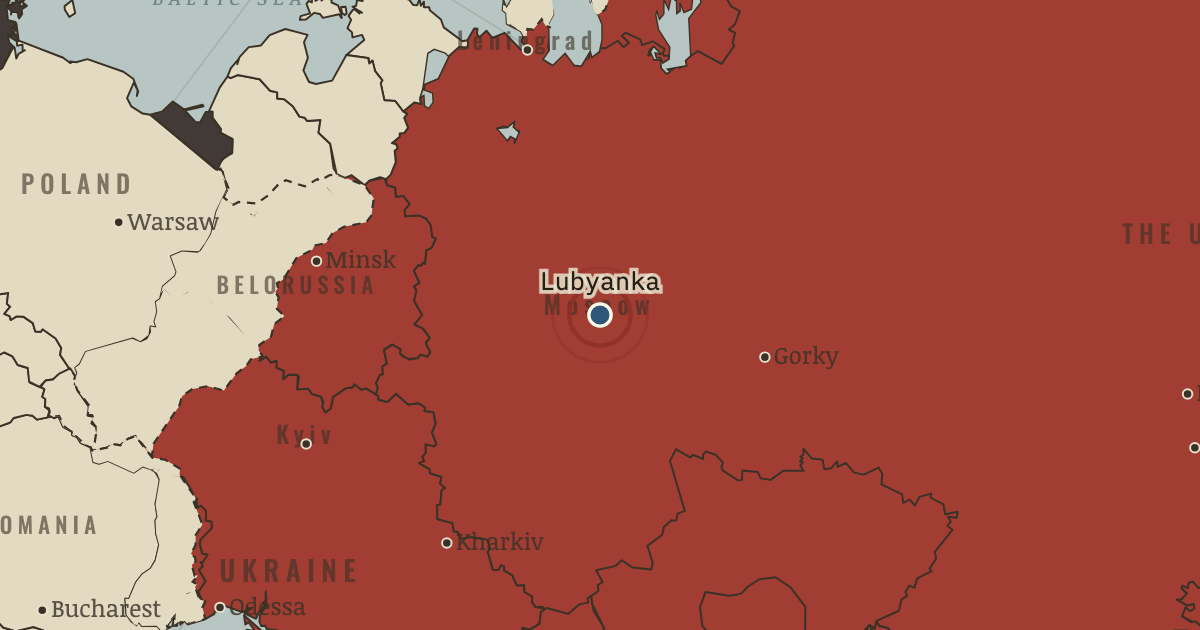
30 Jul 1937 — In NKVD headquarters, Nikolai Yezhov signs Order No. 00447, the “kulak operation”, which set every region a quota of people to be shot and sent to camps; regional chiefs repeatedly asked for higher limits. The show trials of 1936–38 were staged nearby in the House of Unions.
WW2 is free — every chapter. Try chapters 1–2 of any 2 other atlases (3 with a free account). Opening a new atlas uses one of them. Membership opens all 21 — Join.
Free printable Stalin’s Soviet Union study guide, sent by email ↓
The moment in context
The Great Terror, the mass arrests and shootings of 1937–38, grew out of a murder, a fear and a decision to settle accounts. On 1 December 1934 Sergei Kirov, the party leader in Leningrad, was shot by a disgruntled party member, Leonid Nikolaev. Stalin used the killing to pass a decree allowing quick trials without defence and to blame former oppositionists. Whether he arranged the murder is still debated; most historians who have worked in the archives, such as Matthew Lenoe, find no evidence that he did. The first great show trial, a public trial performed to a script, in August 1936 convicted Zinoviev, Kamenev and fourteen others of organising Kirov’s murder for Trotsky, and all were shot. In September Stalin replaced Genrikh Yagoda as head of the NKVD, the political police and a forerunner of the KGB, with Nikolai Yezhov, complaining that the police were “four years behind” in unmasking enemies. The pretext created in 1934 became the template for everything that followed.
From Great Terror (Great Purge), chapter 6 of The Soviet Union under Stalin, 1924–1953 (1937).
The place: NKVD Order No. 00447 — map and full story →
Teach this in 5 minutes
- Why it happened — The Kirov murder supplied a pretext. The killing of Kirov in December 1934 gave Stalin the claim that opposition led to assassination. The emergency decree passed that day allowed…
- The turn — The Lubyanka, 30 July 1937. Order No. 00447, signed by Yezhov in the NKVD headquarters on the Lubyanka and approved by the Politburo the next day, is the hinge of the Terror…
- What it changed — A personal dictatorship without rivals. The Terror left no one in the leadership by 1939 who had known Stalin as an equal or could challenge him. The Politburo met less often, decisions…
Then ask the room: Was the Great Terror the result of Stalin’s personal decisions or of pressures within the Soviet system? The argued answer is on the chapter page →
The atlas that shows it
THE FREE PRINTABLE STUDY GUIDE
Join the Dispatch — a short welcome series, then a letter when a new atlas opens — and the printable study guide for The Soviet Union under Stalin is yours now, free.
NO TRACKING · YOUR ADDRESS IS USED FOR THE DISPATCH AND NOTHING ELSE · UNSUBSCRIBE ANYTIME