Stalin’s Soviet Union · CHAPTER 6 ·
Great Terror (Great Purge)
Chapter 6 of The Soviet Union under Stalin, 1924–1953: “The Great Terror”
In 1937–38 the NKVD arrested about 1.5 million people and shot roughly 680,000 to 750,000 of them. Moscow show trials condemned Lenin’s old comrades, purges struck the party leadership and the officer corps, and quota-driven “mass operations” targeted former kulaks, priests and national minorities.
Chapter 6 is part of membership. WW2 is free — every chapter. Try chapters 1–2 of any 2 other atlases (3 with a free account). Opening a new atlas uses one of them. Membership opens all 21 — Join.
Free printable Stalin’s Soviet Union study guide, sent by email ↓
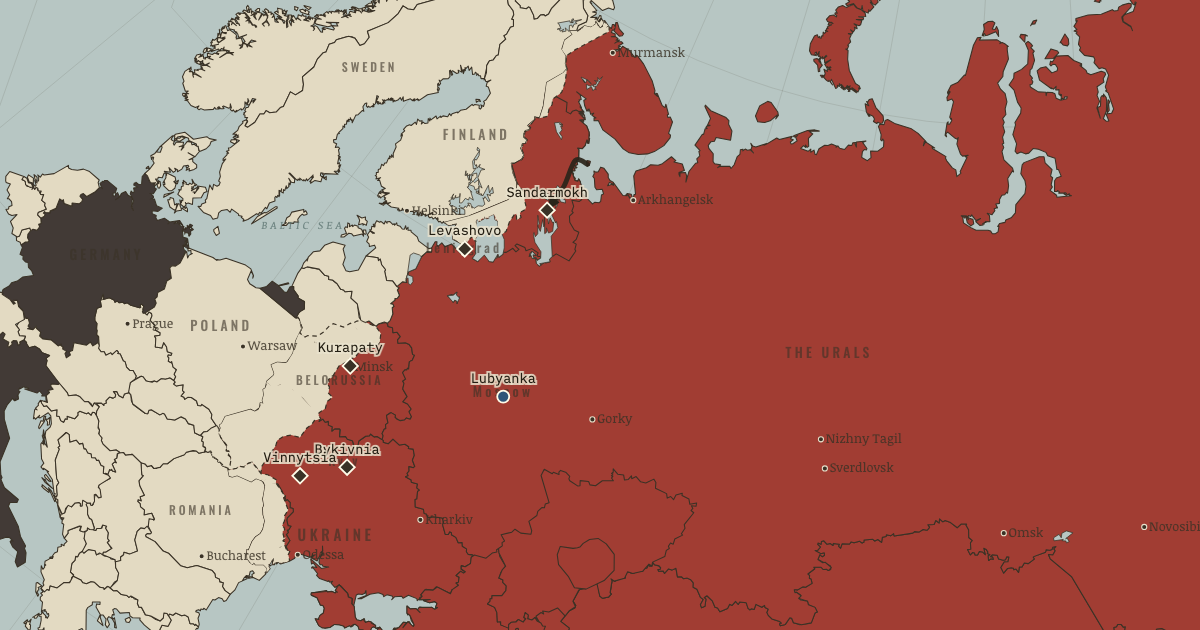
The map above is the world of The Soviet Union, August 1937 — The Great Terror; the Axis forms.
Part of IB History: The Soviet Union under Stalin →
BRIEF EXPLANATION — THE ESSENTIAL ARGUMENT
The regime turned its machinery of repression on the whole of Soviet society in 1937–38, arresting about 1.5 million people in two years and shooting between roughly 680,000 and 750,000 of them. Historians call this the Great Terror, and it had two faces. The visible one was the show trials in Moscow, staged courtroom performances in which Lenin’s old comrades confessed to plotting with Trotsky and foreign spies. Alongside them ran a purge, the expulsion and arrest of members accused of disloyalty, that destroyed much of the party leadership and the officer corps. The hidden one was a series of “mass operations” ordered by the NKVD, the political police and a forerunner of the KGB, against former kulaks, the better-off peasants dispossessed during collectivisation, and against criminals, priests and whole national minorities. They were run like production campaigns with quotas for each region, and the diamond markers on the map are the forests where their victims were buried. Both faces served one purpose, which was to remove anyone who might resist, from famous Bolsheviks to anonymous peasants.
The Terror began at the top and was carried out through every level of the state. Stalin approved the operations, signed lists of names for execution and pressed for more arrests, and the NKVD under Nikolai Yezhov organised them, with troikas, three-person panels that acted as judge and jury, sentencing thousands without trial. Regional officials asked for higher quotas, and ordinary people denounced neighbours, colleagues and rivals, sometimes from fear and sometimes for gain. In November 1938 Stalin halted the mass operations as abruptly as he had started them, and Yezhov was later shot. The Terror left Stalin with no possible rival and a frightened, renewed elite that owed him everything, which is why historians see it as the moment his personal dictatorship became complete.
The full story
The Great Terror, the mass arrests and shootings of 1937–38, grew out of a murder, a fear and a decision to settle accounts. On 1 December 1934 Sergei Kirov, the party leader in Leningrad, was shot by a disgruntled party member, Leonid Nikolaev. Stalin used the killing to pass a decree allowing quick trials without defence and to blame former oppositionists. Whether he arranged the murder is still debated; most historians who have worked in the archives, such as Matthew Lenoe, find no evidence that he did. The first great show trial, a public trial performed to a script, in August 1936 convicted Zinoviev, Kamenev and fourteen others of organising Kirov’s murder for Trotsky, and all were shot. In September Stalin replaced Genrikh Yagoda as head of the NKVD, the political police and a forerunner of the KGB, with Nikolai Yezhov, complaining that the police were “four years behind” in unmasking enemies. The pretext created in 1934 became the template for everything that followed.
The purge, the expulsion and arrest of members branded disloyal, then spread to every institution of the state. A second show trial in January 1937 and a third in March 1938, which condemned Bukharin and Rykov, accused Lenin’s former comrades of spying and sabotage. In June 1937 Marshal Mikhail Tukhachevsky and seven other senior commanders were shot, and in 1937–38 about 35,000 officers were discharged, many of them arrested, as the purge spread through the army. Of the 139 members and candidates of the Central Committee, the party’s governing body of senior figures, much like a company’s board of directors, elected at the Seventeenth Congress in 1934, 98 were arrested and shot. Factory managers, engineers, scientists, writers and officials were seized in turn, and their posts went to younger men promoted from below. The elite that had built the system was largely destroyed by it, leaving power concentrated in Stalin alone.
The deadliest part of the Terror was hidden from public view and fell on ordinary people. NKVD Order No. 00447 of 30 July 1937 set every region a “limit” for shootings and another for camp sentences, starting at about 76,000 shootings and 186,500 camp sentences. Because regional chiefs were judged by results, they asked for more. National operations targeted Poles, Germans, Latvians, Finns, Greeks and others as presumed spies; the Polish operation alone sentenced about 140,000 people and shot about 111,000. Sentences were passed by troikas, the three-person panels, in minutes and carried out at night in prison cellars and forests. The markers on the map show some of the burial sites found after 1988, at Levashovo near Leningrad, Bykivnia near Kyiv, Kurapaty near Minsk, Vinnytsia and Sandarmokh in Karelia. The arrow traces the prisoners moved from Solovki to be shot in Karelia. Quotas turned killing into a target to be met.
DEEP EXPLANATION — EVIDENCE & INTERPRETATION
Who drove the Terror?
Stalin ordered the Terror and a system that rewarded denunciation magnified it, a conclusion historians reached only after half a century of argument. Robert Conquest’s The Great Terror (1968) portrayed a plan conceived and directed by Stalin. In the 1980s J. Arch Getty and other “revisionists” argued from regional records that the purges grew out of chaotic conflicts between Moscow and provincial bosses and gained momentum from below. The archives opened after 1991 settled much of this. They show Stalin approving the mass operations, editing interrogation records and signing hundreds of lists that sentenced about 44,000 people, mostly party members and officials, to death or camp. Getty and Oleg Naumov’s The Road to Terror (1999) and Oleg Khlevniuk’s research accept that Stalin directed the Terror, while showing that regional chiefs, the NKVD and ordinary denouncers shaped its scale. Wendy Goldman documents how denunciations in factories and party cells spread arrests sideways. The consensus today is that the Terror was ordered from the top and amplified by a system that rewarded those who found enemies.
Why 1937? The fifth-column argument
Stalin launched the Terror in 1937, when he faced no organised opposition, most probably because he feared a hidden enemy in the coming war. One influential answer, argued by Oleg Khlevniuk, Stephen Kotkin and James Harris in The Great Fear (2016), links the Terror to the approach of war. Stalin watched the Spanish Civil War, where Franco’s supporters were said to form a “fifth column” inside Madrid, and feared that in a war with Germany or Japan former oppositionists, kulaks, priests and diaspora minorities would side with the enemy. The mass operations and national operations read like a pre-emptive purge of anyone who might become disloyal. Other historians stress Stalin’s personality, which Robert Tucker interpreted through his need for vindication, and the self-reinforcing logic of a police state that measured success by arrests. The fifth-column argument explains the targets well, while Stalin’s suspicion and the NKVD’s quotas explain the scale. Neither excuses the killing, which destroyed many of the very officers and experts the coming war would need.
Why did they confess?
The show trials astonished the world because famous revolutionaries confessed in open court to absurd crimes, such as plotting with Hitler and Japan. Western observers divided: the American ambassador Joseph Davies thought the evidence convincing, while the Dewey Commission, which heard Trotsky in Mexico in 1937, judged the trials frame-ups. The archives and survivors’ testimony explain the confessions. Even in court the scripts sometimes slipped: Nikolai Krestinsky retracted his confession on the first day of the 1938 trial and repeated it the next morning, and Bukharin admitted general responsibility while denying specific crimes. Interrogators used sleep deprivation, beatings and threats to families; Stalin confirmed in January 1939 that “methods of physical pressure” had been authorised since 1937. Some defendants, Bukharin among them, also bargained for their relatives’ lives or believed that confession served the party. Arthur Koestler’s novel Darkness at Noon (1940) proposed that loyal communists confessed out of faith in the party, but the records point more to torture and coercion. The trials were theatre directed at two audiences: Soviet citizens, who were shown that enemies were everywhere, and the world, which was shown that the opposition had been traitors.
Key places on the map
On this day
Why it happened
The Kirov murder supplied a pretext. The killing of Kirov in December 1934 gave Stalin the claim that opposition led to assassination. The emergency decree passed that day allowed trials in ten days without defence lawyers and immediate execution. Stalin travelled to Leningrad himself to take charge of the investigation. Former oppositionists in Leningrad were arrested, and in 1936 the trials of Zinoviev and Kamenev rewrote the murder as a Trotskyist plot, linking every past dissent to terrorism.
Fear of war and a “fifth column”. Stalin faced two hostile powers from 1933, Nazi Germany in the west and Japan in the east, and the Spanish Civil War suggested that hidden enemies could decide a war. Stalin feared that kulaks, former oppositionists, priests and minorities with links abroad would side with an invader. The mass operations and national operations of 1937–38 targeted exactly these groups, which suggests a pre-emptive purge before the expected war, aimed at people who had done nothing yet.
The old elite still remembered alternatives. Many senior communists had known Lenin and had supported Trotsky, Zinoviev or Bukharin in the 1920s, and some had privately criticised collectivisation and the famine. Martemian Ryutin’s 1932 platform called Stalin the “evil genius” of the revolution. At the Seventeenth Congress in 1934 Stalin may have received a number of votes against him in the secret ballot for the Central Committee, according to later testimony that historians dispute. Destroying this generation removed anyone who could imagine the party without him.
A police state measured success by arrests. The NKVD had grown through collectivisation and the camps into a vast bureaucracy whose officers were rewarded for uncovering plots. Quotas turned repression into a plan to be fulfilled and overfulfilled, and regional chiefs who reported few enemies risked being seen as enemies themselves. Yezhov’s NKVD also arrested and shot many of its own officers, so fear drove the police as hard as ambition did. Once launched, the operations generated their own momentum through confessions that named new accomplices.
THE TURNING POINT
The Lubyanka, 30 July 1937. Order No. 00447, signed by Yezhov in the NKVD headquarters on the Lubyanka and approved by the Politburo the next day, is the hinge of the Terror because it changed a purge of the elite into mass killing of ordinary people. Before it, arrests had concentrated on party members, officials and former oppositionists. After it, quotas sent hundreds of thousands of peasants, workers, believers and former kulaks before troikas, and the national operations that followed added whole minorities. Most of the Terror’s victims died under orders issued after this date, which is why it marks the shift from political purge to social cleansing.
What it changed
A personal dictatorship without rivals. The Terror left no one in the leadership by 1939 who had known Stalin as an equal or could challenge him. The Politburo met less often, decisions were taken by Stalin and small groups he chose, and his surviving colleagues, Molotov, Kaganovich and Voroshilov among them, depended on his favour. The cult of the late 1930s celebrated a leader who now had no one left to contradict him.
A weakened army on the eve of war. The purge of the officer corps removed experienced commanders just before the war with Finland in 1939–40, where the Red Army performed badly, and before the German invasion of 1941. Historians debate how much the purge contributed to the disasters of 1941, since many discharged officers were reinstated and other failures mattered, but it damaged initiative and trust throughout the army.
A new generation in power. The Terror opened posts for young officials, engineers and managers trained in the 1930s, the vydvizhentsy. Men such as Leonid Brezhnev, Alexei Kosygin and Andrei Gromyko rose rapidly into posts left empty by the arrested; Brezhnev went from factory engineer in 1935 to secretary of the Dnipropetrovsk regional party committee in 1939. This generation, loyal to Stalin and marked by fear, would govern the Soviet Union until the 1980s.
Fear in everyday life. The arrests reached families in every town and many villages, and children of “enemies of the people” were stigmatised or sent to orphanages, while wives were sent to special camps. People learned to avoid strangers, guard their words and burn letters. That habit of silence protected the regime long after the mass operations ended, and it is one reason the Terror was discussed openly only after 1956.
DISCUSSION QUESTION — Was the Great Terror the result of Stalin’s personal decisions or of pressures within the Soviet system?
The archives make Stalin’s central role clear, but they also show why the Terror took the scale it did. Stalin initiated the show trials, approved Order No. 00447 and the national operations, signed lists sentencing tens of thousands, and ended the mass operations in November 1938, which demonstrates that he could start and stop the killing. Yet he did not carry it out alone. Regional chiefs asked for higher quotas, NKVD officers competed to uncover plots, and denunciations from neighbours and colleagues drew in new victims, as Getty and Goldman show. A strong answer weighs these levels together. It might conclude that the Terror was Stalin’s decision in origin, purpose and timing, linked to his fear of a fifth column before war, while the system’s incentives and fears explain its extraordinary reach. The transferable insight is that mass repression in a modern state needs both a decision from the top and many people below who see reasons to take part.
An interesting fact
The constitution the Terror ignored was drafted partly by its victims. The “Stalin Constitution”, adopted on 5 December 1936 and hailed by Stalin as the most democratic in the world, was prepared by a commission whose drafting groups included Nikolai Bukharin and Karl Radek. Its Article 127 promised that no one could be arrested except by decision of a court or with a prosecutor’s sanction. Within weeks Radek was a defendant in the second Moscow show trial, and fifteen months later Bukharin stood in the dock of the third, so the authors of its guarantees became examples of how little they meant.
Related
THE FREE PRINTABLE STUDY GUIDE
Join the Dispatch — a short welcome series, then a letter when a new atlas opens — and the printable study guide for The Soviet Union under Stalin is yours now, free.
NO TRACKING · YOUR ADDRESS IS USED FOR THE DISPATCH AND NOTHING ELSE · UNSUBSCRIBE ANYTIME