ON THIS DAY ·
Second Taiwan Strait Crisis
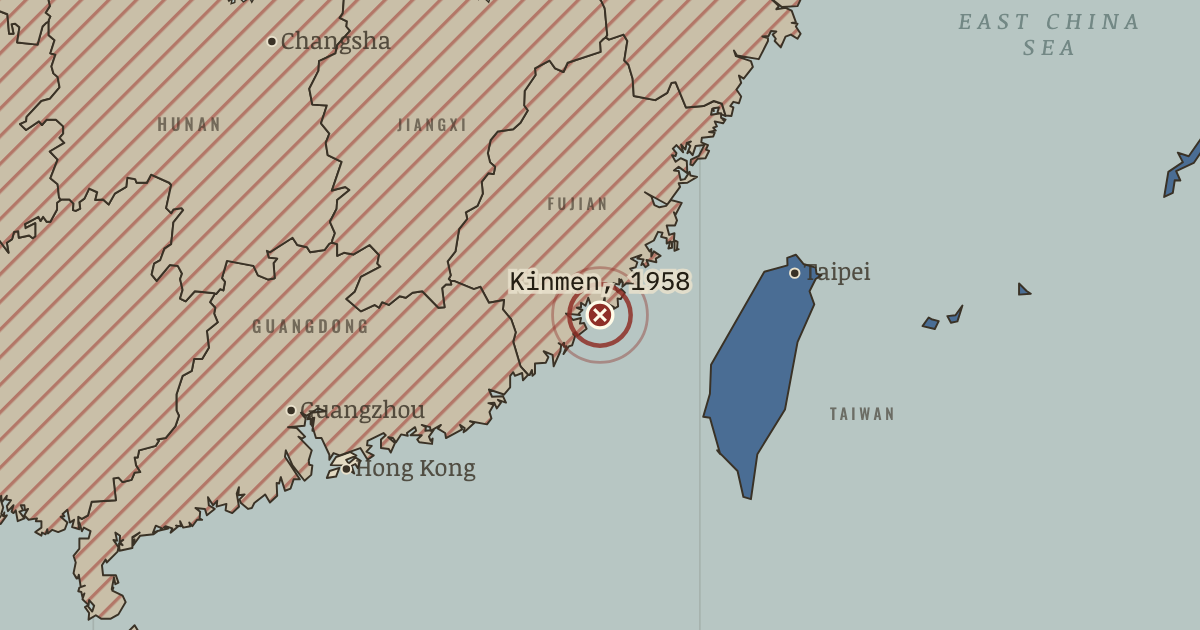
23 Aug 1958 — PLA batteries open a bombardment of Kinmen with tens of thousands of shells, testing Washington and rallying the Leap at home. US warships escort Nationalist supply convoys to the edge of Chinese waters. In October Beijing settles on shelling only on odd-numbered days, a ritual that lasted until 1979.
WW2 is free — every chapter. Try chapters 1–2 of any 2 other atlases (3 with a free account). Opening a new atlas uses one of them. Membership opens all 21 — Join.
The moment in context
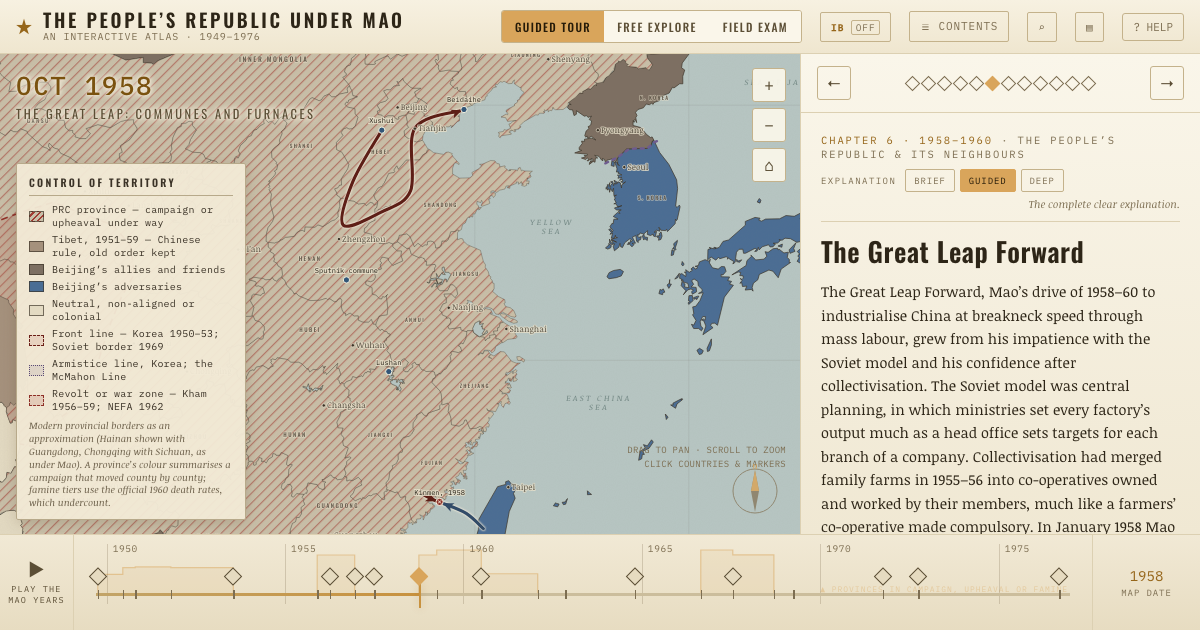
The Great Leap Forward, Mao’s drive of 1958–60 to industrialise China at breakneck speed through mass labour, grew from his impatience with the Soviet model and his confidence after collectivisation. The Soviet model was central planning, in which ministries set every factory’s output much as a head office sets targets for each branch of a company. Collectivisation had merged family farms in 1955–56 into co-operatives owned and worked by their members, much like a farmers’ co-operative made compulsory. In January 1958 Mao attacked the premier Zhou Enlai’s caution of 1956, which he called “opposition to rash advance”, so fiercely that Zhou offered to resign. In the winter of 1957–58 tens of millions of peasants were mobilised to dig irrigation works, and their success seemed to prove that labour could replace capital. Mao called China’s people “poor and blank”, and he saw that poverty as an advantage, because people with nothing to lose would leap.
From Great Leap Forward, chapter 6 of The People’s Republic under Mao, 1949–1976 (1958).
The place: Second Taiwan Strait Crisis — map and full story →
Teach this in 5 minutes
- Why it happened — The easy victory of collectivisation. Collectivisation had been completed in eighteen months without the famine that followed Stalin’s, and the irrigation campaign of the winter of…
- The turn — Lushan, July–August 1959. Lushan is the hinge because it was the last moment at which the Leap could have been halted without catastrophe, and Mao chose to defend his…
- What it changed — The Great Famine. With grain quotas set on false harvests, private food abolished and the mess halls running out, the countryside began to starve in the winter of…
Then ask the room: How far was Mao personally responsible for the Great Leap Forward and its failure? The argued answer is on the chapter page →
The atlas that shows it
THE FREE PRINTABLE STUDY GUIDE
Join the Dispatch — a short welcome series, then a letter when a new atlas opens — and the printable study guide for The People’s Republic under Mao is yours now, free.
NO TRACKING · YOUR ADDRESS IS USED FOR THE DISPATCH AND NOTHING ELSE · UNSUBSCRIBE ANYTIME