Mao’s China · CHAPTER 6 ·
Great Leap Forward
Chapter 6 of The People’s Republic under Mao, 1949–1976: “The Great Leap Forward”
The Great Leap Forward of 1958–60 was Mao’s attempt to industrialise China at breakneck speed through mass labour. Co-operatives became giant communes from April 1958, the deadline to overtake Britain in steel kept shrinking, and at Lushan in 1959 Mao dismissed his defence minister for criticising the Leap.
Chapter 6 is part of membership. WW2 is free — every chapter. Try chapters 1–2 of any 2 other atlases (3 with a free account). Opening a new atlas uses one of them. Membership opens all 21 — Join.
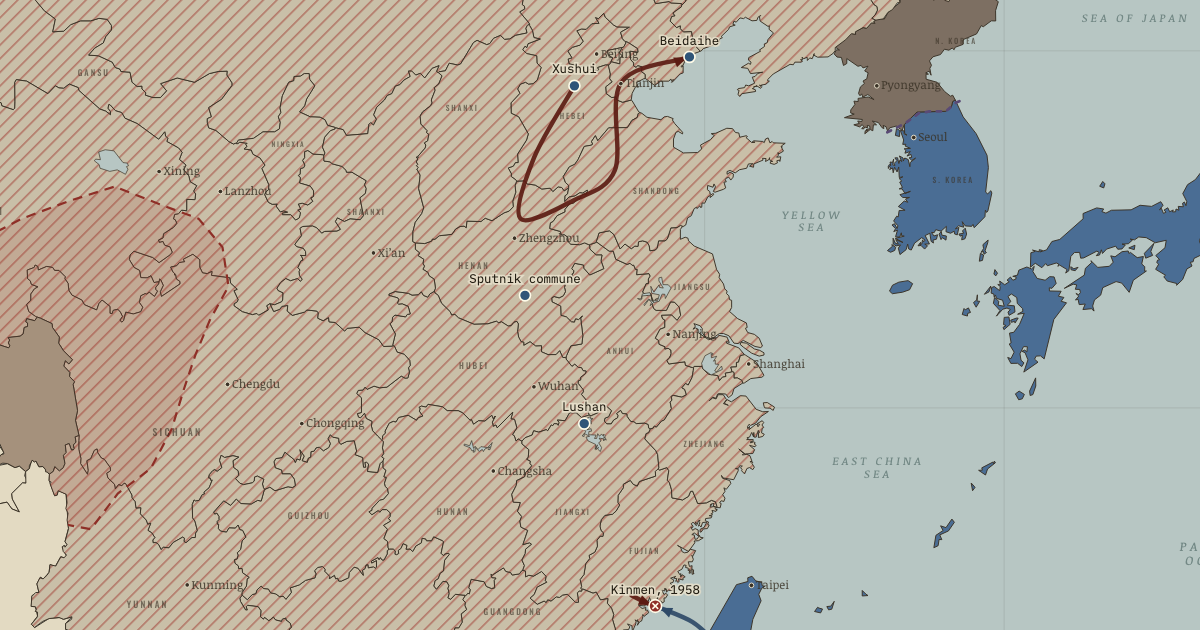
The map above is the world of China, October 1958 — The Great Leap: communes and furnaces.
Part of IB History: The People’s Republic under Mao →
BRIEF EXPLANATION — THE ESSENTIAL ARGUMENT
The Great Leap Forward was Mao’s attempt to industrialise China at a speed no planner thought possible, and its logic turned a political campaign into an economic catastrophe. A campaign was a burst of nationwide mobilisation in which the Communist Party, the single party that ran every level of government, set targets, staged mass meetings and punished the reluctant, much like a wartime national drive. On the map every province turns hatched again, the sign of a campaign under way, and the red arrow traces Mao’s tour of model villages in August 1958. Mao believed that China’s greatest resource was its people, so mass labour and enthusiasm could replace the money and machines the country lacked. In November 1957, in Moscow, he promised that China would overtake Britain in steel within fifteen years, and in 1958 the deadline kept shrinking. The co-operatives of 1956, farms owned and worked by their members, were merged into about 26,000 people’s communes, huge units averaging nearly 5,000 households that ran farming, industry, schools and militia together, much like a whole county run as a single company town. Peasants ate in communal mess halls, and some 90 million people were sent to smelt iron in backyard furnaces, small brick kilns built in villages and city yards. The whole country was staked on the belief that enthusiasm could do the work of capital.
Because officials were rewarded for reporting miracles, the Leap ran on false numbers. Communes claimed harvests many times any yield ever recorded, and labour diverted to furnaces left crops rotting in the fields. The state still set its grain quotas on the basis of those claims; a quota was the amount each village had to sell to the state at a fixed price, in effect a tax paid in grain. Defence Minister Peng Dehuai, the hero of Korea, warned Mao in a private letter at the Lushan conference of July 1959, a meeting of the Party leadership at a mountain resort. Mao answered by purging him and launching a campaign against “right opportunists”, a label for Party members accused of losing their revolutionary nerve, much like being branded a defeatist in wartime. The purge silenced every other critic and pushed the Leap on just as the food ran out. A programme that might have been corrected in 1959 was driven into the famine of 1959–61, because the person most responsible for the policy was also the only one with the power to stop it.
The full story
The Great Leap Forward, Mao’s drive of 1958–60 to industrialise China at breakneck speed through mass labour, grew from his impatience with the Soviet model and his confidence after collectivisation. The Soviet model was central planning, in which ministries set every factory’s output much as a head office sets targets for each branch of a company. Collectivisation had merged family farms in 1955–56 into co-operatives owned and worked by their members, much like a farmers’ co-operative made compulsory. In January 1958 Mao attacked the premier Zhou Enlai’s caution of 1956, which he called “opposition to rash advance”, so fiercely that Zhou offered to resign. In the winter of 1957–58 tens of millions of peasants were mobilised to dig irrigation works, and their success seemed to prove that labour could replace capital. Mao called China’s people “poor and blank”, and he saw that poverty as an advantage, because people with nothing to lose would leap.
The commune was the Leap’s central institution, because only units that large could pool the labour of tens of thousands for dams and furnaces. A commune ran farming, industry, schools and militia for a whole district, much like a county run as one company town. The first, formed in Suiping county, Henan, in April 1958, was named Sputnik after the Soviet satellite. In August Mao toured model counties in three provinces, the route the red arrow follows, praising communes and asking at Xushui what peasants would do with so much grain. At the Beidaihe meeting that month the Politburo, the inner cabinet of the Communist Party that ran every level of government, endorsed communes and a steel target of 10.7 million tonnes, double 1957’s output. By December nearly every rural household belonged to a commune. Communal mess halls served free meals, and women, freed from cooking, were sent to the fields and furnaces. Private plots, family pigs and village markets disappeared, and so did the household’s control over its own food.
The incentives of the campaign, a national drive with targets and punishments, produced lies at every level, and the lies decided who would eat. Officials who reported modest harvests were accused of rightism, the charge that had branded some 550,000 critics in 1957, so counties competed to launch “sputniks”, claims of yields many times any ever achieved. The 1958 harvest was first announced as 375 million tonnes; the true figure was about 200 million. The state’s procurement, its compulsory purchase of grain at a fixed price, in effect a tax in grain, was set on the claims and in 1959 took close to two-fifths of a shrinking real harvest. The backyard furnaces, meanwhile, consumed pots, tools and doors and produced mostly useless iron. At the Lushan conference of July 1959, a Party meeting at a mountain resort, the defence minister Peng Dehuai’s letter to Mao named the problem “petty-bourgeois fanaticism”. Mao turned the debate into a test of loyalty, Peng was dismissed, and a campaign against “right opportunists”, Party members accused of losing their revolutionary nerve, punished officials across the country. The Leap was renewed at the very moment it should have been stopped.
DEEP EXPLANATION — EVIDENCE & INTERPRETATION
Why did Mao launch the Leap?
Historians trace the Leap to a mixture of ideology, rivalry and personality. Roderick MacFarquhar’s second volume of The Origins of the Cultural Revolution shows Mao turning against the Soviet model in 1956–57: he thought it bureaucratic, too slow and too dependent on experts, and he wanted a Chinese road that used the country’s abundant labour. The Moscow meeting of November 1957 added rivalry, since Khrushchev’s boast that the Soviet Union would overtake the United States prompted Mao’s promise to overtake Britain. Frederick Teiwes and Warren Sun, in China’s Road to Disaster, stress that Mao alone drove the policy and that colleagues such as Liu Shaoqi and Zhou Enlai went along out of loyalty and fear after the attack on “opposing rash advance”. Others point to provincial leaders who pushed their own regions ahead of Beijing. The debate concerns how blame should be shared. Few historians doubt that the decisive impulse came from Mao’s belief that political will could overcome material limits.
How the numbers lied
The Leap destroyed the information on which any government depends, and the mechanism is clear in the archives. Statistics were declared a political matter, so the State Statistical Bureau lost its independence and figures were set by campaign targets. Each level of government added to the claims of the level below, since a county leader who reported less than his neighbours risked being labelled a rightist. The People’s Daily printed photographs of children standing on wheat so dense it seemed to bear their weight. Thomas Bernstein showed that procurement in 1959 took close to two-fifths of the real harvest, the highest share of the decade, because quotas were based on inflated output. By late 1958 Mao himself suspected the figures and briefly encouraged a retreat at the Zhengzhou and Wuchang meetings. The Lushan meeting of 1959 reversed that correction, because Mao treated doubts about the figures as disloyalty. The lesson the sources teach is that a system which punishes bad news will eventually be unable to see the truth, however intelligent its leaders.
Lushan: the decision that made the famine
The Lushan meeting of July and August 1959 is the point at which a policy disaster became a catastrophe, and the records allow it to be followed closely. Li Rui, one of Mao’s secretaries, kept notes that were later published, and they show a meeting called to consolidate a modest retreat. Peng Dehuai’s letter of 14 July praised the Leap’s achievements and criticised its excesses in measured terms. Mao circulated it, then on 23 July told the meeting that if the army followed Peng he would go to the countryside and raise a new Red Army. Peng, Zhang Wentian, Huang Kecheng and Zhou Xiaozhou were condemned as an “anti-Party clique”, and Lin Biao replaced Peng as defence minister. The campaign against right opportunism that followed made every provincial leader re-inflate targets. Most historians agree that without Lushan the retreat begun in late 1958 might have continued, and many millions of the famine’s dead might have lived.
Key places on the map
On this day
Why it happened
The easy victory of collectivisation. Collectivisation had been completed in eighteen months without the famine that followed Stalin’s, and the irrigation campaign of the winter of 1957–58 mobilised tens of millions of peasants. These successes convinced Mao that organisation and enthusiasm could achieve in months what planners expected to take years. The co-operatives also provided the units that could be merged into communes, and the officials who had raced to enrol villages in 1955 were ready to race again.
Overtaking Britain. Rivalry inside the Communist world gave the Leap its deadline. At the Moscow conference of Communist parties in November 1957, Khrushchev claimed that the Soviet Union would overtake the United States in fifteen years, and Mao answered that China would overtake Britain in steel in the same time. Rivalry within the Communist world turned this into a race, and in 1958 the target date was brought forward again and again. Steel output became the symbol by which success was measured.
A Party that had silenced its critics. The Anti-Rightist Campaign of 1957 had removed or frightened the economists, engineers and journalists who might have challenged impossible targets. Within the Party, Mao’s attack on Zhou Enlai and Chen Yun for “opposing rash advance” in January 1958 showed that even the most senior leaders could be humiliated for caution, so nobody at any level had an incentive to say that a target was impossible. Silence at the top was copied at every level below, where the penalties for doubt were harsher still.
Mao’s faith in human will. Mao’s revolutionary experience in Yan’an had taught him that a determined, well-organised people could defeat stronger enemies. He applied the same belief to the economy, holding that “politics in command” and mass mobilisation could replace capital, machinery and expertise. Ideas such as close planting and deep ploughing, borrowed from discredited Soviet agronomy, were imposed everywhere as proof that revolutionary methods beat conventional science. Agronomists who objected had often been labelled rightists the year before, so the scientific check on the policy was already gone.
THE TURNING POINT
Lushan, July–August 1959. Lushan is the hinge because it was the last moment at which the Leap could have been halted without catastrophe, and Mao chose to defend his authority instead. Peng Dehuai’s letter was moderate, and many leaders privately agreed with it. By treating it as an attack on himself, Mao turned the question of whether the targets were possible into the question of whether officials were loyal. The campaign against right opportunism that followed made every official at every level revive the inflated targets and the requisitions. The famine of 1959–61 was decided at a mountain resort in the summer of 1959.
What it changed
The Great Famine. With grain quotas set on false harvests, private food abolished and the mess halls running out, the countryside began to starve in the winter of 1958–59, and after Lushan the requisitions were pressed harder. Between 1959 and 1961 somewhere between 15 and 45 million people died, the largest famine in recorded history. The provinces whose leaders had been most zealous in 1958 suffered most.
Lin Biao takes the army. Peng Dehuai’s fall made Lin Biao defence minister, and Lin built his position by promoting the study of Mao’s thought throughout the army, culminating in the Little Red Book of quotations in 1964. The cult that the Cultural Revolution unleashed was first organised in the barracks after Lushan, and by 1969 Lin stood as Mao’s named successor. Two years later Mao turned against him, suspecting that the army’s new power threatened his own.
Mao on the second line. Mao’s retreat to what he called the “second line”, leaving daily government to colleagues, handed them the management of the crisis. In April 1959 he had given up the post of head of state to Liu Shaoqi, saying he wished to concentrate on theory. When the famine forced a retreat, Liu, Deng Xiaoping and Chen Yun ran it, which gave them authority Mao came to resent and set up the struggle of 1966. The famine’s managers became the Cultural Revolution’s targets.
Khrushchev’s scorn. Khrushchev mocked the communes in public in 1959, and Mao suspected that Peng Dehuai had discussed his criticisms with Soviet leaders during a visit to Eastern Europe that spring. The Leap thus deepened the quarrel with Moscow, and in 1960 the Soviet experts were withdrawn. Each side read the other’s policies as a betrayal of the revolution, and the alliance never recovered.
DISCUSSION QUESTION — How far was Mao personally responsible for the Great Leap Forward and its failure?
The case for Mao’s personal responsibility is strong. He devised the Leap’s central ideas, attacked colleagues who urged caution in January 1958, promoted the communes and the steel target, and at Lushan he chose to purge Peng Dehuai and revive the campaign when a correction was under way. Teiwes and Sun conclude that no other leader could have started or stopped it. Yet the Leap also depended on thousands of others. Provincial leaders such as Wu Zhipu in Henan and Li Jingquan in Sichuan competed to exceed targets, county officials invented harvests, and colleagues in Beijing who doubted the figures stayed silent. Some historians, including Andrew Walder, therefore stress the system: a party-state that rewarded zeal and punished honesty would have produced inflated claims under any leader in a campaign. The most convincing judgement is that Mao bore primary responsibility for the decisions, while the political system he built explains why those decisions could not be challenged. Responsibility in authoritarian systems is rarely the leader’s alone, and rarely anyone else’s first.
An interesting fact
One of the Leap’s campaigns was a war on the “Four Pests”: rats, flies, mosquitoes and sparrows, which were accused of eating grain. For three days in April 1958 Beijing’s residents banged pots, beat drums and waved flags from roofs and trees so that sparrows could not land until they fell from exhaustion. The birds also ate insects, and locust and pest damage worsened. After scientists such as the ornithologist Zheng Zuoxin warned the leadership, sparrows were quietly removed from the list in 1960 and replaced by bedbugs. The episode became a standard example, in China and abroad, of what happens when a campaign overrides expert advice.
Related
THE FREE PRINTABLE STUDY GUIDE
Join the Dispatch — a short welcome series, then a letter when a new atlas opens — and the printable study guide for The People’s Republic under Mao is yours now, free.
NO TRACKING · YOUR ADDRESS IS USED FOR THE DISPATCH AND NOTHING ELSE · UNSUBSCRIBE ANYTIME