ON THIS DAY ·
Swing Riots
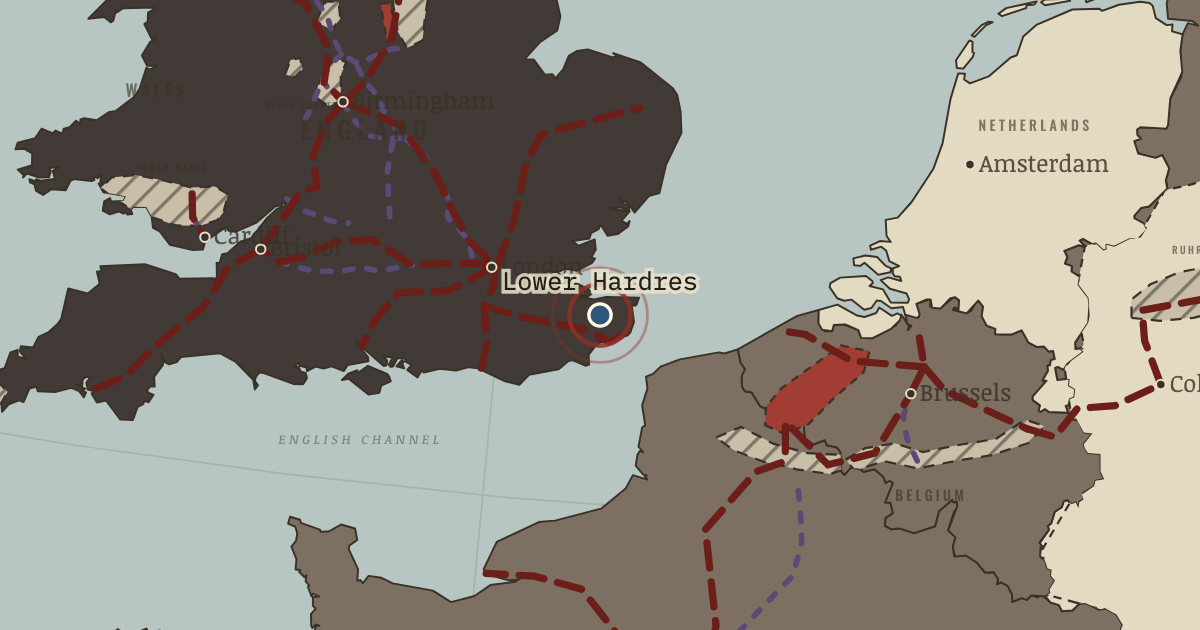
28 Aug 1830 — Labourers destroy a threshing machine near Canterbury, the first act of the Swing Riots. By winter some 2,000 protesters are tried; 19 are executed and about 480 transported to Australia.
WW2 is free — every chapter. Try chapters 1–2 of any 2 other atlases (3 with a free account). Opening a new atlas uses one of them. Membership opens all 21 — Join.
Free printable Industrial Revolution study guide, sent by email ↓
The moment in context
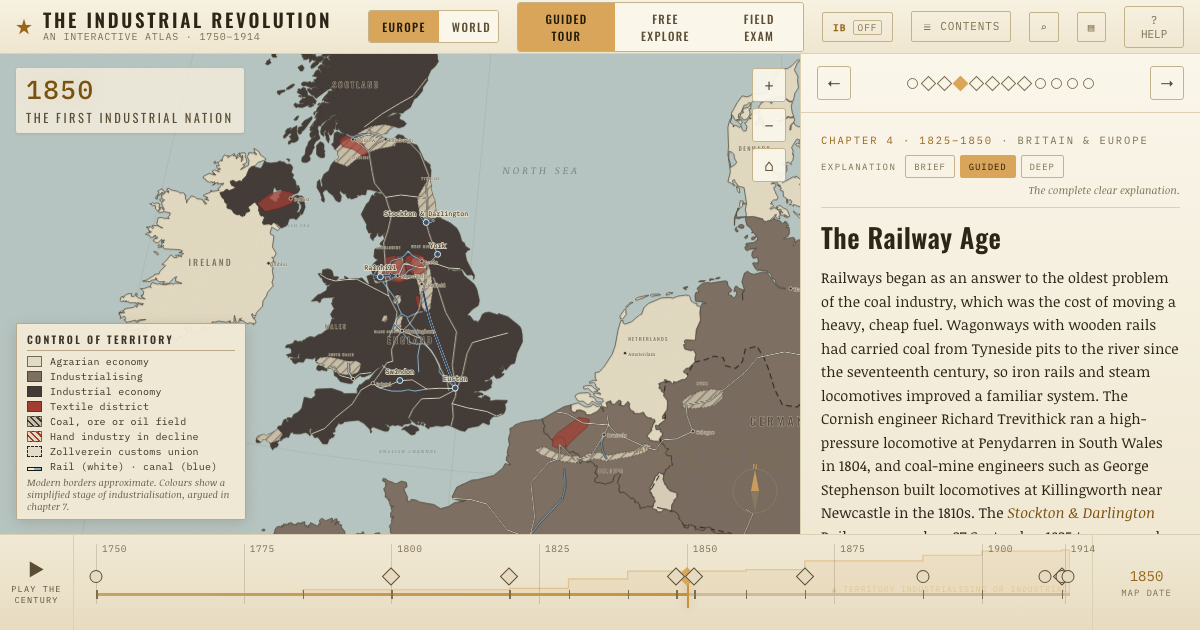
Luddism was a targeted protest by skilled workers, and its targets reveal its logic. In the Midlands stocking trade, framework knitters, who worked rented knitting frames at home, faced falling pay per stocking and wide frames that made cheap, poorly finished stockings. Beginning at Arnold on 11 March 1811 they broke the frames of employers who paid low rates while sparing those who paid fairly. In Yorkshire the croppers, who finished woollen cloth by hand with heavy shears, faced shearing frames that did their work with a fraction of the labour, and in April 1812 about 150 of them attacked William Cartwright’s mill at Rawfolds, where defenders shot two of them dead. In Lancashire, hand weavers attacked mills that used steam-powered looms. These were precise attacks on specific practices, carried out in a decade of war, dear food and trade depression by men who had no vote and no legal union.
From Luddites, Peterloo and Chartism, chapter 6 of The Industrial Revolution, 1750–1914 (1848).
The place: Swing Riots — map and full story →
Teach this in 5 minutes
- Why it happened — Machines threatened skilled trades. New machines threatened skilled trades within a few years: shearing frames trimmed woollen cloth by machine, wide knitting frames turned out broad…
- The turn — Peterloo, 16 August 1819. Peterloo, the massacre at St Peter’s Field in Manchester, is the hinge because it showed both sides what the other was prepared to do. A peaceful,…
- What it changed — Reform reaches the middle classes first. Industrial wealth won political power before industrial labour did. The Reform Act of 1832 gave new industrial towns such as Manchester, Birmingham…
Then ask the room: Were the Luddites enemies of progress, or rational defenders of their livelihoods? The argued answer is on the chapter page →
The atlas that shows it
THE FREE PRINTABLE STUDY GUIDE
Join the Dispatch — a short welcome series, then a letter when a new atlas opens — and the printable study guide for The Industrial Revolution is yours now, free.
NO TRACKING · YOUR ADDRESS IS USED FOR THE DISPATCH AND NOTHING ELSE · UNSUBSCRIBE ANYTIME