Industrial Revolution · CHAPTER 6 ·
Luddites, Peterloo and Chartism
Chapter 6 of The Industrial Revolution, 1750–1914: “Resistance”
Between 1811 and 1813 Luddite stocking knitters, cloth finishers and weavers broke machines in Nottinghamshire, Yorkshire and Lancashire, and the state answered with troops and hangings. Resistance then turned to politics, from the Peterloo meeting in Manchester on 16 August 1819 to the Chartists of the 1830s and 1840s.
Chapter 6 is part of membership. WW2 is free — every chapter. Try chapters 1–2 of any 2 other atlases (3 with a free account). Opening a new atlas uses one of them. Membership opens all 21 — Join.
Free printable Industrial Revolution study guide, sent by email ↓
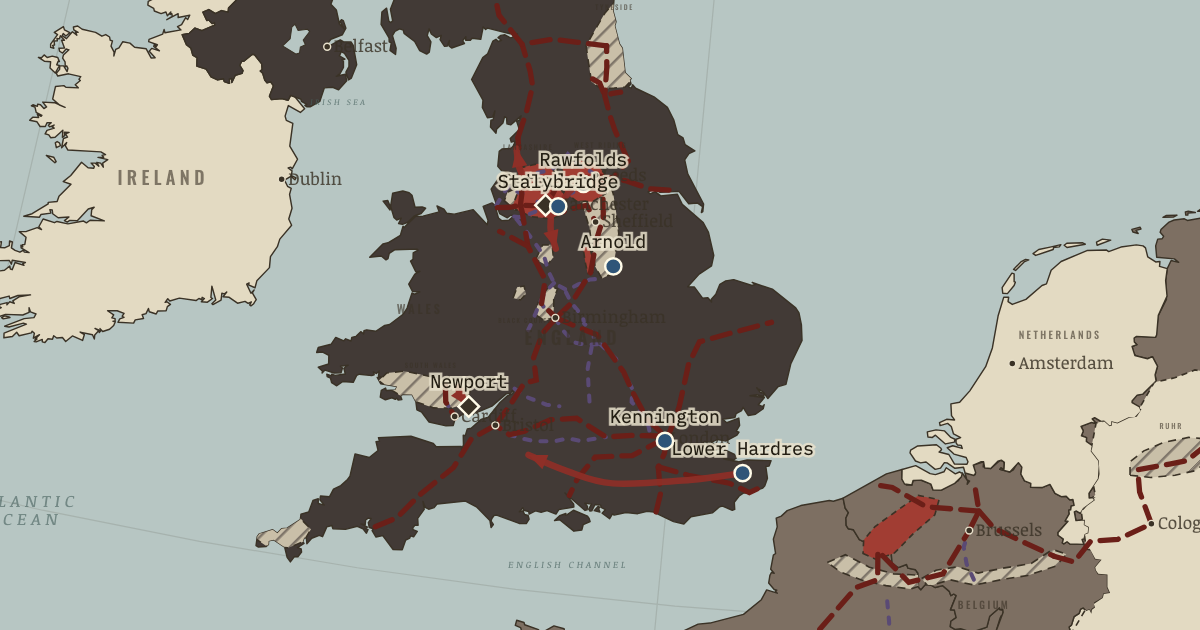
The map above is the world of The Industrial Revolution in Europe, April 1848 — The last Chartist petition.
Part of IB History: The Industrial Revolution →
BRIEF EXPLANATION — THE ESSENTIAL ARGUMENT
The industrial changes of the early nineteenth century met fierce resistance, and the forms it took reveal what working people actually objected to. The first great movement was Luddism. Between 1811 and 1813 stocking knitters in Nottinghamshire, cloth finishers in Yorkshire and weavers in Lancashire broke machines and attacked the mills that threatened their trades and wages, signing their threatening letters with the name of an imaginary leader, General Ludd. They began at Arnold near Nottingham in March 1811 and reached their peak in the attack on Rawfolds Mill in Yorkshire in April 1812. The historian Eric Hobsbawm called this collective bargaining by riot, meaning pressure on employers through damage at a time when trade unions were illegal, much as strikers today use a walkout to force a negotiation.
The state answered with force, and resistance turned increasingly to politics. Machine-breaking became a capital crime, punishable by death, in 1812, and seventeen men were hanged at York in 1813. When a peaceful crowd of perhaps 60,000 met in Manchester in 1819 to demand parliamentary reform, meaning a wider vote and fairer seats in Parliament, cavalry charged it and killed about 18 people, a massacre remembered as Peterloo. On the map the red arrows show protest spreading: the Swing Riots of farm labourers against threshing machines, which separated grain from straw, moving west from Kent in 1830, the Chartists, a mass movement demanding the vote for all men, marching on Newport in 1839, and the general strike of 1842, a stoppage across many industries, fanning out from Stalybridge. Resistance rarely stopped the machines, yet it forced the political changes that later gave workers a voice.
The full story
Luddism was a targeted protest by skilled workers, and its targets reveal its logic. In the Midlands stocking trade, framework knitters, who worked rented knitting frames at home, faced falling pay per stocking and wide frames that made cheap, poorly finished stockings. Beginning at Arnold on 11 March 1811 they broke the frames of employers who paid low rates while sparing those who paid fairly. In Yorkshire the croppers, who finished woollen cloth by hand with heavy shears, faced shearing frames that did their work with a fraction of the labour, and in April 1812 about 150 of them attacked William Cartwright’s mill at Rawfolds, where defenders shot two of them dead. In Lancashire, hand weavers attacked mills that used steam-powered looms. These were precise attacks on specific practices, carried out in a decade of war, dear food and trade depression by men who had no vote and no legal union.
The state’s response shows how seriously the propertied classes took the threat, and it pushed protest toward political demands. Parliament made frame-breaking punishable by death in 1812, about 12,000 troops occupied the disturbed districts, and after a special court at York in January 1813 seventeen men were hanged. In 1817 hundreds of Lancashire weavers set out to march to London carrying blankets, to petition the Prince Regent, who ruled for his incapacitated father George III, and were stopped by troops around Stockport. On 16 August 1819 a crowd of perhaps 60,000 gathered at St Peter’s Field in Manchester to hear the orator Henry Hunt demand reform. The yeomanry, part-time cavalry of local property owners, and then regular cavalry charged the crowd, and about 18 people died. Journalists named it Peterloo, a bitter echo of Waterloo, Britain’s victory over Napoleon in 1815, and the government answered with the Six Acts restricting meetings and the press. The lesson many radicals drew was that only a reformed Parliament could protect them.
Repression and a narrow reform of Parliament pushed protest in the 1830s and 1840s toward mass political organisation, after one last great wave of machine-breaking in the countryside. In the Swing Riots that began at Lower Hardres in Kent in August 1830, farm labourers destroyed threshing machines, which separated grain from straw, and sent letters signed by an imaginary Captain Swing; 19 were executed and about 480 were transported, shipped as convicts, to Australia. Because the Reform Act of 1832 gave the vote only to men of property, about one adult man in five, industrial workers turned to politics. From 1838 the Chartists campaigned for the People’s Charter, a six-point programme whose demands included votes for all men and a secret ballot. In 1839 troops shot dead about 22 armed Chartists marching on Newport. In 1842 a petition claimed over three million signatures, and that summer, as employers cut wages in a deep depression, a general strike, a stoppage across many trades at once, spread from Stalybridge across the industrial north. The last petition, launched at Kennington Common in April 1848, was rejected. Chartism failed in its own time, yet five of its six demands later became law.
DEEP EXPLANATION — EVIDENCE & INTERPRETATION
What the Luddites wanted
For a long time the Luddites, the textile workers who smashed machinery in 1811–13, were remembered as men who hated machines, and the modern insult still carries that meaning. Historians since the 1950s have read them differently. The historian Eric Hobsbawm’s essay “The Machine Breakers” (1952) showed that machine-breaking was an old tactic used to pressure employers in disputes over wages, and the historian E. P. Thompson’s The Making of the English Working Class (1963) set out to rescue them from what he called “the enormous condescension of posterity”. The evidence supports a targeted reading. Midlands knitters attacked the frames of employers who cut rates or made inferior goods, Yorkshire croppers, who finished woollen cloth by hand with heavy shears, attacked the specific machines that abolished their skill, and many Luddites first petitioned Parliament for protection. Historians disagree about how political the movement was. Thompson suspected a revolutionary underground in Yorkshire, while the historian Malcolm Thomis argued in 1970 that it was almost entirely an industrial dispute, and government spies’ reports, the main evidence for conspiracy, are unreliable. The historian Adrian Randall has shown that wool workers in the West Country, England’s south-west, resisted machinery in the same targeted way in the 1790s, which suggests Luddism was one episode in a long tradition.
The moral economy and the law
Many early industrial protesters believed they were defending old rights, and historians have shown that the law was abandoning those rights at the same moment. The historian E. P. Thompson’s essay on “the moral economy of the English crowd” (1971) argued that eighteenth-century protesters acted on a shared sense of fair prices, fair wages and customary rights, and that riots were attempts to enforce those norms. Early industrial protest grew out of that tradition. Parliament repealed the old powers of magistrates to fix wages in 1813 and the apprenticeship rules of the Statute of Artificers, a labour law of 1563, in 1814, rejected weavers’ petitions for a minimum wage, and had banned trade unions under the Combination Acts of 1799 and 1800. Workers who appealed to custom found that the state now backed the free market. The historians Eric Hobsbawm and George Rudé, in Captain Swing (1969), their study of the rural riots of 1830, showed the same pattern in the countryside: labourers broke threshing machines, which separated grain from straw and took away their winter work, and demanded higher wages, and the courts tried nearly 2,000 of them, sentencing 252 to death, of whom 19 were executed. The gap between the moral economy and the new law of the market explains why so much protest in this period was both conservative in its aims and radical in its methods.
Chartism and the making of a working class
Chartism, a campaign named after its People’s Charter of political reforms, was the first national movement of working people anywhere, and historians debate what held it together. Its six points demanded votes for all adult men, a secret ballot, electoral districts of equal size, payment of MPs, no property qualification for MPs and annual parliaments. Its petitions gathered about 1.28 million signatures in 1839 and 3.3 million in 1842; the 1848 petition claimed 5.7 million, but Commons clerks counted fewer than two million genuine names. The historian Dorothy Thompson’s The Chartists (1984) stressed its roots in industrial communities and the role of women’s Chartist associations. The historian Gareth Stedman Jones argued in 1983 that its language was mainly political: it blamed hardship on a corrupt and unrepresentative state, and said little about class struggle against employers. Chartism failed for several reasons: divisions between moral-force leaders, who relied on persuasion, and physical-force leaders, who threatened violence; the imprisonment of its leaders; the strength of a state that could deploy troops by railway; and the rising prosperity after 1848. Yet its demands entered the mainstream, and five of the six became law between 1858 and 1918, which shows that a movement can fail in its own time and still set the agenda for the next.
Key places on the map
On this day
Why it happened
Machines threatened skilled trades. New machines threatened skilled trades within a few years: shearing frames trimmed woollen cloth by machine, wide knitting frames turned out broad sheets of fabric cut and sewn into cheap, poorly finished stockings, and steam-powered looms began to do the hand weaver’s work. A cropper, a hand finisher of woollen cloth who had served a seven-year apprenticeship, or a weaver who had once earned a craftsman’s wage, could see the machine that would replace him in the next valley. Their protest defended a whole way of life, with its customs of training, fair rates and independence, at a time when employers were cutting rates in a depressed wartime economy.
War, hunger and depression. Hunger turned grievance into action, because the worst protests came when war, bad harvests and blocked trade made food dear and work scarce. The Luddite machine-breaking of 1811–13 fell during the long war against France, when trade with Europe and America was blocked and unemployment rose, and the Corn Law of 1815, which barred foreign wheat until British prices were high in order to protect landowners’ rents, kept bread dear after the war ended. Protest peaked in the hard years of 1811–12, 1816–19, 1830 and 1842, so hunger set the timing of revolt even where machines supplied the grievance.
Laws that silenced workers. The Combination Acts of 1799 and 1800 made trade unions illegal until 1824, and working men had no vote, so they had no lawful way to bargain or to change the law. Parliament had also repealed old laws that fixed wages and protected apprenticeships. When petitions failed, as the weavers’ appeals for a minimum wage did in 1808 and 1811, direct action seemed the only means they had left. The law had closed the peaceful routes before workers chose violent ones.
Reformers gave anger a programme. Radical writers and orators such as the journalist William Cobbett and the public speaker Henry Hunt argued that hardship came from a corrupt Parliament elected by a small minority, so the cure was reform of the vote. Cheap newspapers, reading rooms and mass meetings spread that argument across the industrial districts. By the 1830s it had turned local grievances into a national political movement with a single programme, the People’s Charter, whose six demands began with votes for all men. Political reform promised a remedy that machine-breaking could never deliver.
THE TURNING POINT
Peterloo, 16 August 1819. Peterloo, the massacre at St Peter’s Field in Manchester, is the hinge because it showed both sides what the other was prepared to do. A peaceful, disciplined crowd of perhaps 60,000 had come to demand the vote, many marching in step behind banners, and the authorities answered with sabres. About 18 people died and hundreds were wounded. The massacre discredited the government in the eyes of many middle-class observers and became a founding memory of working-class radicalism, while the Six Acts that followed, laws restricting public meetings and the radical press, showed how easily peaceful protest could be suppressed. From then on, the struggle over industrial Britain was fought mainly over who should have a voice in Parliament.
What it changed
Reform reaches the middle classes first. Industrial wealth won political power before industrial labour did. The Reform Act of 1832 gave new industrial towns such as Manchester, Birmingham and Leeds their own members of Parliament and gave the vote to many middle-class men, but it excluded almost all workers, a betrayal that fed Chartism, the mass campaign for votes for all men. Many urban working householders gained the vote in 1867, and many in the counties in 1884, so the vote followed organised pressure one slow step at a time.
Trade unions become lawful. The law turned slowly from punishing trade unions to protecting them. The Combination Acts, which had banned unions, were repealed in 1824–25 and unions grew in the skilled trades, yet in 1834 six Dorset labourers from Tolpuddle were transported, meaning shipped as convicts to Australia, for swearing a union oath. By the 1870s unions had secure legal standing in Britain. The right to organise, a crime in 1800, had become part of how industrial society governed itself.
Resistance spreads with industry. Wherever machines arrived, workers resisted them in similar ways. The silk weavers of Lyon rose in 1831 and 1834, the Silesian linen weavers in 1844, and textile workers in Japan and India later struck against long hours and wage cuts. The British pattern of protest proved the first of many, and states everywhere answered it with the same mixture of force and reform.
DISCUSSION QUESTION — Were the Luddites enemies of progress, or rational defenders of their livelihoods?
The modern use of “Luddite” to mean someone who fears technology misreads the people it is named after, the machine-breaking textile workers of 1811–13. The evidence shows targeted, disciplined action: knitters broke the frames of employers who paid low rates and spared the rest, and croppers, who finished cloth by hand, attacked the mills where shearing frames were being installed. In a decade when unions were illegal, wages were falling and food was dear, machine-breaking was a way to bargain, which is why the historian Eric Hobsbawm called it collective bargaining by riot and the historian E. P. Thompson defended the Luddites against the condescension of later historians. Yet the Luddites could not stop technical change, and the machines they fought eventually made cloth and stockings far cheaper for everyone, workers included. The fairest judgement is that they were rational defenders of their livelihoods who lost to a change whose benefits went mainly to other people and later generations. Any society facing a new technology must decide how the costs of change are shared, and the Luddites were among the first to ask.
An interesting fact
The poet Lord Byron made his first speech in the House of Lords, on 27 February 1812, against the bill that made frame-breaking, the smashing of knitting frames, a crime punishable by death. He had seen the distress of the Nottinghamshire knitters near his family estate at Newstead Abbey, and he told the Lords that the men breaking frames were driven by hunger and that the law would not feed them. The bill passed into law regardless. In 1816 Byron wrote a short poem, “Song for the Luddites”, imagining the weavers trading the shuttles of their looms for swords. His was one of very few voices in Parliament raised for the frame-breakers, a measure of how little men without votes could expect from those who made the law.
Related
THE FREE PRINTABLE STUDY GUIDE
Join the Dispatch — a short welcome series, then a letter when a new atlas opens — and the printable study guide for The Industrial Revolution is yours now, free.
NO TRACKING · YOUR ADDRESS IS USED FOR THE DISPATCH AND NOTHING ELSE · UNSUBSCRIBE ANYTIME