ON THIS DAY ·
Khasavyurt Accord
31 Aug 1996 — Weeks after Chechen fighters retake Grozny, Russia’s security chief Alexander Lebed and the Chechen commander Aslan Maskhadov sign an accord that ends the war and postpones the question of Chechnya’s status until 2001.
WW2 is free — every chapter. Try chapters 1–2 of any 2 other atlases (3 with a free account). Opening a new atlas uses one of them. Membership opens all 21 — Join.
Free printable Meiji Japan and post-Soviet Russia study guide, sent by email ↓
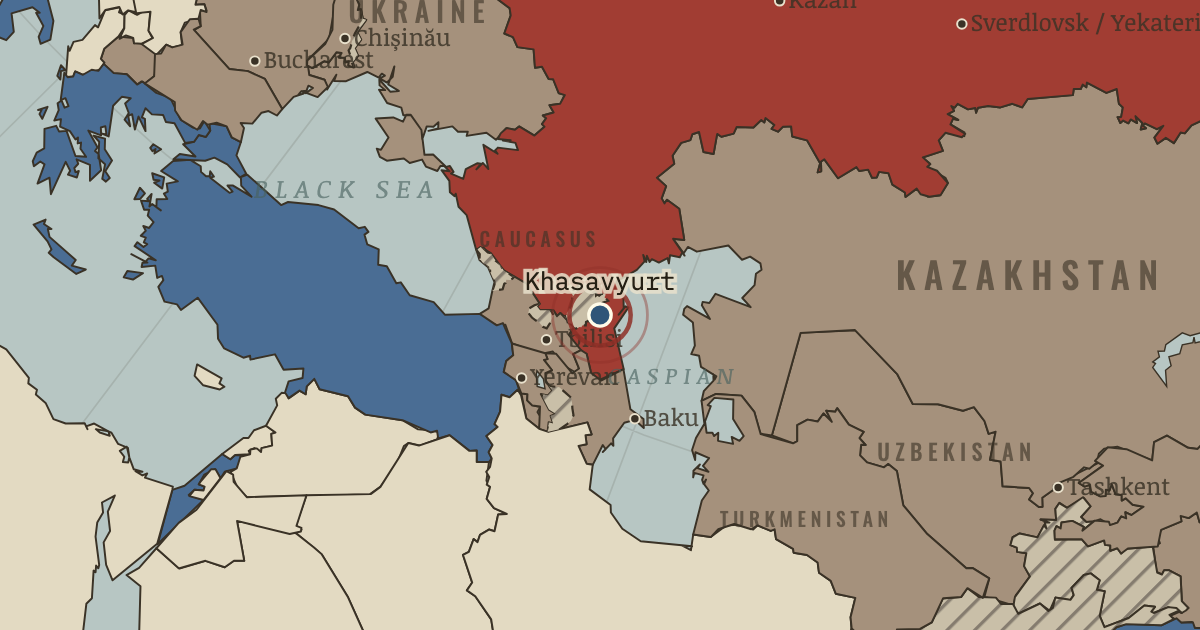
The moment in context
Russia’s weakness began with the bargain that held the federation together. During the struggle with Gorbachev, Yeltsin had told the republics inside Russia, homelands of non-Russian peoples, to “take as much sovereignty as you can swallow”, and Tatarstan, Sakha and others declared themselves sovereign in 1990, claiming that their laws overrode Moscow’s, the dashed outlines on the maps of 1990–94. Regional leaders kept tax revenue, controlled local police and courts and struck deals with Moscow. Tatarstan, an oil-rich Volga republic whose population was about two-fifths Russian, held a referendum on sovereignty in 1992 and then signed a treaty in February 1994 that left it inside Russia with control over its oil, budget and much of its law. Dozens of regions signed similar deals by 1998. Federal tax collection collapsed, firms paid each other in goods, and the state paid teachers, doctors and soldiers months late. Russia held together by bargaining, and the bargains left the centre short of money and authority.
From Oligarchs and the First Chechen War, chapter 11 of Remaking the State: Meiji Japan 1600–1912 and Post-Soviet Russia 1964–2000 (1996).
The place: Khasavyurt Accord — map and full story →
Teach this in 5 minutes
- Why it happened — The state could not collect its own taxes. Privatisation and inflation had left a state whose revenue depended on large firms that paid late, in goods or not at all. The regions kept much of…
- The turn — Loans-for-shares, November–December 1995. The auctions of late 1995 are the hinge of this chapter because they fused wealth and power in a way that defined Russian capitalism. A handful of…
- What it changed — Oligarchs became a power in politics. After 1996 men such as Boris Berezovsky and Vladimir Gusinsky used their banks and television channels to influence ministers and elections, and…
Then ask the room: Were Russia’s oligarchs a product of weak state institutions, or the cause of their weakness? The argued answer is on the chapter page →
The atlas that shows it
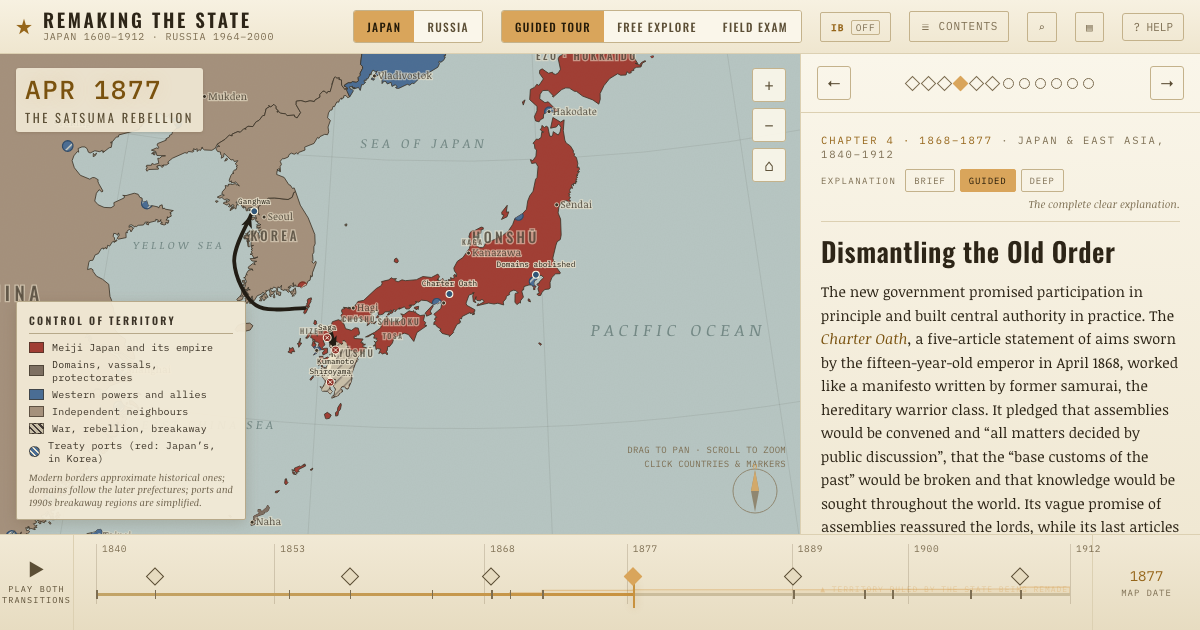
THE FREE PRINTABLE STUDY GUIDE
Join the Dispatch — a short welcome series, then a letter when a new atlas opens — and the printable study guide for Remaking the State is yours now, free.
NO TRACKING · YOUR ADDRESS IS USED FOR THE DISPATCH AND NOTHING ELSE · UNSUBSCRIBE ANYTIME